
Loading article…

Santa Sofia is a Roman Catholic church in the town of Benevento, in the region of Campania, in southern Italy; founded in the late-8th century, it retains many elements of its original Lombard architecture.
In 2011, it became a UNESCO World Heritage Site as part of a group of seven inscribed as Longobards in Italy. Places of the power (568–774 A.D.).
The church was founded by the LombardArechis II of Benevento around 760, as testified by numerous privileges signed by him, some of which are in the Museum of Samnium near the church. The edifice was modeled on the Palatine Chapel of the Lombard king Liutprand in Pavia and, after the defeat of Desiderius by Charlemagne and the fall of the Lombard kingdom in northern Italy (774), it became the national church of the Lombards who had taken shelter in the Duchy of Benevento. The church was part of a large program of construction which would legitimate Arechis' claim as the highest Lombard authority, after his failed attempt to acquire the title of king and the renaming of the duchy as a principality.[1]

Arechis dedicated it to Holy Wisdom ("Hagia Sophia" in Greek), like the Hagia Sophia church of Constantine in Constantinople; he also annexed a nearby Benedictine convent, which had been dependent on the Abbey of Montecassino. The convent was placed under the leadership of his sister, Gariperga. The sanctuary also housed the relics of Saint Mercurius, which putatively had been abandoned in 633 near Quintodecimo by the eastern Roman emperor Constans II.[2]
教会は1688年と1702年の地震で甚大な被害を受け、元のドームと後から増築された中世の部分が崩壊した。後の教皇ベネディクト13世となるオルシーニ枢機卿は、教会をバロック様式で再建させた。1705年に始まった修復工事では、平面図が星形から円形に変更され、2つの側廊礼拝堂が追加され、後陣、正面、柱の外観が変わった。さらに、内部を飾っていたフレスコ画のほとんどが破壊され、現在ではキリストと聖母マリアの物語を描いた断片がわずかに残っているだけである。[ 3 ]
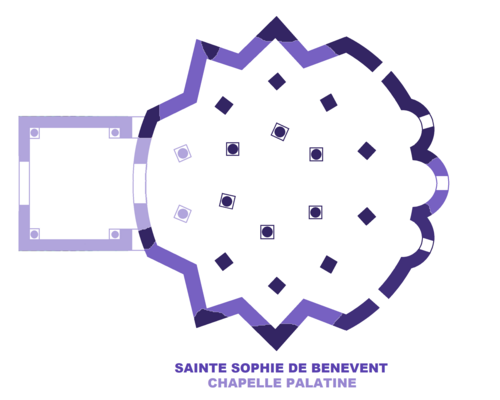
この教会は、アヤソフィア大聖堂に倣った、直径23.5メートル(77フィート)の中央集中型平面構造を採用している。中央には、おそらく古代イシス神殿から移設されたと思われる6本の柱が六角形の頂点に配置され、ドームを支えるアーチで繋がれている。内部の六角形は、白い石灰岩の柱8本と入口の両側に柱2本を持つ十角形の環状構造で囲まれている。3つのアプスの部分は円形だが、中央部と正面部は星形の一部を形成しており、入口によって分断され、四隅には4つのニッチが設けられている。
1957年、歴史的文書の証拠に基づいて、バロック様式のファサードを除いて、元の外観のほとんどが復元された。外観では、18世紀のファサードに埋め込まれたロマネスク様式のポータルがあり、その半円形部分には13世紀のレリーフがある。[ 2 ]後者は元々はプロティルムの一部であったが、現在は破壊されており、聖母マリア、聖マルクリウス、グレゴリウス修道院長の間に玉座に座るキリストを描いている。ポータルの両側には、別のアーチを支える2本の柱がある。

この構造は様々な源泉の影響を受けている。高く持ち上げられた中央部分は、パヴィアの現存しないサンタ・マリア・イン・ペルティカ教会を彷彿とさせ、ボリュームの構成はビザンチン建築の影響を示している。[ 4 ]

現代の彫像を除けば、美術品には8世紀後半から9世紀初頭のフレスコ画があり、その断片のみが両側の後陣に残っている。フレスコ画は「ザカリアの受胎告知」、「ザカリアの沈黙」、 「受胎告知」、「聖母訪問」である。これらはベネヴェントの写本装飾家派に属する芸術家によって制作された。[ 2 ]
鐘楼は、ロンバルディア文字の碑文が示すように、サレルノのパンドゥルフ3世の統治下にあったグレゴリー2世修道院長によって建てられ、アレキス2世の墓を守っていた。1688年の地震で倒壊したが、1703年に別の場所に再建された。
この教会には12世紀に建てられた回廊があり、その一部はそれ以前の建物の断片を用いて建設されています。回廊からはサムニウム博物館に入ることができ、そこには古代から中世にかけての遺跡が展示されています。その中には、かつてイシス神殿を飾っていた2本のオベリスクのうちの1本も含まれています。もう1本は、今もなお市の中心部にあるパピニアーノ広場で見ることができます。
北緯41度07分50.21秒、東経14度46分52.25秒/北緯41.1306139度、東経14.7811806度/北緯41.1306139度、東経14.7811806度