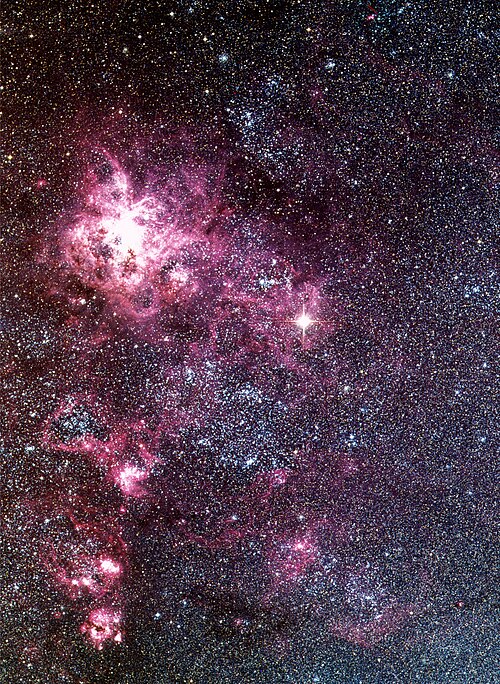
Four days after the event was recorded, the progenitor star was tentatively identified as Sanduleak −69 202 (Sk −69 202), a blue supergiant.[7] After the supernova faded, that identification was definitively confirmed, as Sk −69 202 had disappeared. The possibility of a blue supergiant producing a supernova was considered surprising,[8] and the confirmation led to further research which identified an earlier supernova with a blue supergiant progenitor.[9]
Some models of SN 1987A's progenitor attributed the blue color largely to its chemical composition rather than its evolutionary stage, particularly the low levels of heavy elements.[10] There was some speculation that the star might have merged with a companion star before the supernova.[11] However, it is now widely understood that blue supergiants are natural progenitors of some supernovae, although there is still speculation that the evolution of such stars could require mass loss involving a binary companion.[12]
Neutrino emissions
Approximately two to three hours before the visible light from SN 1987A reached Earth, a burst of neutrinos was observed at three neutrino observatories. This was likely due to neutrino emission which occurs simultaneously with core collapse, but before visible light is emitted as the shock wave reaches the stellar surface.[13] At 7:35 UT, 12 antineutrinos were detected by Kamiokande II, 8 by IMB, and 5 by Baksan in a burst lasting less than 13 seconds. Approximately three hours earlier, the Mont Blancliquid scintillator detected a five-neutrino burst, but this is generally believed to not be associated with SN 1987A.[10]
The Kamiokande II detection, which at 12 neutrinos had the largest sample population, showed the neutrinos arriving in two distinct pulses. The first pulse at 07:35:35 comprised 9 neutrinos over a period of 1.915 seconds. A second pulse of three neutrinos arrived during a 3.220-second interval from 9.219 to 12.439 seconds after the beginning of the first pulse.[10][14]
Although only 25 neutrinos were detected during the event, it was a significant increase from the previously observed background level. This was the first time neutrinos known to be emitted from a supernova had been observed directly, which marked the beginning of neutrino astronomy. The observations were consistent with theoretical supernova models in which 99% of the energy of the collapse is radiated away in the form of neutrinos.[15] The observations are also consistent with the models' estimates of a total neutrino count of 1058 with a total energy of 1046 joules, i.e. a mean value of some dozens of MeV per neutrino.[16] Billions of neutrinos passed through a square centimeter on Earth.[17]
The neutrino measurements allowed upper bounds on neutrino mass and charge, as well as the number of flavors of neutrinos and other properties.[10] For example, the data show that the rest mass of the electron neutrino is <16eV/c2 at 95% confidence, which is 30,000 times smaller than the mass of an electron. The data suggest that the total number of neutrino flavors is at most 8 but other observations and experiments give tighter estimates. Many of these results have since been confirmed or tightened by other neutrino experiments such as more careful analysis of solar neutrinos and atmospheric neutrinos as well as experiments with artificial neutrino sources.[18][19][20]
Neutron star
SN 1987A appears to be a core-collapse supernova, which should result in a neutron star given the size of the original star.[10] The neutrino data indicate that a compact object did form at the star's core, and astronomers immediately began searching for the collapsed core. The Hubble Space Telescope took images of the supernova regularly from August 1990 without a clear detection of a neutron star.
↑ Dwarkadas, VV (2011). "On luminous blue variables as the progenitors of core-collapse supernovae, especially Type IIn supernovae" . Monthly Notices of the Royal Astronomical Society . 412 (3): 1639– 1649. arXiv : 1011.3484 . Bibcode : 2011MNRAS.412.1639D . doi : 10.1111/j.1365-2966.2010.18001.x . S2CID 118359033 .
↑ Allen, WH (1987). "SN1987Aの3つのカラー観測" . Royal Astronomical Society of New Zealand Publications of Variable Star Section . 14 : 82– 84. Bibcode : 1988PVSS...14...82A . 2022年11月7日取得。
↑ Elias, JH; et al. (1988). "SN 1987A の赤外線スペクトルにおける輝線同定". The Astrophysical Journal . 331 : L9. Bibcode : 1988ApJ...331L...9E . doi : 10.1086/185225 .
↑ Terndrup, DM; et al. (1988). "Cerro TololoからのSN 1987Aの光学的および赤外線観測". Publications of the Astronomical Society of Australia . 7 (4): 412–423 . Bibcode : 1988PASA....7..412T . doi : 10.1017/S1323358000022566 . S2CID 117801292 .
1 2 Indebetouw, R.; et al. (2014). "超新星1987Aにおける塵の生成と粒子加速がALMAで明らかに". The Astrophysical Journal . 782 (1): L2. arXiv : 1312.4086 . Bibcode : 2014ApJ...782L...2I . doi : 10.1088/2041-8205/782/1/L2 . S2CID 33224959 .
↑ Kamenetzky, J.; et al. (2013). "超新星1987Aの低温残骸中の一酸化炭素". The Astrophysical Journal . 782 (1): L2. arXiv : 1307.6561 . Bibcode : 2013ApJ...773L..34K . doi : 10.1088/2041-8205/773/2/L34 . S2CID 5713172 .
↑ Zanardo, G.; et al. (2014). "ALMAとATCAによる超新星1987A残骸のスペクトルおよび形態学的解析". The Astrophysical Journal . 796 (2): 82. arXiv : 1409.7811 . Bibcode : 2014ApJ...796...82Z . doi : 10.1088/0004-637X/796/2/82 . S2CID 53553965 .
↑ Matsuura, M.; et al. (2017). "ALMAとATCAによる超新星1987A残骸のスペクトルおよび形態学的解析" .Monthly Notices of the Royal Astronomical Society . 469 (3): 3347–3362 . arXiv : 1704.02324 . Bibcode : 2017MNRAS.469.3347M . doi : 10.1093/mnras/stx830 . S2CID 693014 .