
Loading article…
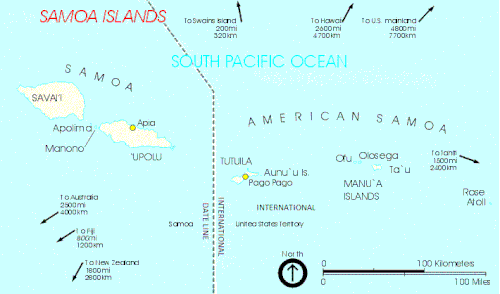
ローズ環礁は、マヌア諸島の人々からはローズ島またはモツ・オ・マヌ(「鳥の島」)と呼ばれることもあり、アメリカ領サモアにある海洋環礁です。無人島の野生生物保護区であり、アメリカ領サモアの主島であるツツイラ島の東約170マイル(150海里、270km )に位置する、アメリカ合衆国に属する最南端の島です。陸地面積は満潮時でわずか0.05km²(12エーカー)です。環礁の総面積は、ラグーンと礁原を含めて6.33km² (1,560エーカー)です。最北端のすぐ西には、幅約80メートル(260フィート)のラグーンへの水路があります。サンゴ礁の北東縁には2つの小島があり、東側には高さ3.5メートル(11フィート)の大きなローズ島、北側には高さ1.5メートル(5フィート)の植生のないサンド島がある。
ローズ環礁海洋国立記念物は、環礁の2つの傑出した島に位置し、米国魚類野生生物局とアメリカ領サモア政府との共同管理によって運営されている。[ 2 ]
ほぼ正方形のこの環礁は、世界最小の環礁の一つで、大きさはわずか2.6km × 2.7km (1.6マイル× 1.7マイル)である。また、サモア諸島唯一の環礁でもある。(スウェインズ島も環礁だが、地理的にはアメリカ領サモアの一部ではなく、政治的にのみアメリカ領サモアに属している。)
ローズ環礁は非常に孤立しており、最も近い島は西北西に140km (87マイル)離れたタウ島である。
The earliest Western sighting was June 13, 1722, during the voyage of Jacob Roggeveen, who called it Vuil Eiland "useless island".[3] The name Rose Island comes from its sighting by Louis de Freycinet in 1819. He named it after his wife Rose. While the second woman to circumnavigate the globe, Rose de Freycinet was the first to tell her tale.[4] In his official report Louis de Freycinet records that 'I named Rose Island, from the name of someone who is extremely dear to me'.[5] Soon afterwards, in 1824, it was seen by the expedition under Otto von Kotzebue, who named it Kordinkov after his First Lieutenant.
Apollo 10 returned to Earth in the ocean near Rose Atoll on May 26, 1969. The three astronauts were treated to a lavish welcome at Pago Pago International Airport before being flown to Hawai’i.[6]
The island was protected as the Rose Atoll National Wildlife Refuge in 1973 with 39,066 acres (61.04 sq mi; 46.09 sq nmi; 158.09 km2), only 20 acres (8.1 ha) of which is emergent. The wildlife refuge is managed by the United States Fish and Wildlife Service.[7]
Rose Atoll Marine National Monument is a United States National Monument covering 8,571,633 acres (13,393.18 sq mi; 10,113.45 sq nmi; 34,688.17 km2). It was established in 2009.[8] At the signing of the order establishing the monument, President George W. Bush noted that "the waters surrounding the atoll are the home of many rare species, including giant clams and reef sharks—as well as an unusual abundance of rose-colored corals".[9] The monument's marine areas were incorporated into the National Marine Sanctuary of American Samoa in 2014; they are co-managed by the Fish and Wildlife Service and the Office of National Marine Sanctuaries, a component of the National Oceanic and Atmospheric Administration (NOAA).

ローズ環礁には、アメリカ領サモア全体で最大のオオシャコガイ、営巣する海鳥、希少なサンゴ礁魚類の個体群が生息しています。魚類の個体群は、肉食魚の密度が高く草食魚の密度が低いことから、この地域の他の地域とは異なります。過去 15 年間で、約 270 種の魚が記録されています。 マグロ、マヒマヒ、カジキ、バラクーダ、サメはラグーンの外に生息しています。より深い水域では、スキューバ探検隊によってホヤ類や有柄ウミユリ類が発見されています。絶滅危惧種のザトウクジラやイルカ属のステネラなどの海洋哺乳類もこの海域を利用しています。[ 10 ]
この環礁は、絶滅危惧種のアオウミガメと絶滅危惧種のタイマイにとって重要な産卵地となっている。ウミガメはアメリカ領サモアと他の太平洋諸島の間を回遊する。産卵期は8月から2月までである。
ここは、ミズナギドリ、ハシボソミズナギドリ、アジサシなどの希少種の営巣地です。アメリカ領サモアの海鳥の約97%がローズ環礁に生息しています。12種の鳥類はそれぞれ連邦政府によって保護されています。アカアシカツオドリ 、オオグンカンドリ、コグンカンドリはブカの木に営巣します。 クロアジサシとシロアジサシは中枝と下枝に営巣します。根系はサンゴ礁サギとアカオネッタイチョウに利用されています。その他の鳥類は、サモアに残る唯一のピソニアの森で見られます。 [ 11 ]この環礁は、1974年に推定された約40万羽のクロアジサシの繁殖個体群を支えているため、バードライフ・インターナショナルによって重要野鳥生息地(IBA)として認められています。 [ 12 ]