
Loading article…
ポライトス・ロバタ(学名: Porites lobata)は、一般的にロブコーラルと呼ばれ、ポライトス科 に属する石サンゴの一種ですインド洋と太平洋の熱帯地域のサンゴ礁に生息しています。 [ 2 ]
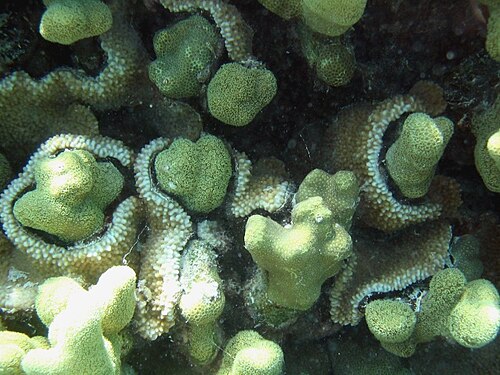
ポライトス・ロバタは造礁サンゴです。生息環境によって大きさや形が大きく異なります。波にさらされるサンゴ礁の斜面では被覆状に成長しますが、穏やかな水域では高さと幅が最大6メートル(20フィート)にもなる大きなヘルメット型または半球状の塊に成長します。成長速度は非常に遅く、年間わずか1センチメートル(0.39インチ)しかない場合もあり、そのため大きなサンゴは非常に古いものです。一般的に、組織内に共生する単細胞微細藻類である褐虫藻の影響で、緑色、黄色、または黄褐色をしています。褐虫藻は光合成によってポリプに有機栄養素を提供します。[ 3 ] [ 4 ]
サンゴの個体は非常に小さく、密に詰まっている。それらは融合した多孔質の壁で直接互いに結合しており、顕微鏡下でのみ見える特徴的な骨格構造を持っている。隔壁も融合している。ポリプの 直径は1ミリメートル(0.04インチ)で、骨格を覆う共肉は薄い。[ 5 ]
ポライトス・ロバタは一般的なサンゴの一種で、インド洋と太平洋の熱帯地域に生息しています。分布域は東アフリカ、紅海、アデン湾からインドネシアとオーストラリアの海域を経て、カリフォルニア湾と中央アメリカの太平洋沿岸まで広がっています。[ 1 ]ハワイでは最も一般的なサンゴ種です。[ 4 ]しばしば、水深30メートル(98フィート)までの礁縁、ラグーン、裾礁で優占種となっています。[ 1 ]カリフラワーサンゴよりもやや深いゾーンに生息しています。[ 6 ]
Porites lobata is gonochoristic which means that individual colonies are either male or female. Gametes are liberated into the water column and the developing planula larvae drift with the currents as part of the zooplankton. These later settle, undergo metamorphosis and develop into polyps which found new colonies. Mortality is very high and very few recruits are found in the Eastern Pacific. Fragments of coral that become detached from the colony may also develop into new colonies. Breakup may happen as a result of wave damage or it may be due to the skeletal structure of the coral being weakened by the boring activities of date mussels (Lithophaga spp.) or the feeding activities of fish such as the stone triggerfish (Pseudobalistes naufragium).[1]
Porites lobata forms part of the coral reef biome. Several fish species live among the lobes of the coral, some sheltering there and others, like the puffer fish (Arothron meleagris) grazing on the polyps.[1] The snapping or pistol shrimp (Alpheus deuteropus) is a commensal and lives among the lobes where it may form grooves and tunnels.[4][6]
Porites lobata is one of the more resilient species of coral. A rise in sea temperature may kill the zooxanthellae and cause bleaching, however, it is more resistant to bleaching than many corals and if bleaching does occur, it often recovers. Tropical reefs in general are under threat from many causes. These include El Nino events, ocean acidification which tends to dissolve the coral skeleton, trawling which results in mechanical damage to reefs, and coral diseases which kill the polyps. Due to the lack of coloration, this coral is very rarely collected for use in the aquarium hobby.[1]