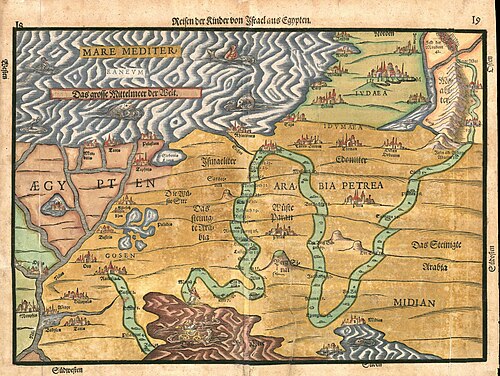
↑Gregory F. LaNave, et al., The Fathers of the Church: Mediaeval Continuation, The Letters of Peter Damian 151-180, Letter 160, pp. 110 ff., The Catholic University of America Press, Washington D.C. (2005)
↑Julia Bolton Holloway, Sweet New Style: Brunetto Latino, Dante Alighieri and Geoffrey Chaucer, Chapter III, (2003)
↑Nili S. Fox, in Adele Berlin, Marc Zvi Brettler (editors), The Jewish study Bible, Jewish Publication Society TANAKH Translation, Oxford University Press, Oxford (1999), p. 349: "The literary style of the itinerary, the repetition of campsite names, and the highlighting of events in those places closely resemble extant military records from the ancient Near East, especially from Assyria. Accordingly, the notation in this Priestly source that Moses recorded the starting points of their various marches (v. 2) fits the genre. Some scholars, however, consider ch 33 a composite text extracted from other portions of Numbers, Exodus, and Deuteronomy."
↑Redmount, Carol A. (2001) [1998]. "Bitter Lives: Israel In And Out of Egypt". In Coogan, Michael D. (ed.). The Oxford History of the Biblical World. OUP. p.87. ISBN9780199881482.
12Avraham Faust (2015). Israel's Exodus in Transdisciplinary Perspective: Text, Archaeology, Culture, and Geoscience. Springer. p.476. ISBN978-3-319-04768-3.
↑Sparks, Kenton L. (2010). "Genre Criticism". In Dozeman, Thomas B. (ed.). Methods for Exodus. Cambridge University Press. p.73. ISBN9781139487382.
↑William G. Dever (2001). What Did the Biblical Writers Know and When Did They Know It?: What Archeology Can Tell Us About the Reality of Ancient Israel. Wm. B. Eerdmans Publishing. p.99. ISBN978-0-8028-2126-3.
↑Finkelstein, Israel; Silberman, Neil Asher (2001). The Bible Unearthed: Archaeology's New Vision of Ancient Israel and the Origin of Sacred Texts. Free Press. pp.62–3. ISBN0-684-86912-8.
↑van Seters, John (2001). "The Geography of the Exodus". In Dearman, J. A.; Graham, M. P. (eds.). The Land that I Will Show You. Sheffield Academic Press. p.264. ISBN1-84127-257-4ほとんどの学者は、ラムセスを、ラムセス2世によって建設された第19王朝の首都ピラメッセと同一視する見解を受け入れている。
1 2 3 4 5 6 7 8 9 10 11 12 13 14 15 16 17 18 19 20 21 22 23 24 25 26 Janzen , Mark D.; McKinny, Chris (2024). "An Overview of The Historical Geography of The Exodus and Wilderness Itinerary (Exod 12:1–19:25; Num 33:1–49)". In Beitzel, Barry J. (ed.). Lexham Geographic Commentary on the Pentateuch . Lexham Press. pp. 705–739 . ISBN978-1-68359-729-2。
↑プラティコ、ゲイリー・D. (1993).ネルソン・グルックによるテル・エル・ケレイフェ遺跡の1938~1940年の発掘調査:再評価. アメリカ東洋研究学校. p. 17. ISBN9781555408831ネルソン・グルックによるテル・エル・ケレイフェを聖書のエツィオン・ゲベルと同一視する見解は、考古学界で広く受け入れられている。
↑ de Geus, CHJ (1977). 「カデシュ・バルネア:地理的および歴史的考察」。Brongers, HA (編) 『教育と解釈:ヘブライ語、パレスチナ考古学、聖書解釈の研究』所収。Brill Archive、58頁。ISBN90-04-05433-2出エジプト記の文献に精通している人なら誰でも、カデシュ・バルネアがほぼ常にアイン・エル・クデイラトと同一視されていることを知っているだろう。