ホットジュピターの大気が流体力学的脱出によって剥ぎ取られると、その核は地底惑星になる可能性がある。最外層から除去されるガスの量は、惑星の大きさ、外層を形成するガス、恒星からの軌道距離、恒星の光度によって決まる。典型的なシステムでは、主星の周りを 0.02 AU で公転するガス惑星は、その寿命の間に質量の 5~7% を失うが、0.015 AU より近い軌道を公転すると、惑星の質量のかなり大きな割合が蒸発する可能性がある。[ 31 ]このような天体はまだ発見されておらず、仮説上のものに過ぎない。
As of 2025, 12 known Jovian USP planets are found.[50]
Puffy planets
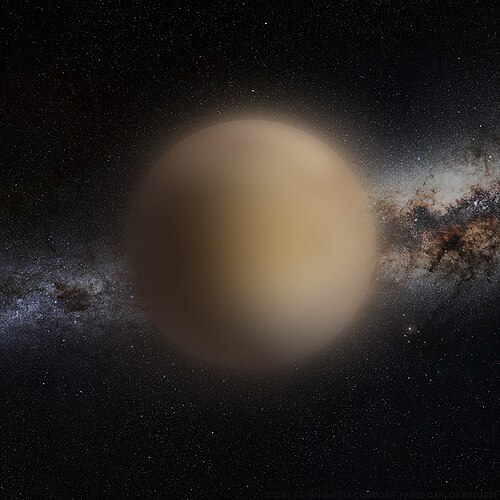
Artistic rendering of a puffy planet
Gas giants with a large radius and very low density are sometimes called "puffy planets"[51] or "hot Saturns", due to their density being similar to Saturn's. Puffy planets orbit so close to their stars that their surface heat combined internal heating from their cores inflate their atmospheres. Six large-radius, low-density planets have been detected with the transit method: HAT-P-1b,[52][53]CoRoT-1b, TrES-4b, WASP-12b, WASP-17b, and Kepler-7b. Some hot Jupiters detected by their radial-velocity may be puffy planets. Most of these planets are around or below Jupiter's mass, as more mass would give them stronger gravity and compress them to roughly Jupiter's size. Gas giants less massive than Jupiter with temperatures above 1,800K (1,530°C; 2,780°F) are so light that they risk Roche-Lobe overflow and the complete evaporation of their atmosphere.[54]
Even with surface heating from their star, many transiting hot Jupiters have more volume than expected. This could be caused by interaction between atmospheric winds and the planet's magnetosphere creating an electric current through the planet that heats it up, causing it to expand. A hotter planet had greater atmospheric ionization and thus greater magnitude of the interaction and electric current, creating more heat and expanding the planet. This theory matches the observation that planetary temperature is correlated with inflated planetary radii.[54]
↑ Alvarado-Montes JA; García-Carmona C. (2019). "Orbital decay of short-period gas giants under evolving tides" . Monthly Notices of the Royal Astronomical Society . 486 (3): 3963– 3974. arXiv : 1904.07596 . Bibcode : 2019MNRAS.486.3963A . doi : 10.1093/mnras/stz1081 . S2CID 119313969 .
↑ Johnson, John Asher; Gazak, J. Zachary; Apps, Kevin; et al. (2011). "低温KOIの特徴付け II. M矮星KOI-254とそのホットジュピター". The Astronomical Journal . arXiv : 1112.0017 . doi : 10.1088/0004-6256/143/5/111 . S2CID 25791517 .
↑Becker, Juliette C.; Vanderburg, Andrew; Adams, Fred C.; Rappaport, Saul A.; Schwengeler, Hans Marti (10 August 2015). "WASP-47: A Hot Jupiter System with Two Additional Planets Discovered by K2". The Astrophysical Journal Letters. 812 (2). IOP Publishing (published October 2015): L18. arXiv:1508.02411. Bibcode:2015ApJ...812L..18B. doi:10.1088/2041-8205/812/2/L18. S2CID14681933. The mass of WASP-47d is 15.2±7M⊕. Only an upper limit can be placed on WASP-47e of < 22M⊕.
↑"Kepler: A far-off solar system". kepler.nasa.gov. 31 March 2015. Archived from the original on 14 August 2016. Retrieved 2 August 2016.
↑Hebrard, G.; Desert, J.-M.; Diaz, R. F.; Boisse, I.; Bouchy, F.; des Etangs, A. Lecavelier; Moutou, C.; Ehrenreich, D.; Arnold, L. (2010). "Observation of the full 12-hour-long transit of the exoplanet HD80606b. Warm-Spitzer photometry and SOPHIE spectroscopy". Astronomy and Astrophysics. 516: A95. arXiv:1004.0790. Bibcode:2010A&A...516A..95H. doi:10.1051/0004-6361/201014327. ISSN0004-6361. S2CID73585455.
↑Triaud, A. H. M. J.; Queloz, D.; Bouchy, F.; Moutou, C.; Collier Cameron, A.; Claret, A.; Barge, P.; Benz, W.; Deleuil, M. (1 October 2009). "The Rossiter-McLaughlin effect of CoRoT-3b and HD 189733b"(PDF). Astronomy and Astrophysics. 506 (1): 377–384. arXiv:0907.2956. Bibcode:2009A&A...506..377T. doi:10.1051/0004-6361/200911897. ISSN0004-6361. S2CID10454322. Archived from the original(PDF) on 20 August 2017. Retrieved 4 November 2018.
↑ Bell, Taylor J.; Cowan, Nicolas B. (2018). "Increased Heat Transport in Ultra-hot Jupiter Atmospheres through H 2 Dissociation and Recombination" . The Astrophysical Journal . 857 (2): L20. arXiv : 1802.07725 . Bibcode : 2018ApJ...857L..20B . doi : 10.3847/2041-8213/aabcc8 . S2CID 119404042 .
↑ Parmentier, Vivien; Line, Mike R.; Bean, Jacob L.; Mansfield, Megan; Kreidberg, Laura; Lupu, Roxana; Visscher, Channon; Désert, Jean-Michel; Fortney, Jonathan J.; Deleuil, Magalie; Arcangeli, Jacob; Showman, Adam P.; Marley, Mark S. (2018). "超高温木星の大気における熱解離から凝縮へ:WASP-121bの文脈"。Astronomy & Astrophysics . 617 : A110. arXiv : 1805.00096 . Bibcode : 2018A & A...617A.110P . doi : 10.1051/0004-6361/201833059 . S2CID 62895296。
↑ Serrels, Mark (2021年4月27日). 「科学者たちが、ほとんどの金属を蒸発させるほど高温の『地獄のような』惑星を発見」 . CNET . 2021年4月27日取得。
↑ "'Hellish' new planet discovered". University of Southern Queensland. April 27, 2021. Archived from the original on April 29, 2021. Retrieved April 27, 2021.
↑Malavolta, Luca; etal. (9 February 2018). "An Ultra-short Period Rocky Super-Earth with a Secondary Eclipse and a Neptune-like Companion around K2-141". The Astronomical Journal. 155 (3): 107. arXiv:1801.03502. Bibcode:2018AJ....155..107M. doi:10.3847/1538-3881/aaa5b5. S2CID54869937.
↑"WASP Planets". wasp-planets.net. 5 December 2013. Retrieved 1 April 2018.
12Jaime, A. Alvarado-Montes; Mario, Sucerquia; Jorge, I. Zuluaga; Christian, Schwab (15 July 2025). "Orbital Decay of the Ultra-hot Jupiter TOI-2109b: Tidal Constraints and Transit-timing Analysis". The Astronomical Journal. 988 (1): 66. arXiv:2505.18941. Bibcode:2025ApJ...988...66A. doi:10.3847/1538-4357/ade057.
↑Chang, Kenneth (11 November 2010). "Puzzling Puffy Planet, Less Dense Than Cork, Is Discovered". The New York Times.
↑Ker Than (14 September 2006). "Puffy 'Cork' Planet Would Float on Water". Space.com. Retrieved 8 August 2007.
↑"Puffy planet poses pretty puzzle". BBC News. 15 September 2006. Retrieved 17 March 2010.
1 2 Batygin, Konstantin; Stevenson, David J.; Bodenheimer, Peter H.; Huang, Xu (2011). "オーム加熱されたホットジュピターの進化". The Astrophysical Journal . 738 (1): 1. arXiv : 1101.3800 . Bibcode : 2011ApJ...738....1B . doi : 10.1088/0004-637X/738/1/1 . S2CID 43150278 .
↑ Barnes, Jason W.; O'Brien, DP (2002). "Stability of Satellites around Close-in Extrasolar Giant Planets". The Astrophysical Journal . 575 (2): 1087–1093 . arXiv : astro-ph/0205035 . Bibcode : 2002ApJ...575.1087B . doi : 10.1086/341477 . S2CID 14508244 .
↑Российские астрономы впервые открыли луну возле экзопланеты ]ロシアの天文学者たちは、WASP-12bの輝きの変化曲線を研究した結果、珍しい発見をした。規則的な飛沫が見つかったのだ。... 星の表面の汚れも同様の輝きの変化を引き起こす可能性があるが、観測された飛沫は、持続時間、形状、振幅が非常に似ており、系外衛星の存在を裏付けている。
↑ Grunblatt, Samuel K.; Huber, Daniel (2017年12月1日). "K2で二重に見える:赤色巨星分枝星の周りの2つの驚くほど似た惑星で再インフレーションを検証" . The Astrophysical Journal . 154 (6): 254. arXiv : 1706.05865 . Bibcode : 2017AJ....154..254G . doi : 10.3847/1538-3881/aa932d . S2CID 55959801 .
↑ Route, Matthew (2019年2月10日). "The Rise of ROME. I. A Multiwavelength Analysis of the Star-Planet Interaction in the HD 189733 System" . The Astrophysical Journal . 872 (1): 79. arXiv : 1901.02048 . Bibcode : 2019ApJ...872...79R . doi : 10.3847/1538-4357/aafc25 . S2CID 119350145 .
↑ Route, Matthew; Looney, Leslie (2019年12月20日). "ROME (Radio Observations of Magnetized Exoplanets). II. HD 189733 Does Not Accrete Sign from Its Exoplanet Like a T Tauri Star from a Disk" . The Astrophysical Journal . 887 (2): 229. arXiv : 1911.08357 . Bibcode : 2019ApJ...887..229R . doi : 10.3847/1538-4357/ab594e . S2CID 208158242 .