
Loading article…
Cannabaceae is a small family of flowering plants, known as the hemp family. As now circumscribed, the family includes about 170 species grouped in about 11 genera, including Cannabis (hemp), Humulus (hops) and Celtis (hackberries). Celtis is by far the largest genus, containing about 100 species.[2]
Cannabaceae is a member of the Rosales. Members of the family are erect or climbing plants with petalless flowers and dry, one-seeded fruits. Hemp (Cannabis) and hop (Humulus) are the most economically important species.[4]
Other than a shared evolutionary origin, members of the family have few common characteristics; some are trees (e.g. Celtis), others are herbaceous plants (e.g. Cannabis).
Members of this family can be trees (e.g. Celtis), erect herbs (e.g. Cannabis), or twining herbs (e.g. Humulus).[2]
Leaves are often more or less palmately lobed or palmately compound and always bear stipules. Cystoliths are always present and some members of this family possess laticifers.
Cannabaceae are often dioecious (distinct male and female plants). The flowers are actinomorphic (radially symmetrical) and not ornate, as these plants are pollinated by the wind. As an adaptation to this kind of pollination, the calyx and corolla are radically reduced to only vestigial remnants found as an adherent perianth coating the seed. A reduced and monophyllous cuplike perigonal bract, properly known as the bracteole, immediately surrounds and protects the seed and is often misnamed as a "calyx". Flowers are grouped to form cymes. In the dioecious plants the male inflorescences are long and look like panicles, while the female ones are shorter and bear fewer flowers. The pistil is made of two connate carpels, the usually superior ovary is unilocular; there is no fixed number of stamens.
The fruit can be an achene or a drupe.
1990年代以前に開発された分類体系、例えばクロンキスト(1981)やダールグレン(1989)の分類体系では、当時定義されていたアサ科、クズウコン科、ニレ科、クワ科、ニレ科、イラクサ科を含むイラクサ目が一般的に認識されていた。 1990年代以降の分子データは、これらの科が実際にはバラ目の中に含まれていたことを示しており、 1998年の被子植物系統分類グループによる最初の分類以降、これらは拡張されたバラ目に配置され、「イラクサ目バラ類」と呼ばれるグループを形成している。[ 3 ]
アサ科は以下の属から構成される:[ 5 ] [ 6 ] [ 7 ]
アサ科は白亜紀後期に東アジアで起源したと考えられている。アサ科の代表的な花粉として知られている最古のものは、白亜紀後期(チューロニアン期、約9400万~9000万年前)のボルネオ島サラワクのものである。化石からは、アサ科は新生代初期には北半球に広く分布していたが、新生代後期には気候変動により熱帯地域へと分布域が広がったことが示されている。[ 8 ]
炭素年代測定により、これらの植物は紀元前494年という早い時期に中国の新疆で儀式や薬用目的で使用されていた可能性があることが明らかになった 。[ 11 ]
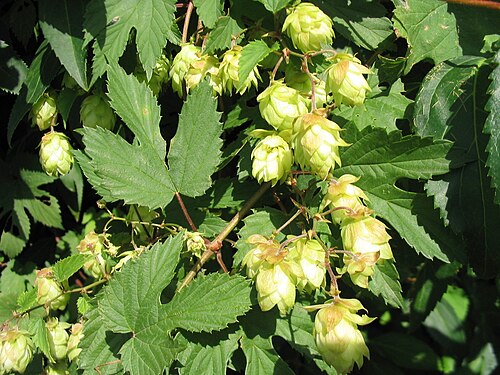
ホップ(学名: Humulus lupulus)は、何百年もの間、ビールの主要な苦味成分として使われてきました。花の樹脂がビールの苦味の原因であり、抗菌作用によって保存期間を延ばす効果もあります。若い芽は野菜として利用できます。 [ 12 ]
カンナビス属の植物の中には、繊維の生産、安価な油の供給源、栄養価の高い種子、食用となる葉を目的として麻として栽培されるものもある。また、乾燥させた花、抽出物、または食品に配合された製品として、医療用または娯楽用として栽培されるものもある。雌花における誘発性単為結果や選択育種は、テトラヒドロカンナビノール(THC)やその他のカンナビノイド、さらにはブルーベリー、イチゴ、柑橘類などの望ましい風味や香りを持つテルペンの収量を増減させるために用いられる。
ケルティス属の多くの樹木は造園や観賞用として栽培されており、プテロケルティスの樹皮は高級な中国紙の製造に用いられる。