意味 させてf : X → V {\displaystyle f:X\to V} ( X 、 Σ 、 μ ) {\displaystyle (X,\Sigma ,\mu )} V {\displaystyle V} 位相ベクトル空間 (TVS)である。V ′ {\displaystyle V'} x ∈ V {\displaystyle x\in V} l ∈ V ′ {\displaystyle l\in V'} l ( x ) ≠ 0 {\displaystyle l(x)\neq 0} V {\displaystyle V} ノルム空間 、または(より一般的には)ハウスドルフ局所凸TVSである。汎関数の評価は 双対ペア として記述できる。 ⟨ φ 、 x ⟩ = φ [ x ] 。 {\displaystyle \langle \varphi ,x\rangle =\varphi [x].}
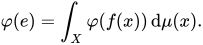
地図f : X → V {\displaystyle f:X\to V} の φ ∈ V ′ 、 {\displaystyle \varphi \in V',} φ ∘ f {\displaystyle \varphi \circ f} は可測写像 である。弱可測写像f : X → V {\displaystyle f:X\to V} 弱積分 X {\displaystyle X} e ∈ V {\displaystyle e\in V} φ ∈ V ′ 、 {\displaystyle \varphi \in V',} φ ∘ f {\displaystyle \varphi \circ f} ルベーグ積分可能 (つまり、φ ∘ f ∈ L 1 ( X 、 Σ 、 μ ) {\displaystyle \varphi \circ f\in L^{1}\left(X,\Sigma ,\mu \right)} φ ( e ) = ∫ X φ ( f ( x ) ) d μ ( x ) 。 {\displaystyle \varphi (e)=\int _{X}\varphi (f(x))\,\mathrm {d} \mu (x).}
地図f : X → V {\displaystyle f:X\to V} ペティス積分 φ ∘ f ∈ L 1 ( X 、 Σ 、 μ ) {\displaystyle \varphi \circ f\in L^{1}\left(X,\Sigma ,\mu \right)} φ ∈ V ′ {\displaystyle \varphi \in V^{\prime }} A ∈ Σ {\displaystyle A\in \Sigma } e A ∈ V {\displaystyle e_{A}\in V} ⟨ φ 、 e A ⟩ = ∫ A ⟨ φ 、 f ( x ) ⟩ d μ ( x ) すべての人々のために φ ∈ V ′ 。 {\displaystyle \langle \varphi ,e_{A}\rangle =\int _{A}\langle \varphi ,f(x)\rangle \,\mathrm {d} \mu (x)\quad {\text{ for all }}\varphi \in V'.}
この場合、e A {\displaystyle e_{A}} ペティス f {\displaystyle f} A 。 {\displaystyle A.} e A {\displaystyle e_{A}} ∫ A f d μ 、 ∫ A f ( x ) d μ ( x ) 、 そして、もし A = X 理解されている、 μ [ f ] 。 {\displaystyle \int _{A}f\,\mathrm {d} \mu ,\qquad \int _{A}f(x)\,\mathrm {d} \mu (x),\quad {\text{また、}}~A=X~{\text{が省略されている場合は、}}\quad \mu [f].}
「弱積分可能」の定義の背後にある動機を理解するために、次の特殊なケースを考えてみましょう。V {\displaystyle V} V = R {\displaystyle V=\mathbb {R} } V = C 。 {\displaystyle V=\mathbb {C} .} φ {\displaystyle \varphi } V {\displaystyle V} φ ( y ) = s y {\displaystyle \varphi (y)=sy} s ∈ V {\displaystyle s\in V} φ {\displaystyle \varphi } φ ( e ) = ∫ A φ ( f ( x ) ) d μ ( x ) すべての人々のために φ ∈ V ′ 、 {\displaystyle \varphi (e)=\int _{A}\varphi (f(x))\,\mathrm {d} \mu (x)\quad {\text{for all}}~\varphi \in V',} s e = ∫ A s f ( x ) d μ ( x ) すべてのスカラーに対して s 。 {\displaystyle se=\int _{A}sf(x)\,\mathrm {d} \mu (x)\quad {\text{すべてのスカラー}}~sについて} f {\displaystyle f} X {\displaystyle X} f {\displaystyle f}
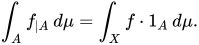
物件 この定義から直ちに導かれる結果として、ペティス積分は連続線形演算子と互換性がある。Φ : V 1 → V 2 {\displaystyle \Phi \colon V_{1}\to V_{2}} f : X → V 1 {\displaystyle f\colon X\to V_{1}} Φ ∘ f {\displaystyle \Phi \circ f} ∫ X Φ ( f ( x ) ) d μ ( x ) = Φ ( ∫ X f ( x ) d μ ( x ) ) 。 \displaystyle \int _{X}\Phi (f(x))\,d\mu (x)=\Phi \left(\int _{X}f(x)\,d\mu (x)\right).}
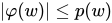
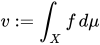
標準推定値| ∫ X f ( x ) d μ ( x ) | ≤ ∫ X | f ( x ) | d μ ( x ) \left|\int_{X}f(x)\,d\mu(x)\right|\leq\int_{X}|f(x)|\,d\mu(x)} p : V → R {\displaystyle p\colon V\to \mathbb {R} } f : X → V {\displaystyle f\colon X\to V} p ( ∫ X f ( x ) d μ ( x ) ) ≤ ∫ X _ p ( f ( x ) ) d μ ( x ) {\displaystyle p\left(\int _{X}f(x)\,d\mu (x)\right)\leq {\underline {\int _{X}}}p(f(x))\,d\mu (x)} [ 0 、 ∞ ] {\displaystyle [0,\infty ]} ∫ X _ g d μ := すする { ∫ X h d μ | h : X → [ 0 、 ∞ ] 測定可能であり、 0 ≤ h ≤ g } 。 {\displaystyle {\underline {\int _{X}}}g\,d\mu :=\sup \left\{\left.\int _{X}h\,d\mu \;\right|\;h\colon X\to [0,\infty ]{\text{ は測定可能であり、}}0\leq h\leq g\right\}.} p ∘ f {\displaystyle p\circ f} ハーン・バナッハの定理から導かれる。 v ∈ V {\displaystyle v\in V} φ ∈ V * {\displaystyle \varphi \in V^{*}} φ ( v ) = p ( v ) {\displaystyle \varphi (v)=p(v)} w ∈ V {\displaystyle w\in V} | φ ( w ) | ≤ p ( w ) {\displaystyle |\varphi (w)|\leq p(w)} v := ∫ X f d μ {\displaystyle v:=\int _{X}f\,d\mu }
平均値の定理 重要な性質として、有限測度に関するペティス積分は、積分領域の測度でスケーリングされた値の 凸包の閉包に含まれるという点が挙げられる。 μ ( A ) < ∞ 暗示する ∫ A f d μ ∈ μ ( A ) ⋅ 共 ( f ( A ) ) ¯ {\displaystyle \mu (A)<\infty {\text{ implies }}\int _{A}f\,d\mu \in \mu (A)\cdot {\overline {\operatorname {co} (f(A))}}}
これはハーン・バナッハの定理 の結果であり、実数値関数の積分に対する平均値の定理 を一般化したものである。V = R {\displaystyle V=\mathbb {R} } f : X → [ 1 、 b ] {\displaystyle f\colon X\to [a,b]} μ ( A ) 1 ≤ ∫ A f d μ ≤ μ ( A ) b 。 {\displaystyle \mu (A)a~\leq ~\int _{A}f\,d\mu ~\leq ~\mu (A)b.}
References
James K. Brooks, Representations of weak and strong integrals in Banach spaces , Proceedings of the National Academy of Sciences of the United States of America 63, 1969, 266–270. FulltextMR 0274697 Israel M. Gel'fand , Sur un lemme de la théorie des espaces linéaires , Commun. Inst. Sci. Math. et Mecan., Univ. Kharkoff et Soc. Math. Kharkoff, IV. Ser. 13, 1936, 35–40 Zbl 0014.16202Michel Talagrand , Pettis Integral and Measure Theory , Memoirs of the AMS no. 307 (1984) MR 0756174Sobolev, V. I. (2001) [1994], "Pettis integral", Encyclopedia of Mathematics EMS Press



![{\displaystyle \langle \varphi ,x\rangle =\varphi [x].}](https://wikimedia.org/api/rest_v1/media/math/render/svg/92584443166736d482e32139463a5eddea49c1d2)








![{\displaystyle \int _{A}f\,\mathrm {d} \mu ,\qquad \int _{A}f(x)\,\mathrm {d} \mu (x),\quad {\text{and, in case that}}~A=X~{\text{is understood,}}\quad \mu [f].}](https://wikimedia.org/api/rest_v1/media/math/render/svg/df9eec809a28e7d6c6e2e4a307ee58fbbbb1fbdc)
















![{\displaystyle [0,\infty ]}](https://wikimedia.org/api/rest_v1/media/math/render/svg/52088d5605716e18068a460dec118214954a68e9)
![{\displaystyle {\underline {\int _{X}}}g\,d\mu :=\sup \left\{\left.\int _{X}h\,d\mu \;\right|\;h\colon X\to [0,\infty ]{\text{ は可測であり、}}0\leq h\leq g\right\}.}](https://wikimedia.org/api/rest_v1/media/math/render/svg/d7131bfd237f02e8e06f56c05225a15da5c3bafa)



![{\displaystyle f\colon X\to [a,b]}](https://wikimedia.org/api/rest_v1/media/math/render/svg/b77d6d43168af8c6664334539c54facc05f077e6)








![{\displaystyle \operatorname {E} [v_{n}]}](https://wikimedia.org/api/rest_v1/media/math/render/svg/a05e6167389c46c59808b6c999058fe86796fabe)


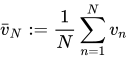

![{\displaystyle \operatorname {E} [{\bar {v}}_{N}]={\frac {1}{N}}\sum _{n=1}^{N}\operatorname {E} [v_{n}]\in V.}](https://wikimedia.org/api/rest_v1/media/math/render/svg/ecf9cb2d6a7643bc95c6999887f0f5816c9737db)
![{\displaystyle {\frac {1}{N}}\sum _{n=1}^{N}\operatorname {E} [{\bar {v}}_{n}]}](https://wikimedia.org/api/rest_v1/media/math/render/svg/48a2ef26625246c8cc99949aa469f9fdee2e085c)

![{\displaystyle \langle \varphi ,\operatorname {E} [{\bar {v}}_{N}]-\lambda \rangle \to 0}](https://wikimedia.org/api/rest_v1/media/math/render/svg/56671ce061d998074a6fca038c2c78fce886b854)

![\displaystyle \operatorname {E} [{\bar {v}}_{N}]\to \lambda }](https://wikimedia.org/api/rest_v1/media/math/render/svg/e3ed2a98fe8adf477397c8140daf38006bd7c336)

![{\displaystyle \operatorname {E} [{\bar {v}}_{N}]}](https://wikimedia.org/api/rest_v1/media/math/render/svg/b42c60cd4f73ca1b7130db48e4ebe3630624a085)
