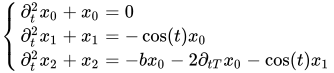
Now search for a solution of the form x(τ)=x0(τ)+εx1(τ)+.... The following solutions for the zeroth and first order problem in are obtained:
So the secular term can be removed through the choice: ω1=3/8. Higher orders of accuracy can be obtained by continuing the perturbation analysis along this way. As of now, the approximation—correct up to first order in ε—is
Example: the van der Pol oscillator
We solve the van der Pol oscillator only up to order 2. This method can be continued indefinitely in the same way, where the order-n term consists of a harmonic term , plus some super-harmonic terms The coefficients of the super-harmonic terms are solved directly, and the coefficients of the harmonic term are determined by expanding down to order-(n+1), and eliminating its secular term.
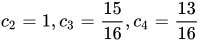
See chapter 10 of [5] for a derivation up to order 3, and [8] for a computer derivation up to order 164.
Consider the van der Pol oscillator with equationwhere is a small positive number. Perform substitution to the second order:
where
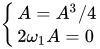
which yields the equationNow plug in , and we have three equations, for the orders respectively:The first equation has general solution . Pick origin of time such that . Then plug it into the second equation to obtain (after some trigonometric identities)To eliminate the secular term, we must set both coefficients to zero, thus we have yielding . In particular, we found that when increases from zero to a small positive constant, all circular orbits in phase space are destroyed, except the one at radius 2. Now solving yields . We can always absorb term into , so we can WLOG have just .
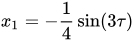
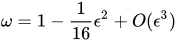
Now plug into the second equation to obtainTo eliminate the secular term, we set .
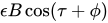
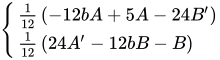
Consider the Mathieu equation, where is a constant, and is small. The equation's solution would have two time-scales, one fast-varying on the order of , and another slow-varying on the order of . So expand the solution as Now plug into the Mathieu equation and expand to obtainAs before, we have the solutionsThe secular term coefficients in the third equation are Setting them to zero, we find the equations of motion:
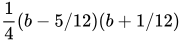
Its determinant is , and so when , the origin is a saddle point, so the amplitude of oscillation grows unboundedly.
↑ Poincaré, H. (1957) [1893]、Les Méthodes Nouvelles de la Mécanique Célèste、vol. II、ニューヨーク: Dover Pub.、§123~§128。
↑ A. リンドステット、Abh. K. Akad. Wiss. St. Petersburg 31、No. 4 (1882)
1 2 Verhulst, Ferdinand (1996). Nonlinear Differential Equations and Dynamical Systems . Universitext. Berlin, Heidelberg: Springer Berlin Heidelberg. doi : 10.1007/978-3-642-61453-8 . ISBN978-3-540-60934-6。
↑ J. デイビッド・ローガン著『応用数学』第2版、ジョン・ワイリー・アンド・サンズ、1997年。ISBN0-471-16513-1。




![{\displaystyle x(t)=\cos(t)+\varepsilon \left[{\tfrac {1}{32}}\,\left(\cos(3t)-\cos(t)\right)-{\tfrac {3}{8}}\,t\,\sin(t)\right]+\cdots .\,}](https://wikimedia.org/api/rest_v1/media/math/render/svg/0f2658a173fc0645d63ee650d493afaf272cb919)








![{\displaystyle x(t)\approx \cos {\Bigl (}\left(1+{\tfrac {3}{8}}\,\varepsilon \right)\,t{\Bigr )}+{\tfrac {1}{32}}\,\varepsilon \,\left[\cos {\Bigl (}3\left(1+{\tfrac {3}{8}}\,\varepsilon \,\right)\,t{\Bigr )}-\cos {\Bigl (}\left(1+{\tfrac {3}{8}}\,\varepsilon \,\right)\,t{\Bigr )}\right].\,}](https://wikimedia.org/api/rest_v1/media/math/render/svg/37f961b3f633e9fab86e99ef0b21a1b06fd95439)