Loading article…

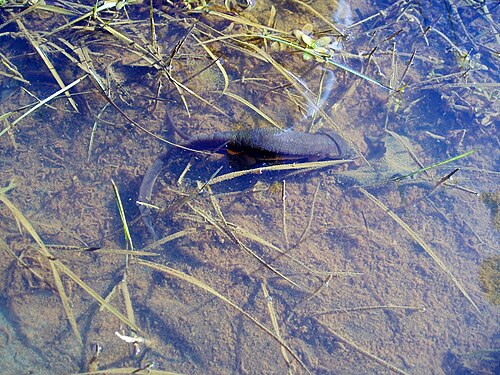
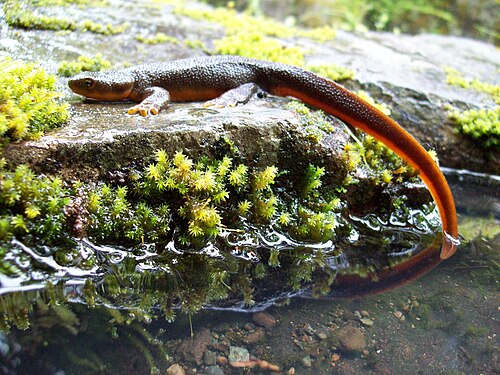
ザラザライモリ(学名: Taricha granulosa)は、皮膚から強い毒素を分泌することで知られる北米産のイモリである。
ずんぐりとした体型で、吻が丸みを帯びているイモリで、背側は薄茶色からオリーブ色または茶褐色で、頭、脚、尾を含む腹側は対照的なオレンジ色から黄色です。[ 2 ] [ 3 ]皮膚は顆粒状ですが、繁殖期のオスは皮膚が滑らかになります。吻から肛門までの長さは6~9cm 、全長は11~18cmです。[ 3 ]カリフォルニアイモリ(Taricha torosa)に似ていますが、目が小さく、虹彩が黄色で、歯のパターンがV字型で、まぶたが均一に暗い点で異なります。[ 2 ]繁殖期には、大きく膨らんだ肛門葉[ 3 ]と角質化した趾パッド[ 2 ]によってオスとメスを区別できます。

ザラザライモリは太平洋岸北西部全域に生息している。生息域は南はカリフォルニア州サンタクルーズ、北はアラスカまで広がっている。カスケード山脈の東では稀だが、モンタナ州まで時折見られる(外来種とみなされ、人為的に導入された可能性もある)。アイダホ州モスクワのすぐ北にあるいくつかの池には孤立した個体群が生息しており、おそらく人為的に導入されたものと思われる。[ 4 ]
地域的な変異に基づいて多くの亜種が定義されていますが、広く認識されているのは 2 つの亜種のみです。[ 2 ] [ 5 ]

現在では、Taricha granulosa mazamaeという亜種はもはや有効ではないと考えられている。なぜなら、 Tgmに似た標本がアラスカの一部地域でも発見されているからである。
多くのイモリは捕食に対する防御として皮膚腺から毒素を分泌するが、タリカ属の毒素は特に強力である。この種では、毒素は皮膚の微生物叢によって産生されているようだ。[ 6 ] [ 7 ]イモリからは刺激臭が放たれ、動物に近づかないように警告する役割を果たす。[ 8 ]毒性は一般的にイモリを摂取した場合にのみ発現するが、皮膚接触後に皮膚刺激を経験したという報告もある。特に、動物を扱った後に手を洗わずに目を触った場合に顕著である。1979年、オレゴン州の29歳の男性がザラザラした皮膚のイモリを摂取した後に死亡した。[ 9 ]
イモリはテトロドトキシン(TTX)と呼ばれる神経毒を産生する。この種では以前は「タリチャトキシン」と呼ばれていた。これはフグや他の多くの海洋動物にも見られる毒素と同じである。[ 10 ]この毒素は、異なるがアロステリックに結合した部位に結合することで、電位依存性ナトリウムチャネルを標的とする。TTXはナトリウムイオンよりもはるかに大きいため、ボトルのコルクのように作用し、ナトリウムの流れを阻害する。神経細胞のナトリウムチャネルへの逆結合は、神経インパルスを伝導するために必要な電気信号を遮断する。この活動電位の発火の阻害は、麻痺と窒息による死を引き起こす。
Throughout much of the newt's range, the common garter snake (Thamnophis sirtalis) has been observed to exhibit resistance to the tetrodotoxin produced in the newt's skin. While in principle the toxin binds to a tube-shaped protein that acts as a sodium channel in the snake's nerve cells, researchers have identified a genetic disposition in several snake populations where the protein is configured in such a way as to hamper or prevent binding of the toxin. In each of these populations, the snakes exhibit resistance to the toxin and successfully prey upon the newts. Successful predation of the rough-skinned newt by the common garter snake is made possible by the ability of individuals in a common garter snake population to gauge whether the newt's level of toxin is too high to feed on. T. sirtalis assays toxin levels of the rough-skinned newt and decides whether or not the levels are manageable by partially swallowing the newt, and either swallowing or releasing the newt.[11] Toxin-resistant garter snakes are the only known animals today that can eat a rough-skinned newt and survive.
The relationship between the rough-skinned newt and the common garter snake is considered an example of co-evolution.[12] The mutations in the snake's genes that conferred resistance to the toxin have resulted in a selective pressure that favors newts which produce more potent levels of toxin. Increases in the amount of toxin then apply a selective pressure favoring snakes with mutations conferring even greater resistance. This cycle of a predator and prey evolving in response to one another is sometimes termed an evolutionary arms race. As a result, some newts secrete enough toxin to kill several adult humans. It appears that in some areas, the common garter snake has surpassed the newt in the evolutionary arms race by developing such a strong resistance to the toxin that the newt is unable to compete with its production of the toxin.[8] There has been phylogenetic evidence that indicates elevated resistance to TTX has originated independently and only in certain species of garter snakes. The resistance has evolved in at least two unrelated species in the genus Thamnophis and at least twice within T. sirtalis.[13]
The toxin, when injected into animals, may not kill resistant animals; however, they are normally slowed down by its toxic effects. In snakes, individuals who showed some resistance tended to move slower after TTX injection, while those with less resistance become paralyzed.[14]
イモリは自身の毒素に対して免疫があるわけではなく、耐性が高まっているだけです。イモリの毒素はトレードオフの関係にあります。毒素を放出するたびに、数ミリグラムの毒素が体内に注入されます。TTXは細胞膜を通過した後、組織の特定の部分に濃縮されます。毒素への組織の曝露の結果、イモリは通常TTXの影響を受ける電位依存性ナトリウムチャネルの単一アミノ酸置換による防御機構を進化させてきました。フグも同様のアミノ酸配列を示し、自身の毒素への曝露から生き延びることができます。[ 10 ]
T. sirtalisによるイモリの捕食は、テトロドトキシンが母親による卵の保護に役立っているという証拠も示している。TTX は主に皮膚の腺に存在するが、イモリや他のいくつかの両生類は卵巣と卵にも TTX を持っている。雌の皮膚の毒素レベルが高いほど、卵の毒素レベルも高かった。これは、皮膚の毒素レベルが高いことが実際には間接的な選択を受けているという証拠である。卵の毒素レベルは最終的にガータースネークなどの捕食者からの子孫の生存率を高めるため、卵の毒素レベルは配偶者による直接的な選択を受けている可能性があり、それは皮膚の毒素レベルによって検出できる。[ 15 ]
イモリの一種であるザラザライモリは、主に一般的なガータースネークなどの捕食者に食べられないように、化学物質を利用した回避行動をとります。ヘビはザラザライモリを飲み込み、消化し、代謝した後、化学物質の痕跡を放出します。この刺激は近くにいるイモリに感知され、回避反応を引き起こし、捕食されるリスクを最小限に抑えることができます。このようにして、イモリはヘビが毒に耐性があるか敏感であるかを区別し、捕食されることを避けることができます。しかし、イモリは消化されたばかりのイモリの死骸が腐敗していくのを避けません。この行動は、他の負傷したサンショウウオを避けることが記録されているサンショウウオとは異なります。[ 16 ]
寄生虫には吸虫のHalipegus occidualisがあり、その成虫はイモリの食道と胃の前部に寄生することがある。[ 17 ]

 ウィキスペシーズにあるタリチャ顆粒膜に関連するデータウィキメディア・コモンズにあるタリチャ顆粒膜に関連するメディア