Scientists predict that the frequency, duration, scale (area), and intensity of marine heatwaves will increase.[20]:1227 This is because sea surface temperatures will continue to increase with global warming. The IPCC Sixth Assessment Report (SAR6) in 2022 stated that "marine heatwaves are more frequent [...], more intense and longer [...] since the 1980s, and since at least 2006 very likely attributable to anthropogenic climate change".[21]:381 This confirmed earlier findings in a 2019 IPCC report that "Marine heatwaves [...] have doubled in frequency and have become longer lasting, more intense and more extensive (very likely)."[22]:67 The 2022 report predicted that marine heatwaves will become "four times more frequent in 2081–2100 compared to 1995–2014" under the lower greenhouse gas emissions scenario, or eight times more frequent under the higher emissions scenario.[20]:1214
Definition
Global marine heatwave characteristics and case-study regions: 34-year (1982–2015) average properties of marine heatwaves based on daily sea surface temperatures datasets.[2]
SAR6 defined marine heatwave as: "A period during which water temperature is abnormally warm for the time of the year relative to historical temperatures, with that extreme warmth persisting for days to months. The phenomenon can manifest in any place in the ocean and at scales of up to thousands of kilometres."[1]
A 2016 study defined it as: an anomalously warm event that "lasts for five or more days, with temperatures warmer than the 90th percentile based on a 30-year historical baseline period".[23]
The term was coined following an unprecedented warming event off the west coast of Australia in summer 2011 that led to a rapid dieback of kelp forests and associated ecosystem shifts along hundreds of kilometers of coastline.[24]
Categories
Categories of marine heatwaves[25]
Categorization allows researchers to compare event drivers and characteristics, geographical and historical trends, and communicate about them consistently.[25]
Marine heatwaves are classified via a naming system, typology, and characteristics.[23][25] The naming system involves locale and year: for example Mediterranean 2003.[25][10]
Events are rated on a scale from 1 to 4. Category 1 is a moderate event, Category 2 strong, Category 3 severe, and Category 4 extreme. The category is defined primarily by sea surface temperature anomalies (SSTA), later adjusted to include typology and characteristics.[25]
They are further classified according to the degree of symmetry, duration, intensity (max, average, cumulative), onset rate (slow/fast), decline rate, locale, and frequency. Various combinations have been observed.[23]
While marine heatwaves have mostly been studied at the sea surface, they can also occur at depth, including at the sea floor.[26]
Drivers
Space and time scales of characteristic MHW drivers. Schematic identifying the characteristic marine heatwave drivers and their relevant space and time scales,[2]
The drivers for marine heatwave events can be broken into local processes, teleconnection processes, and regional climate patterns.[2][3][4] Two quantitative measurements of these drivers have been proposed to characterize marine heatwaves, mean sea surface temperature and sea surface temperature variability.[25][2][4]
At the local level marine heatwave events are dominated by ocean advection, air-sea fluxes, thermocline stability, and wind stress.[2][27] Teleconnection processes refer to climate and weather patterns that connect geographically separated areas.[28] The teleconnection processes that play a dominant role are atmospheric blocking/subsidence, jet-stream position, oceanic kelvin waves, regional wind stress, warm surface air temperature, seasonal climate oscillations, and nearby cyclones[29]. These processes contribute to regional warming trends that disproportionately affect Western boundary currents.[2]
Regional climate patterns including interdecadal oscillations like El Niño Southern Oscillation (ENSO) have contributed to marine heatwave events such as "The Blob" in the Northeastern Pacific.[30]
Sea surface temperature since 1979 in the extrapolar region (between 60 degrees south and 60 degrees north latitude)
Scientists predict that SSTs were expected to increase, along with the frequency, duration, scale (or area) and intensity of marine heatwaves will increase due to climate change.[33][20]:1227 The extent of ocean warming depends on emissions mitigation efforts. More greenhouse gas emissions and/or less mitigation push SSTs up. Emissions scenarios are called Shared Socioeconomic Pathways (SSP). Higher number imply higher emission levels. The low emissions scenario (SSP1-2.6) would trigger an increase of 0.86°C, while the high emissions scenario (SSP5-8.5) would be as high as 2.89°C.[20]:393
Marine heatwaves are predicted to become "four times more frequent in 2081–2100 compared to 1995–2014" under the low emissions scenario, or eight times more frequent under the high emissions scenario.[20]:1214 Mathematical model CMIP6 is used for these predictions. The predictions are for the period (2081-2100) compared to the average of (1995- 2014).[20]:1227
Ocean warming is projected to push the tropical Indian Ocean into a basin-wide near-permanent heatwave state by the end of the 21st century, where marine heatwaves are projected to increase from 20 days per year (1970–2000) to 220–250 days per year.[34] Similarly, in the western North Pacific region, model projections show the mean duration of marine heatwave events rising from about 11 days (1982–2014) to about 138 days per event, and annual marine heatwave days rising to about 270 days by 2100 under high emissions.[35] In June 2026, the fourth annual edition of the Indicators of Global Climate Change study, published in Earth System Science Data, introduced a dedicated marine heatwave indicator for the first time. According to its authors, the number of marine heatwave days more than tripled globally between 1991 and 2025, with 2025 alone recording 65 such days[36].
List of events
Sea surface temperatures have been recorded since 1904 in Port Erin, Isle of Man,[4] and measurements continue through global organizations such as NOAA, NASA, and many more. Events can be identified from 1925 till present day.[4] The list below is not a complete representation of all marine heatwave events that have ever been recorded.
Changes in the thermal environment can have drastic effects on the health and well-being of terrestrial and marine organisms.[19][43] Marine heatwave events increase habitat degradation,[44][45] change species' range,[19] complicate fisheries management,[17] contribute to mass mortality,[10][9][7] and generally reshape ecosystems.[5][15][46] Marine heatwaves alone are estimated to have caused USD 6.6 billion in fisheries losses between 1985–2022. Fisheries and aquaculture remain largely invisible in disaster assessments, despite providing livelihoods for 500 million people.[47]
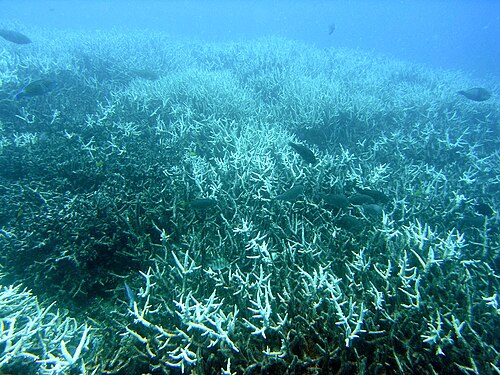
Habitat degradation occurs through restructuring and sometimes complete loss of habitats such as seagrass beds, corals, and kelp forests.[44][45] These habitats contain a significant proportion of the oceans' biodiversity.[19] Changes in currents and thermal environments have already shifted many marine species' ranges away from the equator. Large range shifts, along with outbreaks of toxic algal blooms, have impacted species across taxa.[9] Management of migrant species becomes increasingly difficult and food web dynamics shift.
SST increases are linked to a decline in species abundance such as the mass mortality of 25 benthic species in the Mediterranean in 2003, sea star wasting disease, and coral bleaching events.[10][19][7] Marine heatwaves in the Mediterranean Sea during 2015–2019 resulted in widespread mass sealife die-offs in five consecutive years.[48] Repeated marine heatwaves in the Northest Pacific led to dramatic changes in animal abundances, predator-prey relationships, and energy flux throughout the ecosystem.[5] Marine heatwave events were expected to impact species distribution.[31]:610
In a study conducted on the Hawaiian mushroom coral Lobactis scutaria, researchers discovered that higher temperatures and elevated levels of photosynthetically active radiation (PAR) had a detrimental impact on its reproductive physiology. The purpose of this study was to investigate the survival of reef-building corals in their natural habitat, as coral reproduction is being hindered by the effects of climate change.[57]
On weather patterns
The marine heatwave termed "The Blob" that occurred in the Northeastern Pacific from 2013 to 2016.[58]
Marine heatwaves in the tropical Indian Ocean were associated with dry conditions over central India and an increase in rainfall over south peninsular India in response to marine heatwaves in the northern Bay of Bengal[59]. These changes are transmitted by monsoon winds.[60]
This article incorporates text from a free content work.Licensed under CC BY 4.0(license statement/permission).Text taken from The Impact of Disasters on Agriculture and Food Security 2025,The Food and Agriculture Organization of the United Nations.
References
12Matthews, J.B.R.; Möller, V.; van Diemen, R.; Fuglestvedt, J.S.; Masson-Delmotte, V.; Méndez, C.; Semenov, S.; Reisinger, A. (2021). "Annex VII: Glossary"(PDF). In Masson-Delmotte, V.; Zhai, P.; Pirani, A.; Connors, S.L.; Péan, C.; Berger, S.; Caud, N.; Chen, Y.; Goldfarb, L.; Gomis, M.I.; Huang, M.; Leitzell, K.; Lonnoy, E.; Matthews, J.B.R.; Maycock, T.K.; Waterfield, T.; Yelekçi, O.; Yu, R.; Zhou, B. (eds.). Climate Change 2021: The Physical Science Basis. Contribution of Working Group I to the Sixth Assessment Report of the Intergovernmental Panel on Climate Change. Cambridge University Press. pp.2215–2256. doi:10.1017/9781009157896.022. ISBN978-1-009-15789-6.
123456789101112131415161718Holbrook, Neil J.; Scannell, Hillary A.; Sen Gupta, Alexander; Benthuysen, Jessica A.; Feng, Ming; Oliver, Eric C. J.; Alexander, Lisa V.; Burrows, Michael T.; Donat, Markus G.; Hobday, Alistair J.; Moore, Pippa J. (2019-06-14). "A global assessment of marine heatwaves and their drivers". Nature Communications. 10 (1): 2624. Bibcode:2019NatCo..10.2624H. doi:10.1038/s41467-019-10206-z. ISSN2041-1723. PMC6570771. PMID31201309.
12Oliver, Eric C. J. (2019-08-01). "Mean warming not variability drives marine heatwave trends". Climate Dynamics. 53 (3): 1653–1659. Bibcode:2019ClDy...53.1653O. doi:10.1007/s00382-019-04707-2. ISSN1432-0894. S2CID135167065.
123456Oliver, Eric C. J.; Donat, Markus G.; Burrows, Michael T.; Moore, Pippa J.; Smale, Dan A.; Alexander, Lisa V.; Benthuysen, Jessica A.; Feng, Ming; Sen Gupta, Alex; Hobday, Alistair J.; Holbrook, Neil J. (2018-04-10). "Longer and more frequent marine heatwaves over the past century". Nature Communications. 9 (1): 1324. Bibcode:2018NatCo...9.1324O. doi:10.1038/s41467-018-03732-9. ISSN2041-1723. PMC5893591. PMID29636482.
1234Gomes, Dylan G. E.; Ruzicka, James J.; Crozier, Lisa G.; Huff, David D.; Brodeur, Richard D.; Stewart, Joshua D. (13 March 2024). "Marine heatwaves disrupt ecosystem structure and function via altered food webs and energy flux". Nature Communications. 15 (1): 1988. Bibcode:2024NatCo..15.1988G. doi:10.1038/s41467-024-46263-2. PMC10937662. PMID38480718.
↑Smith, Kathryn E.; Burrows, Michael T.; Hobday, Alistair J.; King, Nathan G.; Moore, Pippa J.; Sen Gupta, Alex; Thomsen, Mads S.; Wernberg, Thomas; Smale, Dan A. (16 January 2023). "Biological Impacts of Marine Heatwaves". Annual Review of Marine Science. 15 (1): 119–145. Bibcode:2023ARMS...15..119S. doi:10.1146/annurev-marine-032122-121437. hdl:11250/3095845. PMID35977411.
123Bates, AE; Hilton, BJ; Harley, CDG (2009-11-09). "Effects of temperature, season and locality on wasting disease in the keystone predatory sea star Pisaster ochraceus". Diseases of Aquatic Organisms. 86 (3): 245–251. Bibcode:2009DisAO..86..245B. doi:10.3354/dao02125. ISSN0177-5103. PMID20066959.
↑Eisenlord, Morgan E.; Groner, Maya L.; Yoshioka, Reyn M.; Elliott, Joel; Maynard, Jeffrey; Fradkin, Steven; Turner, Margaret; Pyne, Katie; Rivlin, Natalie; van Hooidonk, Ruben; Harvell, C. Drew (2016-03-05). "Ochre star mortality during the 2014 wasting disease epizootic: role of population size structure and temperature". Philosophical Transactions of the Royal Society B: Biological Sciences. 371 (1689) 20150212. doi:10.1098/rstb.2015.0212. PMC4760142. PMID26880844.
1234McCabe, Ryan M.; Hickey, Barbara M.; Kudela, Raphael M.; Lefebvre, Kathi A.; Adams, Nicolaus G.; Bill, Brian D.; Gulland, Frances M. D.; Thomson, Richard E.; Cochlan, William P.; Trainer, Vera L. (2016-10-16). "An unprecedented coastwide toxic algal bloom linked to anomalous ocean conditions". Geophysical Research Letters. 43 (19): 10366–10376. Bibcode:2016GeoRL..4310366M. doi:10.1002/2016GL070023. ISSN0094-8276. PMC5129552. PMID27917011.
12345678910Garrabou, J.; Coma, R.; Bensoussan, N.; Bally, M.; Chevaldonné, P.; Cigliano, M.; Diaz, D.; Harmelin, J. G.; Gambi, M. C.; Kersting, D. K.; Ledoux, J. B. (May 2009). "Mass mortality in Northwestern Mediterranean rocky benthic communities: effects of the 2003 heat wave". Global Change Biology. 15 (5): 1090–1103. Bibcode:2009GCBio..15.1090G. doi:10.1111/j.1365-2486.2008.01823.x. S2CID55566218.
↑Bond, Nicholas A.; Cronin, Meghan F.; Freeland, Howard; Mantua, Nathan (2015-05-16). "Causes and impacts of the 2014 warm anomaly in the NE Pacific: 2014 WARM ANOMALY IN THE NE PACIFIC". Geophysical Research Letters. 42 (9): 3414–3420. doi:10.1002/2015GL063306. S2CID129149984.
↑Schaeffer, A.; Roughan, M. (2017-05-28). "Subsurface intensification of marine heatwaves off southeastern Australia: The role of stratification and local winds: SUBSURFACE MARINE HEAT WAVES". Geophysical Research Letters. 44 (10): 5025–5033. doi:10.1002/2017GL073714. S2CID134464357.
↑Perkins-Kirkpatrick, S. E.; King, A. D.; Cougnon, E. A.; Holbrook, N. J.; Grose, M. R.; Oliver, E. C. J.; Lewis, S. C.; Pourasghar, F. (2019-01-01). "The Role of Natural Variability and Anthropogenic Climate Change in the 2017/18 Tasman Sea Marine Heatwave". Bulletin of the American Meteorological Society. 100 (1): S105–S110. Bibcode:2019BAMS..100S.105P. doi:10.1175/BAMS-D-18-0116.1. hdl:1885/237324. ISSN0003-0007. S2CID127347944.
↑Laufkötter, Charlotte; Zscheischler, Jakob; Frölicher, Thomas L. (2020-09-25). "High-impact marine heatwaves attributable to human-induced global warming". Science. 369 (6511): 1621–1625. Bibcode:2020Sci...369.1621L. doi:10.1126/science.aba0690. ISSN0036-8075. PMID32973027. S2CID221881814.
123Frölicher, Thomas L.; Laufkötter, Charlotte (December 2018). "Emerging risks from marine heat waves". Nature Communications. 9 (1): 650. Bibcode:2018NatCo...9..650F. doi:10.1038/s41467-018-03163-6. ISSN2041-1723. PMC5811532. PMID29440658.
12Gulf of Maine Research Institute; Pershing, Andrew; Mills, Katherine; Dayton, Alexa; Franklin, Bradley; Kennedy, Brian (2018-06-01). "Evidence for Adaptation from the 2016 Marine Heatwave in the Northwest Atlantic Ocean". Oceanography. 31 (2). Bibcode:2018Ocgpy..31b.213P. doi:10.5670/oceanog.2018.213.
123Scripps Institution of Oceanography; Cavole, Leticia; Demko, Alyssa; Diner, Rachel; Giddings, Ashlyn; Koester, Irina; Pagniello, Camille; Paulsen, May-Linn; Ramirez-Valdez, Arturo; Schwenck, Sarah; Yen, Nicole (2016). "Biological Impacts of the 2013–2015 Warm-Water Anomaly in the Northeast Pacific: Winners, Losers, and the Future". Oceanography. 29 (2). Bibcode:2016Ocgpy..29b..32C. doi:10.5670/oceanog.2016.32.
12Gentemann, Chelle L.; Fewings, Melanie R.; García-Reyes, Marisol (2017-01-16). "Satellite sea surface temperatures along the West Coast of the United States during the 2014–2016 northeast Pacific marine heat wave: Coastal SSTs During "the Blob"". Geophysical Research Letters. 44 (1): 312–319. doi:10.1002/2016GL071039.
1 2 3 4 5 Smale, Dan A.; Wernberg, Thomas; Oliver, Eric CJ; Thomsen, Mads; Harvey, Ben P.; Straub, Sandra C.; Burrows, Michael T.; Alexander, Lisa V.; Benthuysen, Jessica A.; Donat, Markus G.; Feng, Ming (2019 年 4 月). 「海洋熱波が世界の生物多様性と生態系サービスの提供を脅かす」 . Nature Climate Change . 9 (4): 306– 312. Bibcode : 2019NatCC...9..306S . doi : 10.1038/s41558-019-0412-1 . hdl : 2160/3a9b534b-03ab-4619-9637-2ab06054fe70。ISSN 1758-6798。S2CID 91471054。
1 2 3 4 5 6フォックス=ケンパー、B.、HT ヒューイット、C. シャオ、G. アザルゲイルスドッティル、SS ドライフハウト、TL エドワーズ、NR ゴリッジ、M. ヘマー、RE コップ、G. クリナー、A. ミックス、D. ノッツ、S. ノヴィツキ、IS ヌルハティ、L. ルイス、J.-B. Sallee、ABA Slangen、Y. Yu、2021:第 9 章: 海洋、雪氷圏、海面変化。の気候変動: 物理科学の基礎。気候変動に関する政府間パネル第6次評価報告書への作業部会Iの貢献[Masson-Delmotte, V., P. Zhai, A. Pirani, SL Connors, C. Péan, S. Berger, N. Caud, Y. Chen, L. Goldfarb, MI Gomis, M. Huang, K. Leitzell, E. Lonnoy, JBR Matthews, TK Maycock, T. Waterfield, O. Yelekçi, R. Yu, and B. Zhou (eds.)]. Cambridge University Press, Cambridge, United Kingdom and New York, NY, USA, pp. 1211–1362, doi:10.1017/9781009157896.011.
↑Pörtner, H.-O.; Roberts, D.C.; Masson-Delmotte, V.; Zhai, P.; Poloczanska, E.; Mintenbeck, K.; Tignor, M.; Alegría, A.; Nicolai, M.; Okem, A.; Petzold, J.; Rama, B.; Weyer, N.M. (2022). "Technical Summary"(PDF). IPCC Special Report on the Ocean and Cryosphere in a Changing Climate. Cambridge University Press. pp.39–69. doi:10.1017/9781009157964.002. ISBN978-1-009-15796-4.
1234Hobday, Alistair J.; Alexander, Lisa V.; Perkins, Sarah E.; Smale, Dan A.; Straub, Sandra C.; Oliver, Eric C. J.; Benthuysen, Jessica A.; Burrows, Michael T.; Donat, Markus G.; Feng, Ming; Holbrook, Neil J.; Moore, Pippa J.; Scannell, Hillary A.; Sen Gupta, Alex; Wernberg, Thomas (2016-02-01). "A hierarchical approach to defining marine heatwaves". Progress in Oceanography. 141: 227–238. Bibcode:2016PrOce.141..227H. doi:10.1016/j.pocean.2015.12.014. hdl:2160/36448. ISSN0079-6611. S2CID49583270.
↑Smith, Kathryn E.; Burrows, Michael T.; Hobday, Alistair J.; King, Nathan G.; Moore, Pippa J.; Sen Gupta, Alex; Thomsen, Mads S.; Wernberg, Thomas; Smale, Dan A. (2023). "Biological Impacts of Marine Heatwaves". Annual Review of Marine Science. 15: 119–145. Bibcode:2023ARMS...15..119S. doi:10.1146/annurev-marine-032122-121437. hdl:11250/3095845. PMID35977411.
↑National Center for Atmospheric Research (NCAR) & University Corporation for Atmospheric Research (UCAR) (17 Mar 2023). "Scientists identify heat wave at bottom of ocean". Phys.org.
↑Gupta, Hitesh; Sil, Sourav; Gangopadhyay, Avijit; Gawarkiewicz, Glen (2024-01-01). "Observed surface and subsurface Marine Heat Waves in the Bay of Bengal from in-situ and high-resolution satellite data". Climate Dynamics. 62 (1): 203–221. Bibcode:2024ClDy...62..203G. doi:10.1007/s00382-023-06913-5. ISSN1432-0894.
↑Gu, D. (1997-02-07). "Interdecadal Climate Fluctuations That Depend on Exchanges Between the Tropics and Extratropics". Science. 275 (5301): 805–807. doi:10.1126/science.275.5301.805. PMID9012341. S2CID2595302.
↑Gupta, Hitesh; Deogharia, Rahul; Sil, Sourav; Singh, Vivek; Ray, Arkaprava (2025-08-01). "On the interconnection of marine heatwaves and the extremely severe cyclonic storms Mocha and Biparjoy in the Northern Indian Ocean". Natural Hazards. 121 (15): 18205–18225. Bibcode:2025NatHa.12118205G. doi:10.1007/s11069-025-07513-8. ISSN1573-0840.
↑Schwing, Franklin B.; Mendelssohn, Roy; Bograd, Steven J.; Overland, James E.; Wang, Muyin; Ito, Shin-ichi (2010-02-10). "Climate change, teleconnection patterns, and regional processes forcing marine populations in the Pacific". Journal of Marine Systems. Impact of climate variability on marine ecosystems: A comparative approach. 79 (3): 245–257. Bibcode:2010JMS....79..245S. doi:10.1016/j.jmarsys.2008.11.027. ISSN0924-7963.
12Collins, M.; Sutherland, M.; Bouwer, L.; Cheong, S.-M.; Frölicher, T.; Jacot Des Combes, H.; Koll Roxy, M.; Losada, I.; McInnes, K.; Ratter, B.; Rivera-Arriaga, E.; Susanto, R.D.; Swingedouw, D.; Tibig, L. (2019). "Extremes, Abrupt Changes and Managing Risk"(PDF). In Pörtner, H.-O.; Roberts, D.C.; Masson-Delmotte, V.; Zhai, P.; Tignor, M.; Poloczanska, E.; Mintenbeck, K.; Alegría, A.; Nicolai, M.; Okem, A.; Petzold, J.; Rama, B.; Weyer, N.M. (eds.). IPCC Special Report on the Ocean and Cryosphere in a Changing Climate. Cambridge University Press. pp.589–655. doi:10.1017/9781009157964.008. ISBN978-1-009-15796-4.
↑Mignot, A., von Schuckmann, K., Landschützer, P. et al. Decrease in air-sea CO2 fluxes caused by persistent marine heatwaves. Nature Communications 13, 4300 (2022). Nature website Retrieved 21 September 2022.
↑Gupta, Hitesh; Deogharia, Rahul; Sil, Sourav; Dey, Dipanjan (2025-03-30). "Characteristics of Marine Heat Extreme Evolution in the Northern Indian Ocean". International Journal of Climatology. 45 (4) e8734. Bibcode:2025IJCli..45E8734G. doi:10.1002/joc.8734. ISSN0899-8418.
↑Roxy, M.K. (April 26, 2024). "Future projections for the tropical Indian Ocean". The Indian Ocean and its Role in the Global Climate System. Elsevier. pp.469–482. doi:10.1016/B978-0-12-822698-8.00004-4. ISBN978-0-12-822698-8.
↑Yang, Yifei; Sun, Wenjin; Yang, Jingsong; Lim Kam Sian, Kenny T. C.; Ji, Jinlin; Dong, Changming (5 December 2022). "Analysis and prediction of marine heatwaves in the Western North Pacific and Chinese coastal region". Frontiers in Marine Science. 9 1048557. Bibcode:2022FrMaS...948557Y. doi:10.3389/fmars.2022.1048557.
↑"ESSD - Indicators of Global Climate Change 2025: annual update of key indicators of the state of the climate system and human influence". www.earth-system-science-data.net. Retrieved 2026-06-26.
1 2 Pearce, Alan F.; Feng, Ming (2013-02-01). "2010/2011年の夏季における西オーストラリア沖の「海洋熱波」の増減". Journal of Marine Systems . 111– 112: 139– 156. Bibcode : 2013JMS...111..139P . doi : 10.1016/j.jmarsys.2012.10.009 . ISSN 0924-7963 .
↑ Herring, Stephanie C.; Hoell, Andrew; Hoerling, Martin P.; Kossin, James P.; Schreck, Carl J.; Stott, Peter A. (2016 年 12 月). 「気候の観点から見た 2015 年の異常気象現象の説明入門」 .アメリカ気象学会報. 97 (12): S1– S3. Bibcode : 2016BAMS...97S...1H . doi : 10.1175/BAMS-D-16-0313.1 . ISSN 0003-0007 .
↑ Fumo, James T.; Carter, Melissa L.; Flick, Reinhard E.; Rasmussen, Linda L.; Rudnick, Daniel L.; Iacobellis, Sam F. (2020 年 5 月). "人為的気候変動下における南カリフォルニア湾の海洋熱波の文脈化" . Journal of Geophysical Research: Oceans . 125 (5) e2019JC015674. Bibcode : 2020JGRC..12515674F . doi : 10.1029/2019JC015674 . ISSN 2169-9275 . S2CID 218992543 .
12Greene, Scott; Kalkstein, Laurence S.; Mills, David M.; Samenow, Jason (October 2011). "An Examination of Climate Change on Extreme Heat Events and Climate–Mortality Relationships in Large U.S. Cities". Weather, Climate, and Society. 3 (4): 281–292. doi:10.1175/WCAS-D-11-00055.1. ISSN1948-8327. S2CID49322487.
12Salinger, M James; Renwick, James; Behrens, Erik; Mullan, A Brett; Diamond, Howard J; Sirguey, Pascal; Smith, Robert O; Trought, Michael C T; Alexander, Lisa; Cullen, Nicolas J; Fitzharris, B Blair (2019-04-12). "The unprecedented coupled ocean-atmosphere summer heatwave in the New Zealand region 2017/18: drivers, mechanisms and impacts". Environmental Research Letters. 14 (4): 044023. Bibcode:2019ERL....14d4023S. doi:10.1088/1748-9326/ab012a. hdl:10182/12205. ISSN1748-9326.
12Galli, Giovanni; Solidoro, Cosimo; Lovato, Tomas (2017-05-11). "Marine Heat Waves Hazard 3D Maps and the Risk for Low Motility Organisms in a Warming Mediterranean Sea". Frontiers in Marine Science. 4 136. Bibcode:2017FrMaS...4..136G. doi:10.3389/fmars.2017.00136. ISSN2296-7745.
↑Wernberg, T.; Bennett, S.; Babcock, R. C.; de Bettignies, T.; Cure, K.; Depczynski, M.; Dufois, F.; Fromont, J.; Fulton, C. J.; Hovey, R. K.; Harvey, E. S. (2016-07-08). "Climate-driven regime shift of a temperate marine ecosystem". Science. 353 (6295): 169–172. Bibcode:2016Sci...353..169W. doi:10.1126/science.aad8745. hdl:20.500.11937/31133. ISSN0036-8075. PMID27387951.
↑FAO (2025). The Impact of Disasters on Agriculture and Food Security 2025. FAO. doi:10.4060/cd7185en. ISBN978-92-5-140180-4.
↑Garrabou, Joaquim; Gómez-Gras, Daniel; Medrano, Alba; Cerrano, Carlo; Ponti, Massimo; Schlegel, Robert; Bensoussan, Nathaniel; Turicchia, Eva; Sini, Maria; Gerovasileiou, Vasilis; etal. (18 July 2022). "Marine heatwaves drive recurrent mass mortalities in the Mediterranean Sea". Global Change Biology. 28 (19): 5708–5725. Bibcode:2022GCBio..28.5708G. doi:10.1111/gcb.16301. ISSN1354-1013. PMC9543131. PMID35848527. S2CID250622761.
News report: "Marine heatwave: Record sea temperatures seen in the Mediterranean could devastate marine life". interestingengineering.com. 20 August 2022. Retrieved 21 August 2022.
↑Baker, Andrew C.; Glynn, Peter W.; Riegl, Bernhard (December 2008). "Climate change and coral reef bleaching: An ecological assessment of long-term impacts, recovery trends and future outlook". Estuarine, Coastal and Shelf Science. 80 (4): 435–471. Bibcode:2008ECSS...80..435B. doi:10.1016/j.ecss.2008.09.003. ISSN0272-7714.
123Cooley, S., D. Schoeman, L. Bopp, P. Boyd, S. Donner, D.Y. Ghebrehiwet, S.-I. Ito, W. Kiessling, P. Martinetto, E. Ojea, M.-F. Racault, B. Rost, and M. Skern-Mauritzen, 2022: Chapter 3: Oceans and Coastal Ecosystems and Their Services. In: Climate Change 2022: Impacts, Adaptation and Vulnerability. Contribution of Working Group II to the Sixth Assessment Report of the Intergovernmental Panel on Climate Change [H.-O. Pörtner, D.C. Roberts, M. Tignor, E.S. Poloczanska, K. Mintenbeck, A. Alegría, M. Craig, S. Langsdorf, S. Löschke, V. Möller, A. Okem, B. Rama (eds.)]. Cambridge University Press, Cambridge, UK and New York, NY, USA, pp. 379–550, doi:10.1017/9781009325844.005.
↑US Department of Commerce, National Oceanic and Atmospheric Administration. "How does climate change affect coral reefs?". oceanservice.noaa.gov. Retrieved 2024-02-19.
↑IPCC (2007). "Summary for policymakers"(PDF). In Parry ML, Canziani OF, Palutikof JP, van der Linden PJ, Hanson CE (eds.). Climate Change 2007: impacts, adaptation and vulnerability: contribution of Working Group II to the fourth assessment report of the Intergovernmental Panel on Climate Change. Cambridge, UK: Cambridge University Press. pp.7–22. ISBN978-0-521-70597-4. Archived(PDF) from the original on 13 January 2018. Retrieved 8 July 2009.
↑Fischlin A, Midgley GF, Price JT, Leemans R, Gopal B, Turley C, Rounsevell MD, Dube OP, Tarazona J, Velichko AA (2007). "Ch 4. Ecosystems, their properties, goods and services"(PDF). In Parry ML, Canziani OF, Palutikof JP, van der Linden PJ, Hanson CE (eds.). Climate Change 2007: impacts, adaptation and vulnerability: contribution of Working Group II to the fourth assessment report of the Intergovernmental Panel on Climate Change. Cambridge, UK: Cambridge University Press. pp.211–72. ISBN978-0-521-70597-4. Archived(PDF) from the original on 11 October 2017. Retrieved 8 July 2009.
↑Davidson, Jordan (25 March 2020). "Great Barrier Reef Has Third Major Bleaching Event in Five Years". Ecowatch. Retrieved 27 March 2020.
↑McWhorter, Jennifer K.; Halloran, Paul R.; Roff, George; Skirving, William J.; Perry, Chris T.; Mumby, Peter J. (February 2022). "The importance of 1.5°C warming for the Great Barrier Reef". Global Change Biology. 28 (4): 1332–1341. Bibcode:2022GCBio..28.1332M. doi:10.1111/gcb.15994. hdl:10871/127948. PMID34783126. S2CID244131267.
↑"Coral Reefs Could Be Gone in 30 Years". National Geographic News. 2017-06-23. Archived from the original on 7 May 2019. Retrieved 2019-05-07.
↑Bouwmeester, Jessica; Daly, Jonathan; Zuchowicz, Nikolas; Lager, Claire; Henley, E. Michael; Quinn, Mariko; Hagedorn, Mary (2023-01-05). "Solar radiation, temperature and the reproductive biology of the coral Lobactis scutaria in a changing climate". Scientific Reports. 13 (1): 246. Bibcode:2023NatSR..13..246B. doi:10.1038/s41598-022-27207-6. ISSN2045-2322. PMC9816315. PMID36604569.
↑Naranjo, Laura (2 November 2018). "The blob | Earthdata". earthdata.nasa.gov. Retrieved 2019-09-30.
↑Gupta, Hitesh; Goswami, Piyali; Ray, Arkaprava; Bhattacharjee, Arpan; Sil, Sourav (2026-02-16). "Evolution of marine heatwaves and air-sea interactions during the 2020 Southwest Monsoon in the Bay of Bengal". Climate Dynamics. 64 (3): 105. Bibcode:2026ClDy...64..105G. doi:10.1007/s00382-026-08086-3. ISSN1432-0894.
↑Saranya, J. S.; Roxy, M. K.; Dasgupta, Panini; Anand, Ajay (February 2022). "Genesis and Trends in Marine Heatwaves Over the Tropical Indian Ocean and Their Interaction With the Indian Summer Monsoon". Journal of Geophysical Research: Oceans. 127 (2) e2021JC017427. Bibcode:2022JGRC..12717427S. doi:10.1029/2021JC017427. ISSN2169-9275.



 This article incorporates text from a free content work.Licensed under CC BY 4.0(license statement/permission).Text taken from The Impact of Disasters on Agriculture and Food Security 2025,The Food and Agriculture Organization of the United Nations.