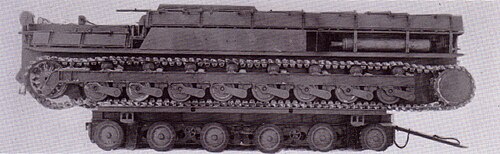
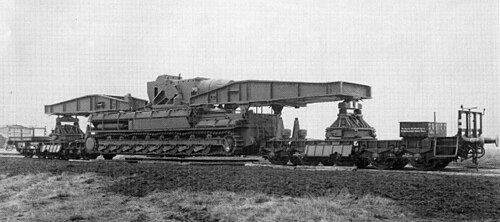
The weapon was moved long distances via rail on a variant of a Schnabel car; the whole chassis was hung between two huge pedestal-mounted swiveling arms fixed to five-axle bogies.[7] When it reached its destination, the weapon was detached from railcars' supporting arms and driven to its intended firing location. The chassis of the ordnance was then lowered to the ground by "raising" the continuous track units' roadwheels by rotating their torsion-bar-sprung suspension arms to drop the chassis close to the ground to distribute the recoil forces more evenly in preparation for firing - the roadwheels for each trackset were also similarly "raised" to allow the tracks to clear the rails while being transported by rail, between the pair of Schnabel railcars. The Karl-Gerät proved to have no problems moving over normal soil, but under no circumstances was it allowed to make turns on soft soil lest it throw a track. The chassis had to be backed into position to fire, which expedited movement to a new position, but the land to be used for the ordnance's firing position had to be precisely leveled and the approach route prepared ahead of time to fill in soft spots and any ditches, etc.[8] The mortar could only be loaded at zero elevation, so it had to be re-aimed between shots.[7]
Automotive features
The various Karl-Geräte used two different types of transmissions, engines and suspension system in a bewildering set of combinations. The table below outlines how each vehicle was outfitted. After May 1944 the gasoline engines were replaced by diesels. Little information is available for No. VII, the experimental model, and the data below must be regarded as unconfirmed.[3]
a. 弾薬040:264発の砲弾がすぐに使用可能で、そのうち150発は638中隊に割り当てられる予定です。さらに96発は今後数日で完成します。241発の砲弾はウンターリュースで高性能爆薬の充填剤交換作業中です。1日あたり約10発が完了しています。一部の弾薬は再加工が必要です。残りの弾薬を再充填できるよう、10月5日に火薬試験が行われます。
b. 弾薬041:コンクリート貫通砲弾50発が、10月初旬に射撃表データ取得のためヒラースレーベンに納入された。9月末までにさらに25発、10月末までにさらに25発が納入され、その後は毎月50発の納入が予定されている。高性能炸薬砲弾(シュプレンググラナート)50発は、11月に射撃表データ取得のために完成する予定である。1945年初頭には、高性能炸薬砲弾とコンクリート貫通砲弾を合わせて毎月60発生産する予定である。
第428中隊は砲を第IIおよび第VI中隊(いずれもGerät 040搭載)に交換し、1944年12月14日に西へ出発してライン川の監視作戦(Unternehmen Wacht am Rhein)に参加したが、前線に到着したのは12月29日だった。第628中隊は、戦闘に投入された最初の54cm Gerät 041である第IV中隊を装備した後、12月20日に続いた。[ 25 ]
1945
戦闘中の彼らの活動についてはほとんど知られていないが、Gerät Nr. II は輸送中に爆弾で損傷し、1945 年 1 月 6 日にユーターボーグに戻った。2 月 3 日までに、Karl Nr. I の部品を使用して修理された。Gerät Nr . IV は多数の貫通弾で損傷し、1 月 31 日にユーターボーグに到着した。Gerät Nr . VI は 1 月 19 日時点ではまだ前線にいた。その間、Nr. V は 54 cm 榴弾砲を使用するように改造され、エンジンが再構築された。[ 25 ]
3月22日付の状況報告によると、Geräte Nr. IとIVはまだユーターボーグにあり、Nr. Iは040として構成され、Nr. IVは041として完成予定であった。Geräte Nr . IIとVはそれぞれ3月11日と10日に前線へ出発した。Gerät Nr . VIはエンジン損傷のためユーターボーグへ帰還中であった。Gerät Nr . IIIはほぼ破壊されており、砲尾のみが回収可能であった。Gerät Nr. VIIは部品が必要で、すぐに運用可能になる見込みはなかった。[ 27 ]



 ウィキメディア・コモンズにある、カール・メルザーに関連するメディア