
Loading article…
Jacques Alexandre Bernard Law, marquis de Lauriston (French pronunciation:[ʒakalɛksɑ̃dʁbɛʁnaʁlo]; 1 February 1768 – 12 June 1828) was a French soldier and diplomat of Scottish and Portuguese descent, and a general officer in the French Army during the Napoleonic Wars. He was born in Pondicherry in French India, where his father, Jean Law de Lauriston, was Governor-General. Jean Law de Lauriston was a nephew of the financier John Law. Jacques' mother was a member of the Carvallho family of Portuguese traders.
Lauriston Castle, in Scotland, was inherited by John Law in 1729. Lauriston is one of the names inscribed on the Arc de Triomphe.
Lauriston obtained his first commission about 1786, served with the artillery and on the general staff during the early campaigns of the Revolution, and became brigadier of artillery in 1795. Resigning in 1796, he was brought back into the service in 1800 as aide-de-camp to Napoleon, with whom, as a cadet, Lauriston had been on friendly terms. In the years immediately preceding the first empire, Lauriston was, successively, director of the La Fère artillery school and special envoy to Denmark before being selected to convey to England the ratification of the Peace of Amiens in 1802.[1]
In 1805, having risen to the rank of general of division, he took part in the war against Austria. He occupied Venice and the Republic of Ragusa in 1806, was made governor-general of Venice in 1807, took part in the Erfurt negotiations of 1808, was ennobled as a count, and served with the emperor during the Peninsular War in Spain (1808–1809), where he commanded the division that besieged and won Pamplona. He fought under Viceroy Eugène de Beauharnais at the Battle of Raab in the Italian campaign and the subsequent advance to Vienna.[1]
1809年7月6日のヴァグラムの戦いで、ナポレオンはローリストンに、左翼に対するオーストリア軍の奇襲攻撃を阻止するために大規模な砲台を編成するよう命じた。時間を稼ぐため、皇帝はエティエンヌ・マリー・アントワーヌ・シャンピオン・ド・ナンスーティ将軍の重騎兵隊に突撃を命じた。ナンスーティの胸甲騎兵とカラビニエがオーストリア軍への無益な攻撃で命を落とす間、ローリストンは巨大な砲台のために112門の大砲を集めた。彼は皇帝親衛隊から60門、カール・フィリップ・フォン・ヴレーデ将軍のバイエルン師団から24門、ウジェーヌのイタリア軍から38門を集めた。彼は砲台を散弾射程まで前進させ、砲を車軸から外し、発砲した。この凄まじい鉛の嵐に直面し、ヨハン・コロウラート将軍率いるオーストリア第3軍団は停止し、射程圏外へと後退した。この砲撃により、ナポレオンは効果的な反撃を組織する時間を稼ぐことができた。[ 2 ]
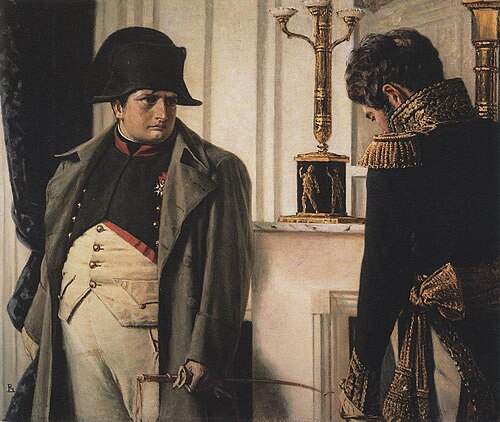
1811年、ローリストンはロシア大使に任命された。1812年には大軍で指揮を執り、モスクワからの撤退を毅然として援護したことで名声を得た。ドイツ戦役中はリュッツェンとバウツェンで第5軍団を指揮したが、 1813年10月のライプツィヒの戦い後の悲惨な撤退中に捕虜となった。[ 1 ]
ローリストンは帝国の崩壊まで捕虜として拘束されていた。その後、フランス国王ルイ18世に仕え、百日天下の間も忠誠を尽くした。その褒賞として貴族院の議席と近衛兵の指揮権を与えられた。[ 1 ] 1817年、侯爵に叙せられ、フィニステール県およびブレスト広場の最高司令官となった。1823年、ローリストンはフランス元帥に叙せられ、スペイン遠征中に軍団を指揮した。1828年6月11日、パリで脳卒中により死去。凱旋門の13番目の柱にはローリストンの名前が刻まれている。