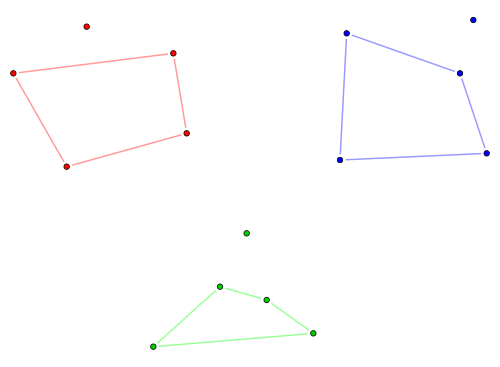
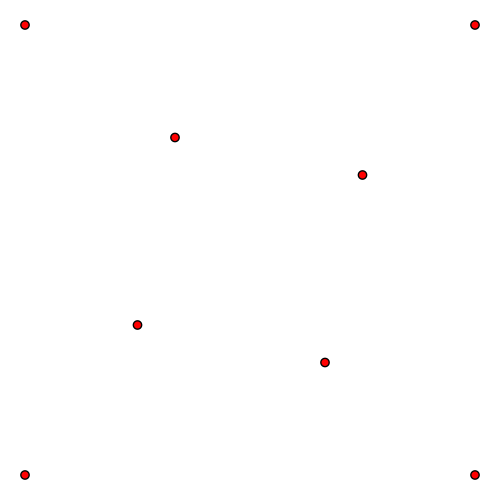
f(5) = 9.[5] A set of eight points with no convex pentagon is shown in the illustration, demonstrating that f(5) > 8; the more difficult part of the proof is to show that every set of nine points in general position contains the vertices of a convex pentagon.
There is also the question of whether any sufficiently large set of points in general position has an "empty" convex quadrilateral, pentagon, etc., that is, one that contains no other input point. The original solution to the happy ending problem can be adapted to show that any five points in general position have an empty convex quadrilateral, as shown in the illustration, and any ten points in general position have an empty convex pentagon.[10] However, there exist arbitrarily large sets of points in general position that contain no empty convex heptagon.[11]
Let be the minimum number of points, such that any points in general position contains an empty hexagon. For a long time it is open whether exists. The question is now solved:
Overmars (2003) showed that if it exists, then , by constructing an example with 29 points.
↑エルデシュとセケレス(1935)によれば、これは最初にエンドレ・マカイ(1915–1987)によって証明された(「隠された秩序:絵画」を参照。www.sfu.ca 。2026年2月9日取得)。、Fizikusok és matematikusok az Eötvös Collegiumban 1895–1950 (PDF) (ハンガリー語)。231~ 232ページ。) 最初に公開された証拠は、Kalbfleisch、Kalbfleisch & Stanton (1970)に掲載されました。
Tóth, G.; Valtr, P. (2005)、「エルデシュ・セケレスの定理:上限と関連結果」、Goodman, Jacob E. ; Pach, János ; Welzl, Emo (編)、『組合せ論と計算幾何学』(PDF)、Mathematical Sciences Research Institute Publications、第52巻、Cambridge University Press、pp. 557–568 、 2019年7月28日にオリジナル(PDF)からアーカイブ、2015年2月28日に取得
Valtr, P. (2008)、「空の六角形について」、Goodman, Jacob E.、Pach, János、Pollack, Richard (編)、「離散幾何学と計算幾何学に関する概説:20年後:AMS-IMS-SIAM合同夏季研究会議、2006年6月18-22日、ユタ州スノーバード」、Contemporary Mathematics、第453巻、American Mathematical Society、pp. 433–442、ISBN9780821842393