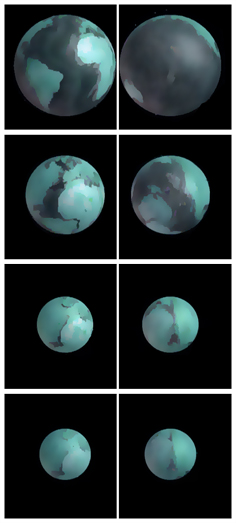
According to the hypothesis of J. Marvin Herndon (2005, 2013) the Earth originated in its protoplanetary stage from a Jupiter-like gas giant. During the development phases of the young Sun, which resembled those of a T Tauri star, the dense atmosphere of the gas giant was stripped off by infrared eruptions from the sun. The remnant was a rocky planet. Due to the loss of pressure from its atmosphere it would have begun a progressive decompression. Herndon regards the energy released due to the lack of compression as a primary energy source for geotectonic activity, to which some energy from radioactive decomposition processes was added. He terms the resulting changes in the course of Earth's history by the name of his theory Whole-Earth Decompression Dynamics. He considered seafloor spreading at divergent plate boundaries as an effect of it.[26] In his opinion mantle convection as used as a concept in the theory of plate tectonics is physically impossible. His theory includes the effect of solar wind (geomagnetic storms) as cause for the reversals of the Earth magnetic field. The question of mass increase is not addressed.[26][27]
Other
A handful of studies consider obituary of the expanding Earth theory as a whole must be considered premature at this time,[28] and point to recent space geodetic and gravimetric studies as evidence.[29]
Main arguments against Earth expansion
The hypothesis had never developed a plausible and verifiable mechanism of action.[17] During the 1960s, the theory of plate tectonics— based initially on the assumption that Earth's size remains constant, and relating the subduction zones to burying of lithosphere at a scale comparable to seafloor spreading[17]—became the accepted explanation in the Earth Sciences.
The scientific community finds that significant evidence contradicts the Expanding Earth theory, and that the evidence used for it is explained better by plate tectonics:
Measurements with modern high-precision geodetic techniques and modeling of the measurements by the horizontal motions of independent rigid plates at the surface of a globe of free radius, were proposed as evidence that Earth is not currently increasing in size to within a measurement accuracy of 0.2mm per year.[2] The main author of the study stated "Our study provides an independent confirmation that the solid Earth is not getting larger at present, within current measurement uncertainties".[30]
The motions of tectonic plates and subduction zones measured by a large range of geological, geodetic and geophysical techniques helps verify plate tectonics.[31][4][32]
Imaging of lithosphere fragments within the mantle is evidence for lithosphere consumption by subduction.[4][32]
Paleomagnetic data has been used to calculate that the radius of Earth 400 million years ago was 102 ± 2.8 percent of the present radius.[33][6]
Examinations of data from the Paleozoic and Earth's moment of inertia suggest that there has not been any significant change of Earth's radius during the last 620 million years.[3]
↑Ott Christoph Hilgenberg: Vom wachsenden Erdball. Berlin 1933.
12Wu, X.; X. Collilieux; Z. Altamimi; B. L. A. Vermeersen; R. S. Gross; I. Fukumori (8 July 2011). "Accuracy of the International Terrestrial Reference Frame origin and Earth expansion". Geophysical Research Letters. 38 (13): 5 PP. Bibcode:2011GeoRL..3813304W. doi:10.1029/2011GL047450.
12Williams, G.E. (2000), "Geological constraints on the Precambrian history of Earth's rotation and the moon's orbit"(PDF), Reviews of Geophysics, 38 (1): 37–59, Bibcode:2000RvGeo..38...37W, CiteSeerX10.1.1.597.6421, doi:10.1029/1999RG900016, S2CID51948507, archived from the original(PDF) on 24 December 2015, retrieved 23 November 2007
123Bucher, K. (2005), "Blueschists, eclogites, and decompression assemblages of the Zermatt-Saas ophiolite: High-pressure metamorphism of subducted Tethys lithosphere", American Mineralogist, 90 (5–6): 821–835, Bibcode:2005AmMin..90..821B, doi:10.2138/am.2005.1718, S2CID129874595
↑Buis A.; Clavin W. (16 August 2011). "NASA Research Confirms it's a Small World, After All". Archived from the original on 3 January 2019. Retrieved 23 July 2018.
12Schmidt, P. W.; Clark, D. A. (1980). "The response of palaeomagnetic data to Earth expansion". Geophysical Journal of the Royal Astronomical Society. 61: 95–100. Bibcode:1980GeoJ...61...95S. doi:10.1111/j.1365-246X.1980.tb04306.x.
↑Sudiro, P. (1 June 2014). "The Earth expansion theory and its transition from scientific hypothesis to pseudoscientific belief". History of Geo- and Space Sciences. 5 (1): 135–148. Bibcode:2014HGSS....5..135S. doi:10.5194/hgss-5-135-2014. ISSN2190-5029.
↑Herbert, Sandra (1991), "Charles Darwin as a prospective geological author", British Journal for the History of Science, 24 (2), Cambridge University Press: 159–192 [184–188], doi:10.1017/S0007087400027060, JSTOR4027165, S2CID143748414, retrieved 24 October 2008, pp. 178, 184, 189, also Darwin, C. R. Geological diary: Elevation of Patagonia. (5.1834) CUL-DAR34.40-60 Transcribed by Kees Rookmaaker (Darwin Online), pp. 58–59.
↑Mantovani, R. (1889), "Les fractures de l'écorce terrestre et la théorie de Laplace", Bulletin de la Société des Sciences et Arts de l'Île de la Réunion: 41–53
↑Mantovani, R. (1909), "L'Antarctide", Je M'instruis. La Science Pour Tous, 38: 595–597
↑Wegener, A. (1966), The Origin of Continents and Oceans, Courier Dover Publications, ISBN978-0-486-61708-4 See Online version in German.
↑Hohl, R. (1970), "Geotektonische Hypothesen", Die Entwicklungsgeschichte der Erde. Brockhaus Nachschlagewerk Geologie mit Einem ABC der Geologie, Bd. 1 (4.ed.): 279–321
↑Yarkovsky, Ivan Osipovich (1888), Hypothèse cinétique de la Gravitation universelle et la connexion avec la formation des éléments chimiques, Moscow{{citation}}: CS1 maint: location missing publisher (link)
↑Ott Christoph Hilgenberg: Vom wachsenden Erdball. Berlin 1933, page 29–35.
↑Hilgenberg, O.C. (1933), Vom wachsenden Erdball (The Expanding Earth), Berlin: Giessmann & Bartsch, Bibcode:1933vwe..book.....H
1234Ogrisseg, Jeff (22 November 2009), "Dogmas may blinker mainstream scientific thinking", The Japan Times, archived from the original on 3 March 2015
↑Carey, S. Warren (1975). "The expanding earth — an essay review". Earth-Science Reviews. 11 (2): 105–143. Bibcode:1975ESRv...11..105C. doi:10.1016/0012-8252(75)90097-5.
↑Samuel Warren Carey (1988), Theories of the earth and universe: a history of dogma in the earth sciences (illustrateded.), Stanford University Press, pp.347–350, ISBN978-0-8047-1364-1
↑Oreskes, Naomi, 2003, Plate Tectonics: An Insider's History of the Modern Theory of the Earth, Westview Press, p. 23, ISBN0813341329
↑Frankel, Henry, The Continental Drift Debate, Ch. 7 in Scientific controversies, p. 226, 1987, Cambridge University Press, ISBN978-0-521-27560-6
↑Wills, Matthew (8 October 2016). "The Mother of Ocean Floor Cartography". JSTOR. Retrieved 14 October 2016. While working with the North Atlantic data, she noted what must have been a rift between high undersea mountains. This suggested earthquake activity, which then [was] only associated with [the] fringe theory of continental drift. Heezen infamously dismissed his assistant's idea as "girl talk." But she was right, and her thinking helped to vindicate Alfred Wegener's 1912 theory of moving continents. Yet Tharp's name isn't on any of the key papers that Heezen and others published about plate tectonics between 1959-1963, which brought this once controversial idea to the mainstream of earth sciences.
↑"What's Hitting Earth? | Science Mission Directorate". Archived from the original on 25 May 2020. Retrieved 16 September 2016.
↑Jordan, P. (1971), The expanding earth: some consequences of Dirac's gravitation hypothesis, Oxford: Pergamon Press, Bibcode:1971eesc.book.....J
↑Born, M. (2003) [1964], Die Relativitätstheorie Einsteins (Einstein's theory of relativity), Berlin-Heidelberg-New York: Springer-publisher, ISBN978-3-540-00470-7
12Herndon, J. Marvin (10 December 2005) [30 Jun 2005]. "Whole-earth decompression dynamics". Current Science. 89 (11): 1937–1941. arXiv:astro-ph/0507001. Bibcode:2005astro.ph..7001M. JSTOR24111129.
↑Herndon, J. Marvin (4 July 2013). "A New Basis of Geoscience: Whole-Earth Decompression Dynamics". NCGT Journal. Cornell University Physics. arXiv:1307.1692.
↑Matthew R. Edwards (2016). "Indications from space geodesy, gravimetry and seismology for slow Earth expansion at present – comment on "The Earth expansion theory and its transition from scientific hypothesis to pseudoscientific belief" by Sudiro (2014)". History of Geo- and Space Sciences. 7 (2): 125–133. Bibcode:2016HGSS....7..125E. doi:10.5194/hgss-7-125-2016.
↑Matthew R. Edwards (2019). "Deep mantle plumes and an increasing Earth radius". Geodesy and Geodynamics. 10 (3): 173–178. Bibcode:2019G&G....10..173E. doi:10.1016/j.geog.2019.03.002.
↑It's a Small World, After All: Earth Is Not Expanding, NASA Research Confirms, ScienceDaily (Aug. 17, 2011)
12Van Der Lee, Suzan; Nolet, Guust (1997), "Seismic image of the subducted trailing fragments of the Farallon plate", Nature, 386 (6622): 266, Bibcode:1997Natur.386..266V, doi:10.1038/386266a0, S2CID4340130
↑McElhinney, M. W.; Taylor, S. R. & Stevenson, D. J. (1978), "Limits to the expansion of Earth, Moon, Mars, and Mercury and to changes in the gravitational constant", Nature, 271 (5643): 316–321, Bibcode:1978Natur.271..316M, doi:10.1038/271316a0, S2CID4258162
Bibliography
Carey, S.W.; 1976: "The Expanding Earth", Developments in Geotectonics (10), Elsevier, ISBN0-444-41485-1; digital edition 2013: ASIN B01E3II6VY.
Carey, S.W.;1988: "Theories of the Earth and Universe: A History of Dogma in the Earth Sciences", Stanford University Press, ISBN0-804-71364-2.
Duff, D.; 1993: Holmes' principles of physical geology, Chapman & Hall (4th ed.), ISBN0-412-40320-X.
Fowler, C.M.R.; 1990: The Solid Earth, an introduction to Global Geophysics, Cambridge University Press, ISBN0-521-38590-3.