Loading article…

The fractional part or decimal part[1] of a non‐negative real number is the excess beyond that number's integer part. The latter is defined as the largest integer not greater than x, called floor of x or . Then, the fractional part can be formulated as a difference:
The fractional part of logarithms,[2] specifically, is also known as the mantissa; by contrast with the mantissa, the integral part of a logarithm is called its characteristic.[3][4] The word mantissa was introduced by Henry Briggs.[5]
For a positive number written in a conventional positional numeral system (such as binary or decimal), its fractional part hence corresponds to the digits appearing after the radix point, such as the decimal point in English. The result is a real number in the half-open interval [0, 1).
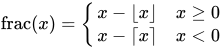
However, in case of negative numbers, there are various conflicting ways to extend the fractional part function to them: It is either defined in the same way as for positive numbers, i.e., by (Graham, Knuth & Patashnik 1992),[6] or as the part of the number to the right of the radix point (Daintith 2004),[7] or by the odd function:[8]
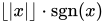
with as the smallest integer not less than x, also called the ceiling of x. By consequence, we may get, for example, three different values for the fractional part of just one x: let it be −1.3, its fractional part will be 0.7 according to the first definition, 0.3 according to the second definition, and −0.3 according to the third definition, whose result can also be obtained in a straightforward way by
The and the "odd function" definitions permit for unique decomposition of any real number x to the sum of its integer and fractional parts, where "integer part" refers to or それぞれ。これらの2つの分数部分関数の定義は冪等性も提供する。
⌊ ⌋との差によって定義される小数部分は、通常、中括弧 :で表されます。
すべての実数は、本質的に単純な連分数として一意に表現できます。つまり、整数部分と小数部分の逆数の和として表され、さらにその逆数の和として表されます。