Loading article…
コピーとは、情報または成果物のインスタンスに基づいて、元の生成プロセスを使用せずに、情報または成果物を複製することです。アナログ形式の情報の場合、コピーは限られた精度でしか実行できません。これは、使用する機器の品質とオペレーターのスキルに依存します。コピーを作成する際、オリジナルからコピーへの生成損失、劣化、および「ノイズ」(ランダムな小さな変化)の蓄積は避けられません。この劣化は、世代を重ねるごとに蓄積されます。デジタル形式の情報の場合、コピーは完璧です。コピーアンドペーストは、コンピュータユーザーがテキストやコンテンツの領域を選択してコピーする際によく使用されます。
視覚芸術では、巨匠の作品を模写することは、学生が絵画や彫刻を学ぶ標準的な方法です。[ 1 ]多くの場合、アーティストは、フィンセント・ファン・ゴッホの「最初の一歩(ミレーに倣って)」やパブロ・ピカソの「草上の昼食、マネに倣って」(マネの有名な作品に基づく)のように、模写のタイトルに元のアーティストをクレジットするために「after」という用語を使用します(2つの作品がどれほど似ているかに関係なく)。[ 2 ] [ 3 ]彫刻では、模写は、ポインティングマシン、パンタグラフ、または最近では、モデルをスキャンしてさまざまな素材で任意のサイズで作成できるコンピューター誘導ルーターシステムなどの装置を使用して作成されることがよくあります。[ 4 ] [ 5 ] 3次元作品を模写するもう1つの方法は、ロストワックス鋳造やその他の成形と鋳造の形式です。
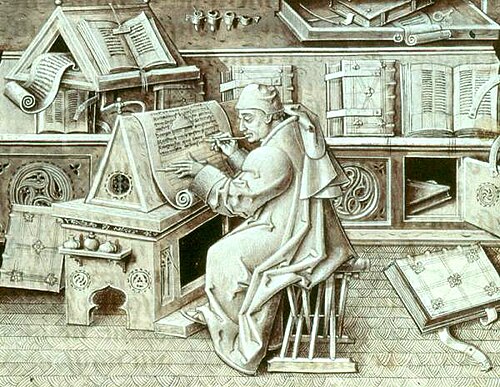
印刷機が発明される以前は、本の写本を入手する唯一の方法は手書きで書き写すことだった(写字生を参照)。中世を通じて、修道士たちは文学、哲学、宗教に関する文献を普及・保存する手段として、全文を書き写していた。
オフィスでは、さまざまな状況で文書のコピーを複数枚必要とします。通常、記録のために発信文書のコピーが必要になります。また、作成した文書のコピーを複数の関係者に配布したい場合もあります。
18世紀後半まで、事務所が発信する手紙の控えを保管したい場合、事務員が手書きで控えを作成する必要がありました。この方法は19世紀の大半を通して広く用いられました。そのため、事務所では写字係(写字生、筆記者、書記とも呼ばれる)が雇用されていました。
17世紀半ばから18世紀後半にかけて、手書きの複写に代わるいくつかの方法が発明されましたが、いずれもオフィスに大きな影響を与えることはありませんでした。1780年、ジェームズ・ワットは手紙複写機の特許を取得し、ジェームズ・ワット社はその年から製造を開始しました。1780年代初頭には、ベンジャミン・フランクリン、ジョージ・ワシントン、トーマス・ジェファーソンといった人々が手紙複写機を使用していました。1785年には、ジェファーソンはジェームズ・ワット社製の据え置き型と携帯型の両方の複写機を使用していました。
19世紀には、オフィスでのコピーのニーズを満たすために、さまざまな競合技術が導入されました。[ 6 ] 1895年に最も一般的に使用されていた技術は、ニューヨーク・ビジネス・カレッジのコースプログラムに関する1895年の説明に記載されています。「重要な手紙や文書はすべてレターブックにコピーするか、カーボンコピーを作成し、謄写版やその他の省力化オフィス機器の使用方法についても指導します。」 [ 7 ]
遺伝情報の複製は、DNA複製によって行われる。DNA複製は高い精度でデータを複製できるが、ミスはよく発生し、突然変異という形で現れる。しかし、 DNA修復の過程では、複製されたデータと元のデータを比較することで、多くのミスが修正される。
The same principle is applied digitally, in devices such as in hard disks, but in a different form. The magnetised data on the disk consists of 1s and 0s. Unlike DNA, it only has two types of information, rather than four types, however, it still has a polar concept of transfer. In this case, the read-write head acts as an intermediary. A data section reading "1", can only trigger one type of response, and "0" for the other. These responses from reading are converted into an electrical form that gets carried through the circuits. Although this can be later converted and processed for other ways of using the data, which can be modified, if a file was being copied from one hard disk to another, the principle ensures that the data is transferred with high fidelity, because only each type of signal can only trigger one type of data write, in this case, a 1 or a 0. This excludes exceptions where the data was written incorrectly or the existing data has been corrupted while on the disk such that no distinction can be made, but usually the hard disk returns the area as unreadable. The other concept that using digital copying is website copy, digital copying has more interpretation than just the basic concept of disk read and write itself. Digital Copy is a sample of interpretation of digital copying.
The concept of copying has a particular significance in certain areas of law. In each of the primary areas of intellectual property law, a number of cases have refined the question of what exactly constitutes the kind of copying prohibited by law, especially in areas such as copyright law.
A related concept is plagiarism, copying others' work and passing it off as one's own. Many schools will take plagiarism to academic suspension, or even the failure of a course.