Loading article…
線形代数、幾何学、三角法において、ケイリー・メンガー行列式は、空間の内容、すなわち高次元の体積を表す公式である。次元単体を、その頂点間のすべての距離の二乗で表したもの。この行列式は、アーサー・ケイリーとカール・メンガーにちなんで名付けられました。
のペアワイズ距離多項式間の(実)ユークリッド空間の点は、ケイリー・メンガー関係によって関連付けられるユークリッド不変量である。[ 1 ]これらの関係は、ヘロンの公式を一般化したり、次元単体、そして最終的には距離幾何学の分野では、任意の実対称行列が何らかのユークリッド距離行列であるかどうかを判定する。ポイント。[ 2 ]
カール・メンガーはウィーン大学の若い幾何学教授で、アーサー・ケイリーは代数幾何学を専門とするイギリスの数学者でした。メンガーはケイリーの代数的な結果を拡張し、合同等性までの距離幾何学の概念を用いて距離空間の新しい公理を提案しました。これはケイリー・メンガー行列式として知られています。これは最終的に、三角形の面積を辺の長さで計算する距離幾何学の最初の発見の1つであるヘロンの公式を一般化することになりました。 [ 3 ]
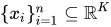
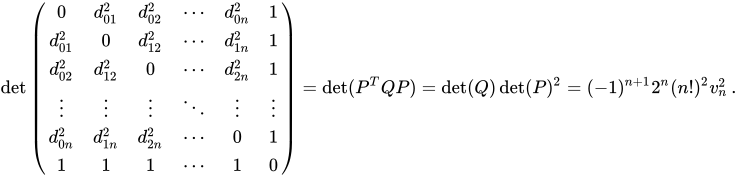
させてなれポイント次元ユークリッド空間、 . [ a ]これらの点は頂点です-次元単体: 三角形の場合、正四面体の場合など。頂点間のユークリッド距離をそして。コンテンツ、つまり、この単体の次元体積を で表す。 は、の関数として表現できます。そして、ある行列の行列式は、次の 2 つの方法で求められます。 [ 4 ] [ 5 ]
これはケイリー・メンガー行列式です。、三角形を扱っているのですが、辺を入れ替えると向きが変わります(向き付け可能な場合)が、面積は変わりません。したがって、三角形は必然的にの対称多項式には、これらの量の置換に対して不変である。任意のより大きな n 単体に対して、ここで、特殊な場合にのみ、エッジの交換が不変となる。 [ b ]特に、 、十分に不規則な四面体内の任意の2つの斜めの辺の間の距離を交換すると、(最良の場合でも)異なる行列式を持つ別の四面体になります。頂点を共有する任意の2つの辺の間の距離を交換するという、それほど攻撃的でない場合でも、これは(接続された辺の3つの頂点によって形成される)1つの面の向きを反転させますが、4番目の頂点への3つの接続の向きは反転させないため、異なる四面体を形成する可能性がありますが、一般的には、この変異したオブジェクトは実行可能な四面体ですらない可能性があります。
最後の行と列を除いての(そして) この方程式の 2 番目の形式の行列は、ユークリッド距離行列です。
単体の向き付けられた体積の通常の公式は次のとおりです。行列式の倍数行列はエッジベクトルケーリー・メンガー行列式とは異なり、後者の行列は単体の回転によって変化しますが、平行移動では変化しません。いずれにせよ、その行列式と結果として得られる体積は変化しません。
繰り返しますが、-シンプレックスは次元多面体と凸包いずれにも属さない点次元平面。[ 6 ]
したがって、-シンプレックスは、そして単体は三角形になる。したがって、決定するための式は三角形の図は以下に示されています: [ 5 ]
その結果、上記の式は、-単体(辺の長さが の平面三角形の面積)、 、そして ) そして、これはヘロンの公式の一般化された形式である。 [ 5 ]
同様に、 -単体は、そして単体は正四面体となる。[ 6 ]したがって、決定するための式は次のようになる。正四面体の図を以下に示します。[ 5 ]
その結果、上記の式は、-単体、これは頂点間の辺が四面体の体積である。そして長さがあります . [ 5 ]
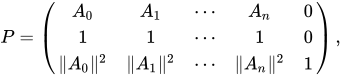
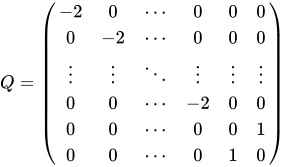
列ベクトルをなれポイント次元ユークリッド空間。 の体積公式から始めて、マトリックス、
行と列を追加してマトリックス、
どこベクトルの長さの二乗です。。さらに、マトリックス
行列式はしたがって、 [ 7 ]
この場合、は三角形の面積であり、これを と表記します。。ケイリー・メンガー行列式によれば、三角形の辺の長さは、 、そして、
3行目の結果はフィボナッチ数列によるものです。最後の行は、3辺の長さが与えられた三角形の面積を求めるヘロンの公式に書き換えることができ、これはアルキメデスが以前から知っていたものです。[ 8 ]
この場合数量は正四面体の体積を表し、それを と表記します。 . 間の距離についてはそしてで示される、ケイリー・メンガー行列式は[ 9 ] [ 10 ]を与える。
非退化-単体、それは外接する半径の球体。それから -単体は、の頂点から構成される -単体と中心 -球は退化している。したがって、
使用、、 そしてこれは、
これはの二次方程式です . 解く、我々は[ 11 ]を得る。
例えば、これは、三角形の辺の長さを用いて、その三角形の外接円半径を表します。
これらの決定要因から、以下の分類も得られます。
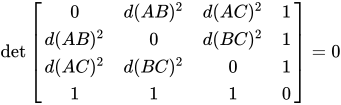
集合Λ (少なくとも 3 つの異なる要素を持つ) は、 Λの任意の3 つの要素A、B、Cに対して、 が成り立つ場合に限りストレート と呼ばれます。[ 12 ]
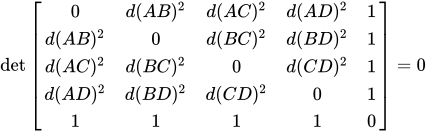
A set Π (with at least four distinct elements) is called plane if and only if, for any four elements A, B, C and D of Π,[12]
but not all triples of elements of Π are straight to each other;
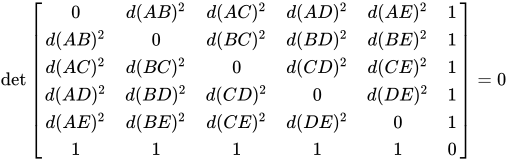
A set Φ (with at least five distinct elements) is called flat if and only if, for any five elements A, B, C, D and E of Φ,[12]
but not all quadruples of elements of Φ are plane to each other; and so on.
Karl Menger made a further discovery after the development of the Cayley–Menger determinant, which became known as Menger's theorem (unrelated to the theorem of that name in graph theory). The theorem states:
In simpler terms, if every subset of points can be isometrically embedded in an -dimensional, but not generally -dimensional Euclidean space, then the semi-metric is Euclidean of dimension unless consists of exactly points and the Cayley–Menger determinant on those points is strictly negative. This type of semi-metric would be classified as pseudo-Euclidean.[1]
Given the Cayley-Menger relations as explained above, the following section will bring forth two algorithms to decide whether a given matrix is a distance matrix corresponding to a Euclidean point set. The first algorithm will do so when given a matrix AND the dimension, , via a geometric constraint solving algorithm. The second algorithm does so when the dimension, , is not provided. This algorithm theoretically finds a realization of the full Euclidean distance matrix in the smallest possible embedding dimension in quadratic time.
For the sake and context of the following theorem, algorithm, and example, slightly different notation will be used than before resulting in an altered formula for the volume of the dimensional simplex below than above.
As stated before, the purpose to this theorem comes from the following algorithm for realizing a Euclidean Distance Matrix or a Gramian Matrix.
- Input
- Euclidean Distance Matrix or Gramian Matrix .
- Output
- Pointset
- Procedure
- If the dimension is fixed, we can solve a system of polynomial equations, one for each inner product entry of , where the variables are the coordinates of each point in the desired dimension .
- Otherwise, we can solve for one point at a time.
- Solve for the coordinates of using its distances to all previously placed points . Thus, is represented by at most coordinate values, ensuring minimum dimension and complexity.
Let each point have coordinates . To place the first three points:
In order to find a realization using the above algorithm, the discriminant of the distance quadratic system must be positive, which is equivalent to having positive volume. In general, the volume of the dimensional simplex formed by the vertices is given by[13]
In this formula above, is the Cayley–Menger determinant. This volume being positive is equivalent to the determinant of the volume matrix being positive.
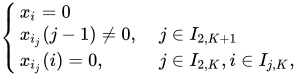
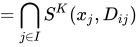
Let K be a positive integer and D be a 1n × n symmetric hollow matrix with nonnegative elements, with n ≥ 2. D is a Euclidean distance matrix with dim(D) = K if and only if there exist and an index set I = such that
where realizes D, where denotes the component of the vector.
The extensive proof of this theorem can be found at the following reference.[14]
Source:[14]
end forreturn K





![{\displaystyle {\begin{aligned}{v_{n}}^{2}&={\frac {1}{(n!)^{2}2^{n}}}{\begin{vmatrix}2d_{01}^{2}&d_{01}^{2}+d_{02}^{2}-d_{12}^{2}&\cdots &d_{01}^{2}+d_{0n}^{2}-d_{1n}^{2}\\d_{01}^{2}+d_{02}^{2}-d_{12}^{2}&2d_{02}^{2}&\cdots &d_{02}^{2}+d_{0n}^{2}-d_{2n}^{2}\\\vdots &\vdots &\ddots &\vdots \\d_{01}^{2}+d_{0n}^{2}-d_{1n}^{2}&d_{02}^{2}+d_{0n}^{2}-d_{2n}^{2}&\cdots &2d_{0n}^{2}\end{vmatrix}}\\[10pt]&={\frac {(-1)^{n+1}}{(n!)^{2}2^{n}}}{\begin{vmatrix}0&d_{01}^{2}&d_{02}^{2}&\cdots &d_{0n}^{2}&1\\d_{01}^{2}&0&d_{12}^{2}&\cdots &d_{1n}^{2}&1\\d_{02}^{2}&d_{12}^{2}&0&\cdots &d_{2n}^{2}&1\\\vdots &\vdots &\vdots &\ddots &\vdots &\vdots \\d_{0n}^{2}&d_{1n}^{2}&d_{2n}^{2}&\cdots &0&1\\1&1&1&\cdots &1&0\end{vmatrix}}.\end{aligned}}}](https://wikimedia.org/api/rest_v1/media/math/render/svg/a0263940b23d2d7370cf04ba366168b0c181cd1a)









![{\displaystyle {\begin{aligned}16A^{2}&={\begin{vmatrix}2a^{2}&a^{2}+b^{2}-c^{2}\\a^{2}+b^{2}-c^{2}&2b^{2}\end{vmatrix}}\\[8pt]&=4a^{2}b^{2}-(a^{2}+b^{2}-c^{2})^{2}\\[6pt]&=(a^{2}+b^{2}+c^{2})^{2}-2(a^{4}+b^{4}+c^{4})\\[6pt]&=(a+b+c)(a+b-c)(a-b+c)(-a+b+c).\end{aligned}}}](https://wikimedia.org/api/rest_v1/media/math/render/svg/757c432ecbe4f6d3bd134f20e90cba3c92ceba25)


![{\displaystyle {\begin{aligned}144V^{2}={}&{\frac {1}{2}}{\begin{vmatrix}2d_{01}^{2}&d_{01}^{2}+d_{02}^{2}-d_{12}^{2}&d_{01}^{2}+d_{03}^{2}-d_{13}^{2}\\d_{01}^{2}+d_{02}^{2}-d_{12}^{2}&2d_{02}^{2}&d_{02}^{2}+d_{03}^{2}-d_{23}^{2}\\d_{01}^{2}+d_{03}^{2}-d_{13}^{2}&d_{02}^{2}+d_{03}^{2}-d_{23}^{2}&2d_{03}^{2}\end{vmatrix}}\\[8pt]={}&4d_{01}^{2}d_{02}^{2}d_{03}^{2}+(d_{01}^{2}+d_{02}^{2}-d_{12}^{2})(d_{01}^{2}+d_{03}^{2}-d_{13}^{2})(d_{02}^{2}+d_{03}^{2}-d_{23}^{2})\\[6pt]&{}-d_{01}^{2}(d_{02}^{2}+d_{03}^{2}-d_{23}^{2})^{2}-d_{02}^{2}(d_{01}^{2}+d_{03}^{2}-d_{13}^{2})^{2}-d_{03}^{2}(d_{01}^{2}+d_{02}^{2}-d_{12}^{2})^{2}.\end{aligned}}}](https://wikimedia.org/api/rest_v1/media/math/render/svg/6630123298d507c70f13225ed5413cd7e0d14abc)