
Loading article…
The Cavendish Laboratory is the Department of Physics at the University of Cambridge, and is part of the School of Physical Sciences. The laboratory was opened in 1874 on the New Museums Site as a laboratory for experimental physics and is named after the British chemist and physicist Henry Cavendish. The laboratory has had a huge influence on research in the disciplines of physics and biology.
The laboratory moved to a new site in West Cambridge in 1974. In 2025 it moved again to the Ray Dolby Centre, still in West Cambridge.
As of 2019, 30 Cavendish researchers have won Nobel Prizes.[2] Notable discoveries to have occurred at the Cavendish Laboratory include the discovery of the electron, neutron, and structure of DNA.


The Cavendish Laboratory was initially located on the New Museums Site, Free School Lane, in the centre of Cambridge. It is named after British chemist and physicist Henry Cavendish[3][4] for contributions to science[5] and his relative William Cavendish, 7th Duke of Devonshire, who served as chancellor of the university and donated funds for the construction of the laboratory.[6]
Professor James Clerk Maxwell, the developer of electromagnetic theory, was a founder of the laboratory and the first Cavendish Professor of Physics.[7] The Duke of Devonshire had given to Maxwell, as head of the laboratory, the manuscripts of Henry Cavendish's unpublished Electrical Works. The editing and publishing of these was Maxwell's main scientific work while he was at the laboratory. Cavendish's work aroused Maxwell's intense admiration and he decided to call the Laboratory (formerly known as the Devonshire Laboratory) the Cavendish Laboratory and thus to commemorate both the Duke and Henry Cavendish.[8][9]
ここでは、 JJトムソンによる電子の発見、ジョン・シーリー・タウンゼントによるタウンゼント放電、 CTRウィルソンによる霧箱の開発など、初期の物理学における重要な発見がいくつかなされた。
アーネスト・ラザフォードは1919年にキャベンディッシュ研究所の所長に就任した。彼の指導の下、 1932年にジェームズ・チャドウィックによって中性子が発見され、同年、彼の指導を受けた学生であるジョン・コッククロフトとアーネスト・ウォルトンによって、原子核を完全に制御された方法で分裂させる最初の実験が行われた。
物理化学科(元々はエリック・ライディールが率いるコロイド科学科)は、旧キャベンディッシュ校舎を離れ、その後、当時新設された化学棟に物理化学科(RG・ノリッシュが率いる)として移転し、レンズフィールド・ロードにあった化学科(トッド卿が率いる)と合流した。両化学科は1980年代に合併した。
第二次世界大戦中、この研究所は原子爆弾の研究を行う英国のチューブ合金プロジェクトの一部であるMAUD委員会の研究を行った。研究者には、ニコラス・ケマー、アラン・ナン・メイ、アンソニー・フレンチ、サミュエル・カラン、そしてルー・コワルスキーやハンス・フォン・ハルバンなどのフランス人科学者がいた。1943年に数名がカナダに移り、モントリオール研究所、そして後にチョークリバー研究所に移った。ウラン238に中性子を照射することによるプルトニウムとネプツニウムの生成は、1940年に独立して活動していた2つのチームによって予測された。キャベンディッシュ研究所のエゴン・ブレッチャーとノーマン・フェザー、そしてカリフォルニア大学バークレー校のバークレー放射線研究所のエドウィン・M・マクミランとフィリップ・アベルソンである。
The Cavendish Laboratory has had an important influence on biology, mainly through the application of X-ray crystallography to the study of structures of biological molecules. Francis Crick already worked in the Medical Research Council Unit, headed by Max Perutz[10][11] and housed in the Cavendish Laboratory, when James Watson came from the United States and they made a breakthrough in discovering the structure of DNA. For their work while in the Cavendish Laboratory, they were jointly awarded the Nobel Prize in Physiology or Medicine in 1962, together with Maurice Wilkins of King's College London, himself a graduate of St. John's College, Cambridge.
The discovery was made on 28 February 1953; the first Watson/Crick paper appeared in Nature on 25 April 1953. Sir Lawrence Bragg, the director of the Cavendish Laboratory, where Watson and Crick worked, gave a talk at Guy's Hospital Medical School in London on Thursday 14 May 1953 which resulted in an article by Ritchie Calder in the News Chronicle of London, on Friday 15 May 1953, entitled "Why You Are You. Nearer Secret of Life." The news reached readers of The New York Times the next day; Victor K. McElheny, in researching his biography, Watson and DNA: Making a Scientific Revolution, found a clipping of a six-paragraph New York Times article written from London and dated 16 May 1953 with the headline "Form of `Life Unit' in Cell Is Scanned." The article ran in an early edition and was then pulled to make space for news deemed more important. (The New York Times subsequently ran a longer article on 12 June 1953). The Cambridge University undergraduate newspaper Varsity also ran its own short article on the discovery on Saturday 30 May 1953. Bragg's original announcement of the discovery at a Solvay Conference on proteins in Belgium on 8 April 1953 went unreported by the British press.
シドニー・ブレナー、ジャック・ダニッツ、ドロシー・ホジキン、レスリー・オーゲル、ベリル・M・オートンは、1953年4月にクリックとワトソンが構築したDNA構造モデルを最初に見た人々の何人かであり、当時彼らはオックスフォード大学の化学科で働いていた。全員が新しいDNAモデルに感銘を受けたが、特にブレナーは、その後ケンブリッジのキャベンディッシュ研究所と新しい分子生物学研究所でクリックと共同研究を行った。故ベリル・オートン博士(後にリマー)によると、ドロシー・ホジキンがDNA構造モデルを見るためにケンブリッジに行くことを告げると、彼らは2台の車で一緒に移動したという。[ 12 ]オーゲルも後にソーク生物学研究所でクリックと共同研究を行った。
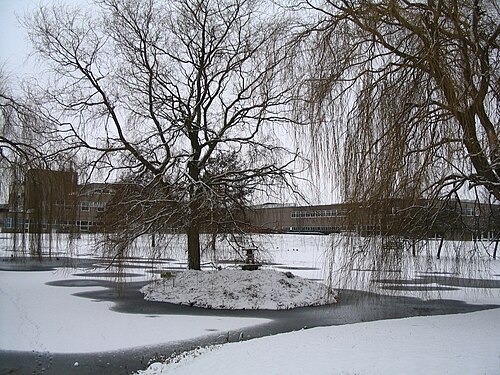


古い建物が過密状態になったため、1970年代初頭にウェストケンブリッジの新しい敷地に移転した。 [ 13 ] 2025年には、近くのレイ・ドルビー・センターという3番目の敷地に移転した。[ 14 ]
キャベンディッシュ教授陣は、ブライアン・ピパード卿の在任期間中は学科長を務めていたが、その期間中に両者の役割は分離された。
†ジャクソン自然哲学教授
当研究所が影響力を行使してきた分野には、以下のようなものがあります。
2023年現在研究所の所長はメテ・アタチュールである。[ 1 ]キャベンディッシュ物理学教授はリチャード・フレンド卿である。[ 22 ]
2015年現在上級教員(教授または准教授)には以下が含まれます:[ 34 ]
キャベンディッシュ研究所には、正式な退職後も研究室で研究を続けている名誉科学者が多数在籍している。[ 34 ]
ノーベル賞受賞者以外にも、キャベンディッシュ大学の卒業生には以下のような人物がいる。
 ウィキメディア・コモンズにあるキャベンディッシュ研究所関連のメディア