
Loading article…
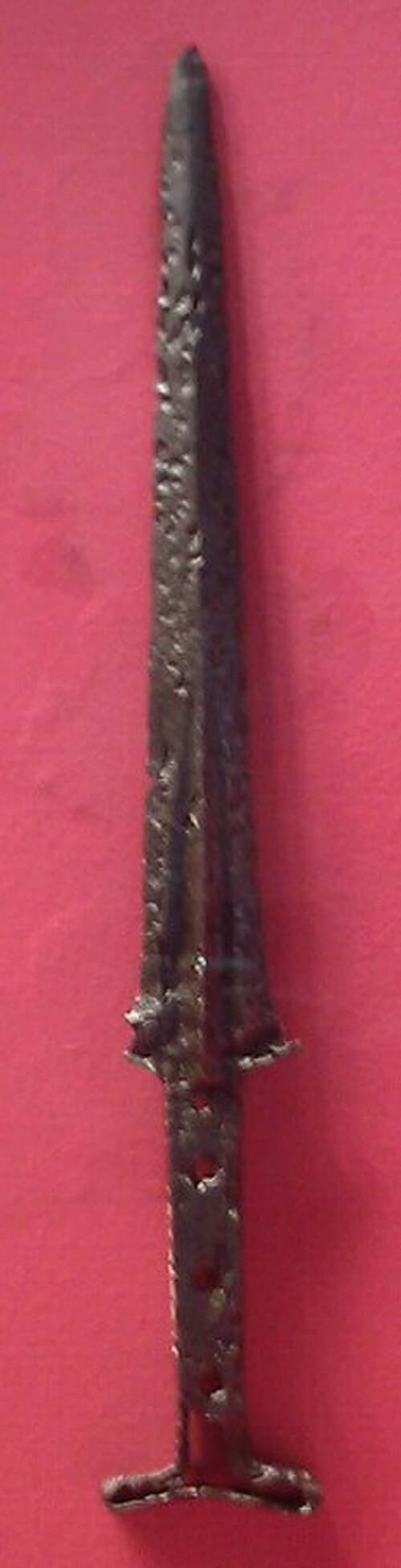

スイスドイツ語でバゼラード(Schwiizerdolch、basilard、baslardとも、中世フランス語ではbadelare 、 bazelaireなどの異形、ラテン語化ではbaselardus、basolardusなど、中高ドイツ語ではbeseler、baseler、basler、pasler、baslermesser )は、中世後期の歴史的な短剣または短剣の一種です。
現代の古物研究家による使用では、 baselardという用語は主に I 字型の柄を持つ 14 世紀の短剣の一種に限定されています。[ 1 ]これは 13 世紀の騎士の短剣から発展したものですが、「誰もが携帯しており、騎士専用の武器ではありませんでした」。[ 2 ]当時の使用法はそれほど限定的ではなく、中期フランス語と中期英語では、この用語はより広い種類の大型短剣に適用できた可能性があります。この用語 (多くの綴りの異形があります) は 14 世紀前半に初めて登場します。baselard という用語は、元々はドイツ語のbasler [messer]「バーゼルナイフ」の中期フランス語または中世ラテン語の訛りであるという証拠があります。[ 3 ] [ 4 ]
「バゼラール」という用語と、H字型の柄を持つ大型短剣、すなわち「本来のバゼラール」は、14世紀半ばまでに登場した。14世紀のフランスからのいくつかの記録では、この用語は「ナイフ」を意味するcoutelと訳されている。[ 5 ]

Depictions of mid-14th-century examples are preserved as part of tomb effigies (figuring as part of the full military dress of the deceased knight). By the mid-14th century, the baselard is a popular sidearm carried by the more violence-prone section of civilian society, and it retains an association with hooliganism. One early attestation of the German form pasler (1341) is from a court document of Nuremberg recording a case against a man who had injured a woman by striking her on the head with this weapon.[6] Several German law codes of the 14th to 15th centuries outlaw the carrying of a basler inside a city.[7] By the late 14th century, it became fashionable in much of Western Europe, including France, Italy, Germany and England. Sloane MS 2593 (c. 1400) records a song satirizing the use of oversized baselard knives as fashion accessories.[8]Piers Plowman also associates the weapon with vain gaudiness: in this case, two priests, "Sir John and Sir Geoffrey", are reported to have been sporting "a girdle of silver, a baselard or a ballok knyf with buttons overgilt."[9]
Wat Tyler was slain with a baselard by the mayor of London, William Walworth, in 1381, and the original weapon was "still preserved with peculiar veneration by the Company of Fishmongers" in the 19th century.[10]
In the Old Swiss Confederacy, the term basler seems to have referred to the 14th- to 15th-century weapons with the characteristic crescent-shaped pommel and crossguard, which occurred with widely variant blade length, and which by the early 16th century had split into the two discrete classes of the short Swiss dagger (Schweizerdolch) and the long Swiss degen (Schweizerdegen), indicating a semantic split between the formerly synonymous terms Dolch and Degen. The baselard was the nation's favoured sidearm, accompanying the halberd as a complementary second weapon that could be used effectively in the press of polearm combat.[11] However, the baselard proper fell out of use by the early 16th century.
「バゼラルド」とその派生語はしばらくの間使われ続けたが、特定の種類のナイフとの関連性は薄れていった。フランス語の「ボードレール」は、湾曲した片刃の彫刻刀を指すようになった。「バジラルダ」は『狂えるオルランド』に登場する剣の名前である。
また英語では、この用語はヤタガンなどのトルコの武器を指すこともある。[ 12 ]
この用語の非常に遅い使用例は、1602年にスコットランドのキャノンビーで行われた決闘の文脈で見られます。決闘で使用された武器に関する合意を記録した文書には、「刃の長さが1ヤード半4分の1の2本のバズラー剣」と記載されています。[ 13 ]
それ以降、この用語の使用は古物研究の文脈に限られるようになった。