
Loading article…
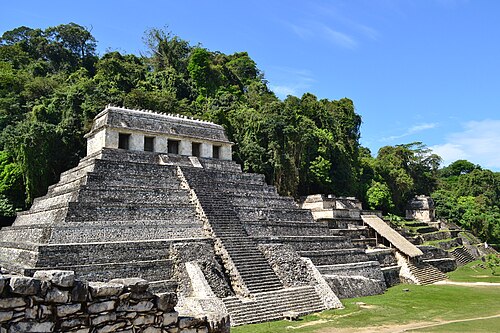
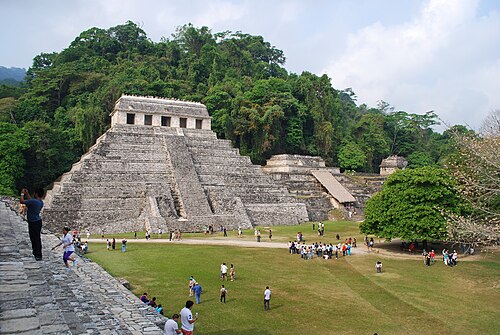
碑文の神殿(古典マヤ語: Bʼolon Yej Teʼ Naah (マヤ語の発音: [ ɓolon jex teʔ naːh ] )「9本の尖った槍の家」[ 1 ] )は、現在のメキシコ、チアパス州にあるコロンブス以前のマヤ文明の遺跡パレンケにある、メソアメリカ最大の階段ピラミッド構造物です。この構造物は、7世紀にパレンケを統治したアハウ(支配者)であるキニチ・ハナアブ・パカル[ 2 ]の葬儀記念碑として特別に建設されました。彼の統治はほぼ70年間続きました。この記念碑の建設は彼の晩年の10年間に始まり、彼の息子で後継者であるキニチ・カン・バフラム2世によって完成されました。[ 3 ]パレンケ内では、碑文の神殿は碑文の神殿の中庭として知られるエリアに位置し、宮殿の南東に対して直角に建っています。[ 4 ]碑文の神殿は、碑文の石板に見られる並外れた象形文字の例、建物の柱にある印象的な彫刻パネル、パカルの墓の内部からの発見により、古代マヤの研究において重要なものとなっています。[ 5 ] [ 6 ]
この建造物は、8段のピラミッド(合計9層)の上に建つ「神殿」構造から成っています。建物の正面にある5つの入口は、彫刻された像と、神殿の名前の由来となったマヤ文字の象形文字が刻まれた柱に囲まれています。神殿内部には、パカル王の石棺が納められた地下室へと続く階段があります。
碑文の神殿は683年の少し後に完成した。建設はパカル自身によって開始されたが、彼の息子であるキニチ・カン・バフラム2世が建物を完成させ、最終的な装飾を施した。[ 7 ]
Despite the fact that Palenque, and the Temple of Inscriptions itself, had been visited and studied for more than two hundred years, the tomb of Pakal was not discovered until 1952. Alberto Ruz Lhuillier, a Mexican archaeologist, removed a stone slab from the floor of the temple, revealing a stairway filled with rubble. Two years later, when the stairway was cleared, it was discovered that it led into Pakal’s tomb.[8]
The temple has six piers, or vertical panels. These are labeled A through F, each with texts, artistic representations, or both executed in reliefs made from plaster stucco. Piers A and F have only hieroglyphic text on them. Piers B through E have images of people holding an infant-like figure, which has a snake as one leg.[9]


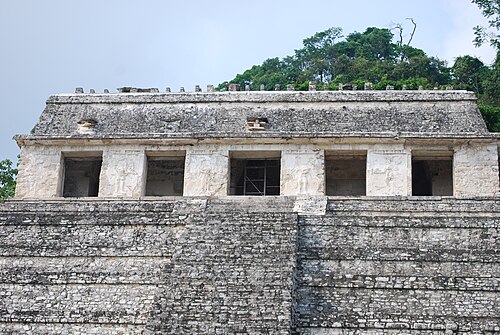
Pier A's decoration consists entirely of hieroglyphic text. However, only eleven glyphs and glyph portions survive to this day. Among these glyphs, “capture” can be clearly seen, but who or what was captured is unknown because the corresponding glyphs are unreadable.
Pier B depicts a scene in which a human figure holds the “child” God K, one of whose legs is a serpent, in his hand.
The human figure is actually life size (165 cm tall), but its position and perspective make it appear much larger. It wears an elaborate feather headdress, a jaguar skin skirt, and a belt. The figure also used to wear a loincloth and a short beaded cape, but due to damage those are largely missing today, as is the head of the figure.
It is thought that the figure held by the human figure is God K, although his characteristic “flared forehead” is only visible on Pier D. The figure of God K, often described as an “infant” or “child,” has one human leg and one serpent-leg. The human leg ends in a six-toed foot that is cradled by the other figure. It is likely, especially considering the emphasis placed on the polydactyly, that this feature is a reference to Pakal’s son, Kan B'alam II, who is portrayed in portraits with six fingers on one hand and six toes on one foot.
The standing figure on Pier C is thought to be a woman, possibly Pakal’s mother, Lady Zac-Kuk. The appearance of the psychoduct (a hollow duct that goes from the outer temple into the tomb of Pakal) and the stone band that connects to it have led many to compare the structure to an umbilical cord. The fact that this “umbilical cord” connects the figure on Pier C to Pakal’s tomb (and by extension, Pakal himself) supports the identification of the figure as Lady Zac-Kuk. The umbilical cord can then be interpreted as a reference to the royal bloodline.
Pier D provides the evidence that the “baby” figure is, in fact, God K. In this depiction of the “baby” figure, it wears an “axe” or “flare” including a mirror (visible below the feathers of the standing figure’s headdress), something characteristic of God K. The figure on this pier is more complete than the same figure on any of the other piers. Also present in the depiction of God K are three vertical cuts on the god’s back. These have been shown to be intentional, but their meaning is still unknown.
The standing figure on Pier E is most likely Kan Bahlam I. The elaborate headdress worn by the figure contains glyphs that identify him as “chan-bahlum.” It is unlikely that this refers to Kan B'alam II because he is thought to be represented by the figure of God K. Because Kan Bʼalam II, great-great-grandson of Kan Bʼalam I, finished the decoration of the Temple of Inscriptions, this can be seen as an effort to reinforce the legitimacy of his claim to the throne; he is emphasizing his relationship to his ancestor and namesake, as well as his relationship to his father and grandmother.
Pier F has only one glyph block that remains today. It contains glyphs for what is thought to be a title, translated as “dead rabbit”, followed by the title and name “Kinich Kan-B'alam,” after which comes an unknown glyph (possibly another title), and the glyph for Palenque.
Although much of the color on the piers has deteriorated, some is still visible today. Originally, the piers would have been extraordinarily colorful. Bright red, yellow, and blue would have been seen on their stucco sculpture. A thin coat of light red paint would have been applied to all of the stucco sculpture as a sort of background coloring while the stucco was still wet, binding the color to the building. Because the temple was repeatedly repainted, one can observe layers of pigment between layers of stucco. The color blue signified the Heavens and the Gods and would have been applied to things relating to the gods, as well as the glyphic texts on the sculpture. The color yellow related to Xibalba, the Maya underworld, which was associated with jaguars, so the jaguar skirts were colored accordingly.
碑文の神殿は、神殿の内壁にある東の石板、中央の石板、西の石板と呼ばれる3枚のヒエログリフの石板にちなんで名付けられました。これらの石板は、過去に起こった出来事が同じ暦日に繰り返されるという考えを強調しており、これはチラム・バラムの書にも見られるテーマで、既知のマヤ碑文の中で最も長いものの1つ(617文字)を構成しています。E列からF列は、パカルの生涯におけるさまざまな出来事の記録の始まりを示しており、石板の最後の2列で彼の死が告げられ、カン・バラム2世が後継者として指名されるまで続きます。最後の2列を除くすべての石板は、パカルの生前に完成しました。[ 10 ]
ピラミッドの途方もない重さによる墓の崩壊を防ぐため、建築家たちは交差ヴォールトと凹んだ控え壁を用いて小屋型の部屋を設計した。[ 11 ]
パカル王の墓からは、数々の重要な考古学的発見物や美術品が発掘された。
これらの発見物の中には、パカルの石棺の蓋があった。蓋を覆う絵には、パカルが「地の怪物」の上に横たわっている様子が描かれている。彼の下には、シバルバを象徴するジャガーの開いた顎がある。彼の上には、宇宙樹(十字架で表される)の上に止まっている天上の鳥がおり、その枝には蛇がぶら下がっている。このように、この絵の中でパカルは天界と冥界という二つの世界の間に横たわっている。また、石棺には、6世代に遡るパカルの祖先が並んでいる。[ 12 ]マール・グリーン・ロバートソンは、石棺の蓋を撮影した唯一の人物である。彼女は撮影のために天井から吊り下げられた。その後、墓は再び封印され、それ以来開けられていない。


パカル王のデスマスクは、この墓から発見されたもう一つの驚くべき遺物である。マスクの顔はすべて翡翠でできており、目は貝殻、真珠貝、黒曜石で構成されている。
パカル王の石棺の中には、いくつかの小さな翡翠の頭部が詰め込まれており、その底部からは王の漆喰肖像画が発見された。


地下室の入り口で、男性と女性の5体の骸骨が発見された。これらの生贄は、パカル王に続いてシバルバに入る予定だった。[ 13 ]
桟橋に関するすべての情報は、Robertson 1983: 29-53 から引用した。
北緯17度29分01秒、西経92度02分48秒/北緯17.4836度、西経92.0468度/北緯17.4836度、西経92.0468度