
Loading article…
2014年4月29日火曜日、月の降交点で金環日食が発生しました[ 1 ] [ 2 ] 。食分は0.9868でした。日食は、月が地球と太陽の間を通過する際に、地球上の観測者から見て太陽の像が完全に、または部分的に隠されるときに発生します。金環日食は、月の見かけの直径が太陽の見かけの直径よりも小さい場合に発生し、太陽の光の大部分を遮り、太陽が環状(リング)のように見えるようになります。金環日食は、地球上の数千キロメートルに及ぶ領域で部分日食として現れます。月の見かけの直径は、近地点から6.2日後( 2014年4月23日1時20分UTC)、遠地点から7.2日前(2014年5月6日11時20分UTC)であったため、平均直径に近かった。[ 3 ]
この日食のガンマ値は、紀元前2000年から紀元後3000年までの他のどの日食よりも1に近かった。これは、月の影の中心が地球の表面とほぼ完全に一致し、南極大陸をわずか数キロメートルの差でかすめたことを意味するが、南極のごく一部からは金環日食が見られ、南極とオーストラリアの一部からは部分日食が見られた。
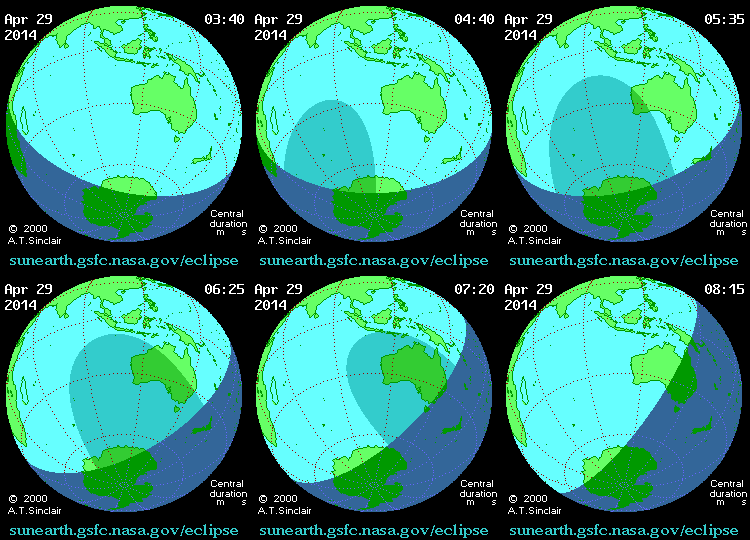 日食経路のアニメーション


以下に、この特定の皆既日食に関する詳細を示す 2 つの表を示します。最初の表は、月の半影または本影が特定のパラメータに達する時刻を示し、2 番目の表はこの日食に関連するその他のさまざまなパラメータについて説明します。[ 4 ]
この日食は日食シーズンの一部です。日食シーズンとは、およそ6か月ごとに日食が発生する期間のことです。日食シーズンは1年に2回(まれに3回)しか発生せず、各シーズンは約35日間続き、6か月弱(173日)後に繰り返されます。したがって、毎年必ず2回の完全な日食シーズンが発生します。各日食シーズンには2回または3回の日食が発生します。以下のシーケンスでは、各日食は2週間間隔で発生しています。
この日食は、セメスター系列の1つです。セメスター系列の日食は、月の軌道の交代交点で約177日4時間(1セメスター)ごとに繰り返されます。 [ 5 ]
This eclipse is a part of Saros series 148, repeating every 18 years, 11 days, and containing 75 events. The series started with a partial solar eclipse on September 21, 1653. It contains annular eclipses on April 29, 2014 and May 9, 2032; a hybrid eclipse on May 20, 2050; and total eclipses from May 31, 2068 through August 3, 2771. The series ends at member 75 as a partial eclipse on December 12, 2987. Its eclipses are tabulated in three columns; every third eclipse in the same column is one exeligmos apart, so they all cast shadows over approximately the same parts of the Earth.
The longest duration of annularity will be produced by member 22 at 22 seconds (by default) on May 9, 2032, and the longest duration of totality will be produced by member 54 at 5 minutes, 23 seconds on April 26, 2609. All eclipses in this series occur at the Moon’s descending node of orbit.[6]
The metonic series repeats eclipses every 19 years (6939.69 days), lasting about 5 cycles. Eclipses occur in nearly the same calendar date. In addition, the octon subseries repeats 1/5 of that or every 3.8 years (1387.94 days). All eclipses in this table occur at the Moon's descending node.
This eclipse is a part of a tritos cycle, repeating at alternating nodes every 135 synodic months (≈ 3986.63 days, or 11 years minus 1 month). Their appearance and longitude are irregular due to a lack of synchronization with the anomalistic month (period of perigee), but groupings of 3 tritos cycles (≈ 33 years minus 3 months) come close (≈ 434.044 anomalistic months), so eclipses are similar in these groupings.
2188年12月18日(サロス周期164の一部)と2199年11月18日(サロス周期165の一部)の部分日食もこのシリーズの一部ですが、以下の表には含まれていません。
この日食は、交代交点で358朔望月(約10,571.95日、または29年マイナス20日)ごとに繰り返される、長周期のイネックス周期の一部です。近点月(近地点周期)との同期が取れていないため、日食の出現と経度は不規則です。しかし、3つのイネックス周期(約87年マイナス2ヶ月)のグループ分けは、これに近い値(約1,151.02近点月)となるため、これらのグループ分けでは日食は類似しています。