
Loading article…

同期位置保持エンゲージおよび再方向付け実験衛星(SPHERES)は、 MITの宇宙システム研究所がNASAと米軍向けに開発した一連の小型衛星であり、地球惑星探査機や軌道エクスプレスなどの分散型宇宙機アーキテクチャを使用する将来の宇宙ミッションに不可欠な計測、編隊飛行、ランデブー、ドッキング、および自律アルゴリズムの開発のための低リスクで拡張可能なテストベッドとして使用されます。[ 1 ]
各 SPHERES 衛星は 18 面体の多面体で、質量は約 4.1 kg、直径は約 21 cm です。国際宇宙ステーションや地上の実験室で 使用できますが、宇宙の真空中では使用できません。バッテリー駆動の自己完結型ユニットは、CO 2ベースの冷ガススラスタを使用して移動し、一連の超音波ビーコンを使用して方向を定めることで、半自律的に動作できます。衛星は、互いに、また制御ステーションと無線で通信できます。衛星の内蔵機能は、拡張ポートを使用して拡張できます。[ 2 ]
2006年から、国際宇宙ステーションでは3つのSPHERESユニットがさまざまな実験に使用されています。SPHERESゲストサイエンティストプログラムでは、科学者がSPHERESユニットを使用して新しい科学実験を実施することができ、ゼロロボティクスプログラムでは、学生がSPHERESユニットを制御するソフトウェアの開発を含む年次コンテストに参加することができます。[ 3 ]
SPHERESプログラムは2017年まで、そしておそらくそれ以降も継続される予定です。[ 3 ]

SPHERES の初期開発は、1999 年にマサチューセッツ工科大学の学生チームによって、航空宇宙工学プログラムの一環として開始されました。衛星のコンセプトは、デビッド・ミラー教授が学生たちに、1977 年の映画「スター・ウォーズ エピソード IV: 新たなる希望」や、より最近では「スター・ウォーズ エピソード II: クローンの攻撃」に登場する戦闘訓練用リモートに似た装置を開発するように課題を与えたことから生まれました。プログラムの過程でいくつかのプロトタイプが開発され、地上の研究所や、NASA の低重力航空機を使用した放物線飛行でテストされました。[ 5 ]
初期開発後、SPHERESプログラムはMITの宇宙システム研究所に引き継がれた。オーロラ・フライト・サイエンスとの協力により設計が改良され、飛行準備が整った衛星が6基製造され、そのうち3基が国際宇宙ステーションに届けられた。[ 5 ]
SPHERESプロジェクトは主に国防高等研究計画局(DARPA)によって資金提供されている。[ 2 ]
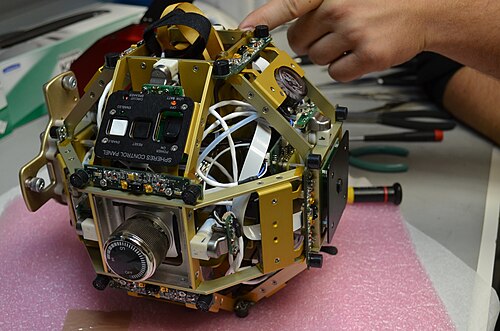
各 SPHERES 衛星は、立方八面体に似た18 面体の多面体のような形をしています。衛星のアルミニウム構造は、半透明のプラスチック製の外殻で覆われています。外殻は、識別しやすいように、赤、青、オレンジ、または黒色です。国際宇宙ステーションにある 3 つの衛星は、赤、青、オレンジです。各ユニットの最大直径は 22.9 cm で、消耗品を含めた質量は 4.16 kg です。[ 5 ] [ 6 ]
167 MHzで動作するテキサス インスツルメンツ C6701 DSPが オンボードコンピュータとして機能します。飛行ソフトウェアと実験関連の命令はC言語で記述されています。[ 1 ]
衛星同士は916.5 MHz、16 kbit/sの無線リンクを使用して通信できます。制御ステーション(ラップトップコンピュータ)との通信は、868.35 MHz、16 kbit/sの無線リンクを使用して行われます。[ 6 ] SPHERES衛星は、より高いデータ帯域幅を必要とするタスクのために、国際宇宙ステーションのオンボードWi-Fiネットワークに接続できます。[ 2 ]
SPHERES satellites determine their position and attitude by using 23 on-board ultrasonic receivers (Murata MA40S4R) and 5 external ultrasonic reference beacons. The ultrasonic time-of-flight measurements from the external beacons to the on-board receivers are used to calculate the satellite's position with respect to the external reference frame.[1]
For rapid determination of position, the ultrasonic time-of-flight information is supplemented with the data from on-board accelerometers (3x Honeywell QA-750 single-axis accelerometers) and gyroscopes (3x Systron Donner QRS14 single-axis rate gyroscopes).[1]
SPHERES satellites are powered using two non-rechargeable 12v battery packs. Each battery pack consists of eight 1.5v AA battery cells that are spot-welded in series.[2]
The satellites are able to translate in the micro-gravity environment with 6 degrees-of-freedom, using twelve cold-gas thrusters that use liquid CO2 as propellant. The liquid CO2 are stored in a small on-board container, similar to those that are used in paintball guns. The CO2 is converted to a gaseous state before being ejected through the thrusters for propulsion. Desired thrust is achieved through pulse modulation of thrust solenoids.[1]
The maximum linear acceleration of the satellites is 0.17m/s2, with an accuracy of 0.5 cm. The maximum angular acceleration is 3.5 rad/s2, with an accuracy of 2.5 degrees.[7]
SPHERES program utilizes supporting facilities located at NASA's Ames Research Centre.

The 3 DoF laboratory facilitates simultaneous testing of up to three SPHERES satellites on a flat, nearly friction-less granite surface. The satellites are mounted on air carriages – stands that eject a stream of CO2 to create a cushion of air – allowing the units to translate on X and Y axis, and rotate on Z axis.[8]
The MicroGravity Test Facility (MGTF) facilitates testing of a single mobile SPHERES satellite, using six degrees-of-freedom. In this, the unit is held by a gimbal with 3 DoF, which is suspended from a translation crane with 3 DoF. The laboratory is able to provide a navigational reference frame in a similar configuration as in the International Space Station using five ultrasonic beacons, and the output of cold gas thrusters are analysed to simulate the expected movement in a micro-gravity environment.[8][9]
The Flight Assembly Laboratory is used to prepare and test consumables – battery packs and liquid CO2 containers – used by the SPHERES units.
Individual cells of the battery packs are tested, spot-welded in series and tested again as a pack. The battery packs are discarded after use.
Spent CO2 containers are returned to the Flight Assembly Laboratory for re-filling and safety testing before being flown back to the International Space Station.[8]
The delivery of SPHERES satellites to the International Space Station were originally planned for 2003. However, due to the loss of Space Shuttle Columbia in February 2003, the delivery did not take place until 2006.[1]
The first SPHERES unit was delivered to ISS by the unmanned resupply mission Progress M-56 (ISS-21P) during April 2006. The second unit was delivered by the Space Shuttle mission STS-121 in July 2006. The final unit was delivered by the Space Shuttle mission STS-116 in December 2006.[10]
The SPHERES experiment aboard the International Space Station commenced on 18 May 2006.[5]
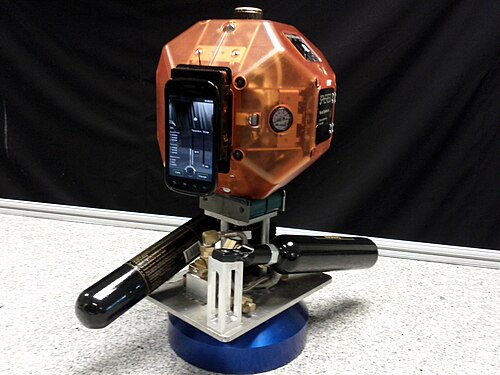
SmartSPHERES experiment equipped the three SPHERES satellite aboard the International Space Station with Nexus Ssmartphones that were delivered via the Space Shuttle mission STS-135. Each satellite was enhanced through the use of processing power, wireless networking, camera, sensors and the touch sensitive display of the connected smartphone. The availability of the Android operating system's source code enabled the devices to be used as a compact, low-cost, low-power computers.[11][12]
この実験では、宇宙ステーション内で自律的かつ遠隔操作による環境調査や在庫調査を実施するためにSPHERES衛星を使用する方法を研究し、宇宙飛行士が日常業務に費やす時間を削減することを目指しています。得られた知識は、船外活動を実行したり、宇宙飛行士の業務を支援したりできる将来の宇宙船の開発にも役立ちます。[ 11 ]
SmartSPHERES実験は、NASAの探査システムミッション局のイネーブリングテクノロジー開発および実証プログラムからの資金提供を受けて、エイムズ研究センターのインテリジェントロボティクスグループによって管理されています。 [ 11 ]

SPHERES-VERTIGO(SPHERES-Visual Estimation and Relative Tracking for Inspection of Generic Objects)実験は、コンピュータビジョンを使用して協調的または非協調的なオブジェクトの3次元マップを生成し、生成されたマップのみを参照してそのようなオブジェクトに対してナビゲートできるソフトウェアとハードウェアを開発することを目的としています。[ 13 ]
実験の一環として、新しい同時自己位置推定および地図作成(SLAM)アルゴリズムが開発され、テストされた。[ 13 ]
SPHERES-VERTIGO実験を容易にするため、ISSに搭載されている各SPHERES衛星には、拡張ポートを使用してSPHERESに接続されるアドオン「ゴーグル」と呼ばれる装置が装備されており、ステレオカメラ、超音波センサー、シングルボードコンピュータ、高速通信機能、バッテリーが搭載されている。[ 13 ]
開発された技術は、小惑星のマッピング、回転する衛星の検査、宇宙デブリの軌道離脱などを行うために、単独またはグループで運用できる将来の自律型宇宙機に使用される予定です。[ 13 ]
この実験は、 DARPAが資金提供するSPHERES統合研究実験(InSPIRE)プログラムの一部である。[ 13 ]
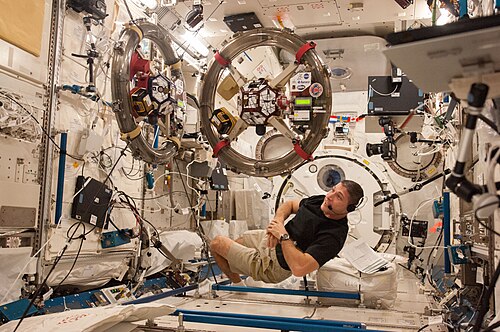
DOD SPHERES-RINGS(国防総省SPHERES共振誘導近接場生成システム)実験は、微小重力環境下での電磁編隊飛行(EMFF)および無線電力伝送が可能なソフトウェアとハードウェアの開発を目的としている。[ 14 ]
この実験では、SPHERES衛星に接続された2つのハードウェアアセンブリを使用しており、アルミニウム共振コイル、ファン付きコイルハウジング、電子機器、バッテリーで構成されています。[ 14 ]
Individual SPHERES units are maneuvered with respect to each other by generating controlled attractive, repulsive and shear forces using the electromagnetic coils. The same coils are used to wirelessly transfer power between SPHERES satellites through resonant inductive coupling. Software algorithms that avoid collision between satellites are also developed as part of the experiment.[14]
Knowledge gained through the experiment will help the development of propellant-free, plume-free clustered space vehicles, increase their operating lifetime, reduce spacecraft mass and associated operating risks.[14]
Article: SPHERES-Slosh
An expansion to the SPHERES satellites that forms a ring (halo) around the satellite to provide six expansion port attachment sites. Two were flown to the ISS.
Docking mechanism that enables two SPHERES satellites to attach rigidly together. Six were flown to the ISS.
Zero Robotics is an annual international programming competition conducted by the Massachusetts Institute of Technology (MIT), in partnership with NASA and other organizations. Student teams program robotic platforms to solve a specific challenge involving navigation and control in microgravity environments aboard the International Space Station (ISS).
Initially, the competition used the SPHERES (Synchronized Position Hold Engage and Reorient Experimental Satellites) robotic platforms—free-flying robots used inside the ISS for research on satellite formation flying and control algorithms. Although referred to as "satellites," SPHERES were not orbiting the Earth independently but operated exclusively within the microgravity environment of the ISS.[15]
In recent years, the competition transitioned to using Astrobee robots, a newer generation of free-flying robotic assistants developed by NASA for autonomous operation on the ISS. (This change began around 2022, following the retirement of SPHERES in 2019). The Astrobee system provides enhanced capabilities including vision-based navigation and more advanced computing power.[16][17]
The competition is held in two tiers: the middle school tournament and the high school tournament. Initial rounds take place in simulation, and the finalists' programs are uploaded to the robotic platforms aboard the ISS and executed in real time. The final event is broadcast live to audiences in the United States, Europe, and Australia.[18]