Loading article…
In mathematics and computer science, the probabilistic automaton (PA) is a generalization of the nondeterministic finite automaton; it includes the probability of a given transition into the transition function, turning it into a transition matrix.[1][2] Thus, the probabilistic automaton also generalizes the concepts of a Markov chain and of a subshift of finite type. The languages recognized by probabilistic automata are called stochastic languages; these include the regular languages as a subset. The number of stochastic languages is uncountable.
The concept was introduced by Michael O. Rabin in 1963;[2] a certain special case is sometimes known as the Rabin automaton (not to be confused with the subclass of ω-automata also referred to as Rabin automata). In recent years, a variant has been formulated in terms of quantum probabilities, the quantum finite automaton.
For a given initial state and input character, a deterministic finite automaton (DFA) has exactly one next state, and a nondeterministic finite automaton (NFA) has a set of next states. A probabilistic automaton (PA) instead has a weighted set (or vector) of next states, where the weights must sum to 1 and therefore can be interpreted as probabilities (making it a stochastic vector). The notions states and acceptance must also be modified to reflect the introduction of these weights. The state of the machine as a given step must now also be represented by a stochastic vector of states, and a state accepted if its total probability of being in an acceptance state exceeds some cut-off.
A PA is in some sense a half-way step from deterministic to non-deterministic, as it allows a set of next states but with restrictions on their weights. However, this is somewhat misleading, as the PA utilizes the notion of the real numbers to define the weights, which is absent in the definition of both DFAs and NFAs. This additional freedom enables them to decide languages that are not regular, such as the p-adic languages with irrational parameters. As such, PAs are more powerful than both DFAs and NFAs (which are equally powerful).
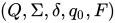
The probabilistic automaton may be defined as an extension of a nondeterministic finite automaton, together with two probabilities: the probability 特定の状態遷移が発生し、初期状態が特定の初期状態にあるオートマトンが存在する確率を示す確率ベクトルに置き換えられる。
通常の非決定性有限オートマトンでは、次のようになる。
ここ、の冪集合を表す。
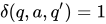
カリー化を用いることで、遷移関数非決定性有限オートマトンの特性はメンバーシップ関数として記述できる。
となることによってもしそしてそれ以外の場合。カリー化された遷移関数は、行列要素を持つ行列として理解できます。
マトリックスこれは正方行列であり、その要素はゼロまたはイチで、遷移が起こったかどうかを示します。これはNFAによって許可されています。このような遷移行列は、非決定性有限オートマトンに対して常に定義されます。
確率オートマトンでは、これらの行列を右確率行列の族に置き換える。アルファベットの各記号 a について遷移の確率は次のように与えられる。
ある状態から任意の状態への状態変化は、当然ながら確率1で発生しなければならず、したがって、
すべての入力文字に対しておよび内部状態確率オートマトンの初期状態は行ベクトルで与えられる。その構成要素は、個々の初期状態の確率である。合計が1になるもの:
遷移行列は右側に作用し、入力文字列を消費した後の確率オートマトンの状態は、
特に、確率オートマトンの状態は常に確率ベクトルです。なぜなら、任意の2つの確率行列の積は確率行列であり、確率ベクトルと確率行列の積もまた確率ベクトルとなるからです。このベクトルは、離散確率分布であることを強調するために、「状態の分布」と呼ばれることもあります。
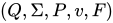
形式的には、確率オートマトンの定義には非決定性オートマトンの動作原理は必要なく、省略してもよい。形式的には、確率オートマトンPAはタプルとして定義される。ラビンオートマトンとは、初期分布がは座標ベクトルです。つまり、1つの要素を除いてすべてゼロであり、残りの1つの要素は1です。
確率オートマトンによって認識される言語の集合は、確率言語と呼ばれます。これには、正規言語が部分集合として含まれます。
させては、オートマトンにおける「受理」状態または「最終」状態の集合である。表記の濫用により、また、メンバーシップ関数である列ベクトルと理解することもできます。つまり、要素に対応する場所に 1 があります。 、それ以外の場合はゼロ。このベクトルは内部状態確率と縮約してスカラーを形成することができる。特定のオートマトンによって認識される言語は次のように定義される。
どこはアルファベットのすべての文字列の集合です(つまり、*はクリーネ星である)。言語はカットポイントの値に依存する。通常は範囲内とみなされる。
ある言語がη確率的であるとは、固定された に対して、その言語を認識する何らかの PA が存在する場合に限る。言語が確率的であるのは、次のような場合のみである 。そのためにη確率的である。
切断点が孤立切断点であるのは、そのため
すべての人々のために
すべての正規言語は確率的であり、さらに強く言えば、すべての正規言語は η-確率的である。弱い逆は、すべての0-確率的言語は正規言語であるということである。しかし、一般的な逆は成り立たない。つまり、正規言語ではない確率的言語が存在する。
すべてのη-確率的言語は、ある条件を満たす確率的である。。
すべての確率的言語は、ラビンオートマトンによって表現可能である。
もし孤立したカットポイントである場合、正規言語です。
p進言語は、正規言語ではない確率言語の例を示し、確率言語の数が非可算であることも示しています。p進言語は、文字列の集合として定義されます。
手紙の中で。
つまり、p進言語とは、[0, 1] の実数をp基数で表した集合であり、以下の値以上である。すべてのp進言語が確率的であることを示すのは簡単である。 [ 3 ]特に、これは確率的言語の数が非可算であることを意味する。p進言語が正則であるのは、次の場合に限る。合理的である。
確率オートマトンには幾何学的な解釈があります。状態ベクトルは、標準単体の面上の直交角の反対側に位置する点として理解できます。遷移行列は、その点に作用するモノイドを形成します。これは、点が何らかの一般的な位相空間に属し、遷移行列がその位相空間に作用する演算子の集合から選択されることで、半オートマトンを形成するように一般化できます。カットポイントが適切に一般化されると、位相オートマトンが得られます。
このような一般化の一例として、量子有限オートマトンが挙げられます。ここでは、オートマトンの状態は複素射影空間内の点によって表され、遷移行列はユニタリ群から選択された固定集合です。カットポイントは、量子角の最大値の制限として理解されます。








![{\displaystyle \left[\theta _{a}\right]_{qq^{\prime }}=\delta (q,a,q^{\prime })}](https://wikimedia.org/api/rest_v1/media/math/render/svg/e515ab611f54af77fea707d90d6dcb3b7e234b97)


![{\displaystyle \left[P_{a}\right]_{qq^{\prime }}}](https://wikimedia.org/api/rest_v1/media/math/render/svg/a56185fabd0431b41a3718a9becccf0975a1abd1)
![\displaystyle \sum _{q^{\prime }}\left[P_{a}\right]_{qq^{\prime }}=1}](https://wikimedia.org/api/rest_v1/media/math/render/svg/e7dfda6297ba540cb5afa625e9de538ad6a7ad5e)


![{\displaystyle \sum _{q}\left[v\right]_{q}=1}](https://wikimedia.org/api/rest_v1/media/math/render/svg/0f5fd6232a03788f8dd63fbd06f6bc02218b4437)