その後、ピンチに関する実験的および理論的な進歩は、核融合発電の研究によって推進された。MG Hainesらは、「ワイヤーアレイ Z ピンチ: ICF用の強力な X 線源」に関する記事の中で、「Z ピンチの初期の歴史」について書いている。[ 43 ]
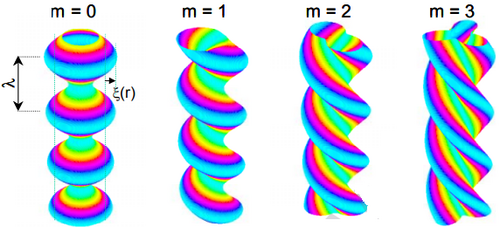
In 1946 Thompson and Blackman submitted a patent for a fusion reactor based on a toroidal Z-pinch[44] with an additional vertical magnetic field. But in 1954 Kruskal and Schwarzschild[45] published their theory of MHD instabilities in a Z-pinch. In 1956, Kurchatov gave his famous Harwell lecture showing nonthermal neutrons and the presence of m = 0 and m = 1 instabilities in a deuterium pinch.[46] In 1957 Pease[47] and Braginskii[48][49] independently predicted radiative collapse in a Z-pinch under pressure balance when in hydrogen the current exceeds 1.4 MA. (The viscous rather than resistive dissipation of magnetic energy discussed above and in[50] would however prevent radiative collapse).
In 1958, the world's first controlled thermonuclear fusion experiment was accomplished using a theta-pinch machine named Scylla I at the Los Alamos National Laboratory. A cylinder full of deuterium was converted into a plasma and compressed to 15 million degrees Celsius under a theta-pinch effect.[7] Lastly, at Imperial College in 1960, led by R Latham, the Plateau–Rayleigh instability was shown, and its growth rate measured in a dynamic Z-pinch.[51]
Equilibrium analysis
One dimension
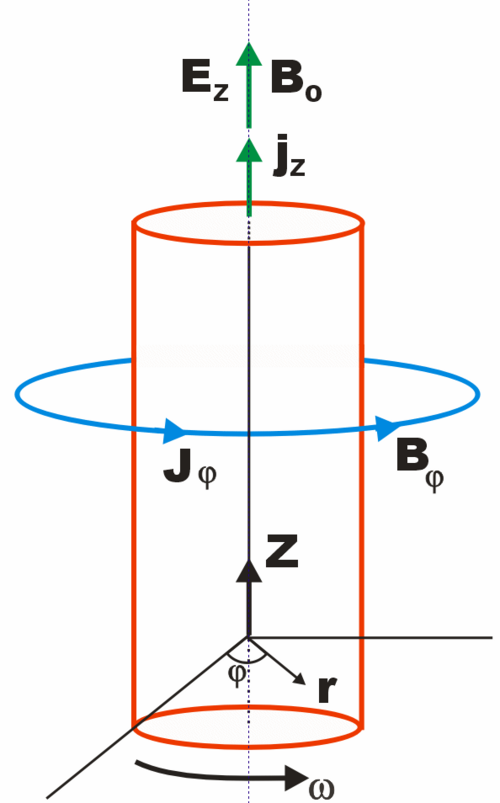
In plasma physics three pinch geometries are commonly studied: the θ-pinch, the Z-pinch, and the screw pinch. These are cylindrically shaped. The cylinder is symmetric in the axial (z) direction and the azimuthal (θ) directions. The one-dimensional pinches are named for the direction the current travels.
The θ-pinch
A sketch of the θ-pinch equilibrium. The z-directed magnetic field corresponds to a θ-directed plasma current.
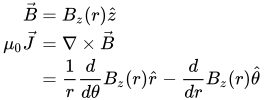
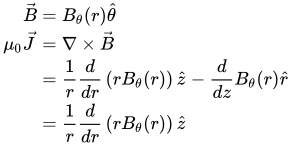
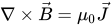
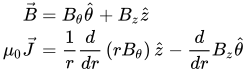
The θ-pinch has a magnetic field directed in the z direction and a large diamagnetic current directed in the θ direction. Using Ampère's circuital law (discarding the displacement term)
Since B is only a function of r we can simplify this to
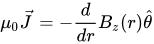
So J points in the θ direction.
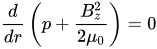
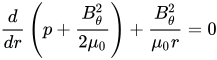
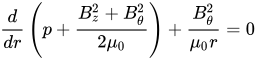
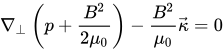
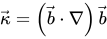
Thus, the equilibrium condition () for the θ-pinch reads:
θ-pinches tend to be resistant to plasma instabilities; This is due in part to Alfvén's theorem (also known as the frozen-in flux theorem).
カールクヴィストの関係は、ベネットピンチにおける全電流 ( I ) と単位長さあたりの粒子数 ( N ) の関係として図示できます (右図参照)。この図は、物理的に異なる 4 つの領域を示しています。プラズマ温度は非常に低く ( T i = T e = T n = 20 K)、主に水素を含み、平均粒子質量は 3×10 −27 kg です。熱運動エネルギーW k >> πa 2 p k (a)。曲線 ΔW Bz は、軸方向磁場 B zによる単位長さあたりの過剰磁気エネルギーの異なる量を示しています。プラズマは非回転であると仮定され、端部での運動圧力は内部よりもはるかに小さいです。
図の領域: (a) 左上の領域では、挟み込み力が支配的です。(b) 下に向かうにつれて、外向きの運動圧力と内向きの磁気圧力が釣り合い、全体の圧力は一定になります。(c) 垂直線 Δ W B z = 0 の右側では、磁気圧力が重力圧力と釣り合い、挟み込み力は無視できます。(d) 傾斜曲線 Δ W B z = 0の左側では、重力は無視できます。この図はカールクヴィスト関係の特殊なケースを示しており、より一般的なベネット関係に置き換えると、図の指定された領域は有効ではなくなることに注意してください。
1 2 Pollock JA および Barraclough S (1905) Proc. R. Soc. New South Wales 39 131
↑ Buneman, O. (1961). "The Bennett Pinch". In Drummond, James E. (ed.). Plasma Physics . New York: McGraw-Hill. p. 202. Bibcode : 1961plph.conf..202B .LOC 60-12766。
↑ Lee, S. (1983). "エネルギーバランスと電磁的にピンチされたプラズマ柱の半径". Plasma Physics . 25 (5): 571–576 . Bibcode : 1983PlPh...25..571L . doi : 10.1088/0032-1028/25/5/009 .
↑ Schmidt, Helmut (1966). "InSbにおける磁気ピンチの形成とピンチにおける反転分布の可能性". Physical Review . 149 (2): 564–573 . Bibcode : 1966PhRv..149..564S . doi : 10.1103/physrev.149.564 .
↑ Zueva, NM; Solov'ev, LS; Morozov, AI (1976). "プラズマピンチの非線形不安定性". Journal of Experimental and Theoretical Physics Letters . 23 : 256. Bibcode : 1976JETPL..23..256Z .
1 2 Phillips, James (1983 年冬)「磁気核融合」Los Alamos Science pp. 64–67 .
↑ Rai, J.; Singh, AK; Saha, S. K (1973). "雷の帰還ストロークチャネル内の磁場". Indian Journal of Radio and Space Physics . 2 : 240– 242. Bibcode : 1973IJRSP...2..240R .
↑ Srivastava, KM; Waelbroeck, F. (1976). "On the stability of the screw pinch in the CGL model". Journal of Plasma Physics . 16 (3): 261. Bibcode : 1976JPlPh..16..261S . doi : 10.1017/s0022377800020201 . S2CID 123689314 .
↑ Anderson , OA; Furth, HP; Stone, JM; Wright, RE (1958年11月)。「逆ピンチ効果」。Physics of Fluids。1 ( 6): 489–494。Bibcode : 1958PhFl....1..489A。doi : 10.1063 /1.1724372。
↑ Helander, P.; Akers, RJ; Valovič, M. (2005年11月3日). 「非誘導電流駆動がトカマク輸送に及ぼす影響」. Plasma Physics and Controlled Fusion . 47 (12B): B151– B163. Bibcode : 2005PPCF...47B.151H . doi : 10.1088/0741-3335/47/12b/s12 . S2CID 121961613 .
↑西川和也、若谷正樹 (2000年1月24日)。プラズマ物理学:第3版。Springer Science & Business Media。ISBN978-3-540-65285-4。
↑ Slutz, Stephen; Vesey, Roger A. (2012). "高利得磁化慣性核融合" . Physical Review Letters . 108 (2) 025003. Bibcode : 2012PhRvL.108b5003S . doi : 10.1103/PhysRevLett.108.025003 . PMID 22324693 .
↑ Peratt, AL、「ピンチされた粒子ビームからのシンクロトロン放射」、(1998) Plasma Physics: VII Lawpp 97: Proceedings of the 1997 Latin American Workshop on Plasma Physics、Pablo Martin、Julio Puerta、Pablo Martmn 編、Meierovich, BE、「電磁崩壊。安定性、放射放出、高密度ピンチの進化の問題」(1984) Physics Reports、第 104 巻、第 5 号、p. 259-346 を参照。
↑ Anderson, Oscar A.; et al. (1958). "線状重水素ピンチにおける中性子生成" . Physical Review . 110 (6): 1375– 1387. Bibcode : 1958PhRv..110.1375A . doi : 10.1103/physrev.110.1375 .
↑ Ryutov, DD; Derzon, MS; Matzen, M. K (2000). "The physics of fast Z pinches" . Reviews of Modern Physics . 72 (1): 167– 223. Bibcode : 2000RvMP...72..167R . doi : 10.1103/revmodphys.72.167 .
↑ Andre Gsponer、「大気中および宇宙空間プラズマにおける高強度高エネルギー粒子ビーム伝播の物理学」(2004年) https://arxiv.org/abs/physics/0409157
↑ Peratt, Anthony L.、「プラズマ宇宙における粒子ビームと電流の役割」(1988) Laser and Particle Beams(ISSN 0263-0346)、第6巻、1988年8月、471-491ページ。













![{\displaystyle {\begin{aligned}{\frac {1}{4}}{\frac {\partial ^{2}J_{0}}{\partial t^{2}}}={}&W_{\perp {\text{kin}}}+\Delta W_{E_{z}}+\Delta W_{B_{z}}+\Delta W_{k}-{\frac {\mu _{0}}{8\pi }}I^{2}(a)\\[8pt]&{}-{\frac {1}{2}}G{\overline {m}}^{2}N^{2}(a)+{\frac {1}{2}}\pi a^{2}\epsilon _{0}\left(E_{r}^{2}(a)-E_{\phi }^{2}(a)\right)\\\end{aligned}}}](https://wikimedia.org/api/rest_v1/media/math/render/svg/71e972f92a0d232a7244df3fa2ed04d57711196f)
