
Loading article…
Struck idiophones is one of the categories of idiophones (that is, any musical instrument that creates sound primarily by the instrument as a whole vibrating—without the use of strings or membranes) that are found in the Hornbostel-Sachs system of musical instrument classification.
Struck idiophones are categorised as 11 in the Hornbostel-Sachs system. There are two main categories of struck idiophones, directly (111) and indirectly (112) struck.
"Struck Idiophones consist of one or several pieces made of a sonorous substance and struck with a stick or a similar device with rotary motion of the arm. Again, they are distinguished by their materials."
Directly struck idiophones produce sound resulting from a direct action of the performer as opposed to the indirectly struck idiophones. The player strikes the instrument with a direct action, either by hand or by mechanical intermediate devices, beaters, keyboards, or by pulling ropes, etc. It is definitive that the player can apply clearly defined individual strokes and that the instrument itself is equipped for this kind of percussion.
There are two main categories of directly struck idiophones, concussion idiophones (111.1) and percussion idiophones (111.2).
Two or more complementary sonorous parts are struck against each other.
According to Sachs,[2] idiophones struck together:
IDIOPHONES STRUCK TOGETHER or concussion instruments. They are either two-handed, if each hand holds the other part (as with cymbals), or else one-handed (or clappers)....It should indicated, if possible, whether they are violently clashed together or gently brought together in order to cause a tinkling sound. Clappers must be described according to their materials...A combined type is cymbals on clappers.
According to Sachs,[3] struck idiophones:
consist of one or several pieces made of a sonorous substance and struck with a stick or a similar device with rotary motion of the arm. Again, they are distinguished by materials.
111.11 Concussion sticks or stick clappers (nearly equal thickness and width).
111.12 Concussion plaques or plaque clappers (flat).
111.13 Concussion troughs or trough clappers (shallow).
111.14 Concussion vessels or vessel clappers (deep).
111.141 カスタネット - 天然素材で中空に加工された容器の舌。
111.142 シンバル - 製造されたリムを備えた容器型クラッパー。
この楽器は、音の出ない物体(手、棒、叩き棒など)で叩くか、音の出ない物体(人体、地面など)に打ち付けて演奏する。
111.21 打楽器スティック。
111.211 打楽器用スティック(1本)
111.212 さまざまな音高の打楽器スティックのセットを1つの楽器に組み合わせたもの。 - 音を出す部品が異なる平面上にない限り、すべての木琴。
111.22 打楽器の銘板。
111.221 個別の打楽器銘板。
111.222 打楽器の板のセット - 例としては、リトフォンやほとんどのメタロフォンがあります。
111.23 打楽器管。
111.231 個別打楽器管。
111.232セットの打楽器管。
111.24 打撃式土器。
111.241 ゴング - 振動は頭頂部付近で最も強くなります。
111.241.1 個々のゴング。
111.241.2 ゴングのセット。
111.242 ベル - 振動は頂点付近で最も弱い。
111.242.1 個別の鐘
111.242.11 開口部が上を向いている休止鐘。
111.242.12 頂上から吊り下げられた鐘。
111.242.121 内部打撃装置のない吊り下げ式鐘。
111.242.122 内部打撃装置付き吊り下げ鐘。
111.242.2 鐘またはチャイムのセット。
111.242.21 開口部が上向きになっている休止鐘のセット。
111.242.22 頂上から吊り下げられた吊り鐘のセット。
111.242.221 内部打鐘装置のない吊り下げ式鐘のセット。
111.242.222 内部打撃装置付き吊り下げ鐘セット。
間接的に叩く体鳴楽器は、直接叩く体鳴楽器とは異なり、演奏者の間接的な動作によって音を出します。[ 4 ]演奏者自身は叩く動作を行いません。打楽器は、演奏者の他の動作によって間接的に発生します。このカテゴリーは、振る体鳴楽器と擦る体鳴楽器の2 つの主要なサブカテゴリーに分けられます。[ 5 ]
プレーヤーが体を揺らす動作をする
112.11 吊り下げ式振動楽器 - 穴の開いた体鳴楽器を一緒に取り付け、振って互いにぶつけ合う。
112.111 紐付きガラガラ - ガラガラと音を立てる物体が紐に列状に連ねられています。
112.112 棒状のガラガラ - 棒や輪にガラガラと音のする物を通します。
112.12 フレームのガタつき - ガタガタする物体が、衝突するキャリアに取り付けられています。
112.121 ペンダントがカタカタ鳴る。
112.122 スライド式ガラガラ。
112.13容器のガタガタ音- 容器の中に閉じ込められたガタガタ音を立てる物体が互いにぶつかり合ったり、容器の壁にぶつかったり、通常は両方にぶつかったりします。
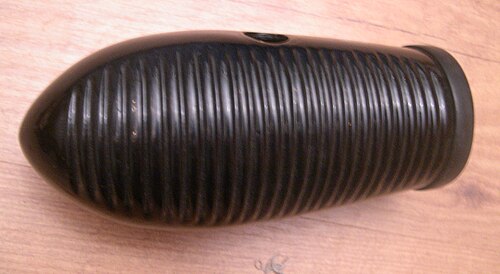
演奏者が直接的または間接的に擦過動作を起こすか、非音響物体が音響物体の刻み目に沿って移動し、交互に歯から持ち上げられたり、歯に叩きつけられたりする。あるいは、弾性のある音響物体が刻み目のある非音響物体の表面に沿って移動し、一連の衝撃を与える。このグループは摩擦式体鳴楽器と混同してはならない。
112.21 削り取った棒。
112.211 共鳴器なしの削り棒。
112.212 共鳴器付きの削り棒。
112.22 削り取られたチューブ。
112.23 廃船。
112.24 ホイールの擦り傷 - 歯車のガタつきまたはラチェット
112.3 分割体鳴楽器 - 片端で接続され、もう一方の端で接触している2本のバネ状の腕の形をした楽器。腕は小さな棒で押し広げられ、反動でチリンチリンと鳴ったり振動したりする。