科学的な歩行分析の先駆者は、アリストテレスの『動物の運動について』(De Motu Animalium)[ 2 ]と、ずっと後の1680年に同じく『動物の運動について』(De Motu Animalium (I et II))と呼ばれるジョヴァンニ・アルフォンソ・ボレッリである。1890年代には、ドイツの解剖学者クリスティアン・ヴィルヘルム・ブラウネとオットー・フィッシャーが、負荷ありと負荷なしの条件下での人間の歩行の生体力学に関する一連の論文を発表した。[ 3 ]
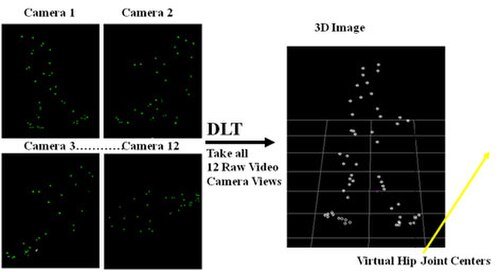
Markerless gait capture systems utilize one or more color cameras or 2.5D depth sensors (i.e. Kinect) to directly calculate the body joint positions from a sequence of images. The markerless system allows non-invasive human gait analysis in a natural environment without any marker attachment. Eliminating markers can expand the applicability of human gait measurement and analysis techniques, considerably reduce the preparation time, and enable efficient and accurate motion assessment in all kinds of applications. Currently, the main markerless system is the video-based motion capture with monocular camera or multiple camera studio.[16] Nowadays, the depth sensor-based gait analysis for clinical applications becomes more and more popular. Since depth sensors can measure the depth information and provide a 2.5D depth image, they have effectively simplified the task of foreground/background subtraction and significantly reduced pose ambiguities in monocular human pose estimation.[17]
Pressure measurement
Pressure measurement systems are an additional way to measure gait by providing insights into pressure distribution, contact area, center of force movement and symmetry between sides. These systems typically provide more than just pressure information; additional information available from these systems are force, timing and spatial parameters. Different methods for assessing pressure are available, like a pressure measurement mat or walkway (longer in length to capture more foot strikes), as well as in-shoe pressure measurement systems (where sensors are placed inside the shoe).[18][19][20] Many pressure measurement systems integrate with additional types of analysis systems, like motion capture, EMG or force plates to provide a comprehensive gait analysis.
Kinetics
Is the study of the forces involved in the production of movements.
Dynamic electromyography
Is the study of patterns of muscle activity during gait.
Applications
Gait analysis is used to analyze the walking ability of humans and animals, so this technology can be used for the following applications:
Medical diagnostics
Pathological gait may reflect compensations for underlying pathologies, or be responsible for causation of symptoms in itself. Cerebral palsy and stroke patients are commonly seen in gait labs. The study of gait allows diagnoses and intervention strategies to be made, as well as permitting future developments in rehabilitation engineering. Aside from clinical applications, gait analysis is used in professional sports training to optimize and improve athletic performance.
↑ Davis RB、Õunpuu S、Tyburski D、Gage JR ( 1991)。「歩行分析データの収集と削減手法」。Human Movement Science。10 ( 5): 575–587。doi : 10.1016 / 0167-9457(91)90046-z。
↑ Robertson DGE, et al. (2004). Research Methods in Biomechanics . Champaign IL:Human Kinetics Pubs.
↑ Best, Russell; Begg, Rezaul (2006). "Overview of Movement Analysis and Gait Features" . In Begg, Rezaul; Palaniswami, Marimuthu (eds.). Computational Intelligence for Movement Sciences: Neural Networks and Other Emerging Techniques . Idea Group (published 30 March 2006). pp. 11–18 . ISBN978-1-59140-836-9。
↑ X. Zhang、M. Ding、G. Fan (2016)「関節歩行および姿勢多様体を用いたビデオベースの人間歩行推定」、IEEE Transactions on Circuits and Systems for Video Technology、2016年
1 2 Amen, John; ElGebeily, Mohamed; El.Mikkawy, DaliaM. E.; Yousry, AhmedH; El-Sobky, TamerA (2018). "Single-event multilevel surgery for crouching cerebral palsy children: Correlations with quality of life and functional mobility" . Journal of Musculoskeletal Surgery and Research . 2 (4): 148. doi : 10.4103/jmsr.jmsr_48_18 . S2CID 81725776 .
↑ Herzog, W (1988). 「腰痛患者を用いた脊椎マニピュレーションの歩行への影響の定量化」. Journal of Manipulative and Physiological Therapeutics . 11 (3): 151– 157. PMID 2969026 .