In 2009, a further government reorganisation resulted in the abolition of all local government boroughs and districts in Northumberland and the establishment of the county as a unitary authority.[14] However, this did not affect the constituency boundaries.
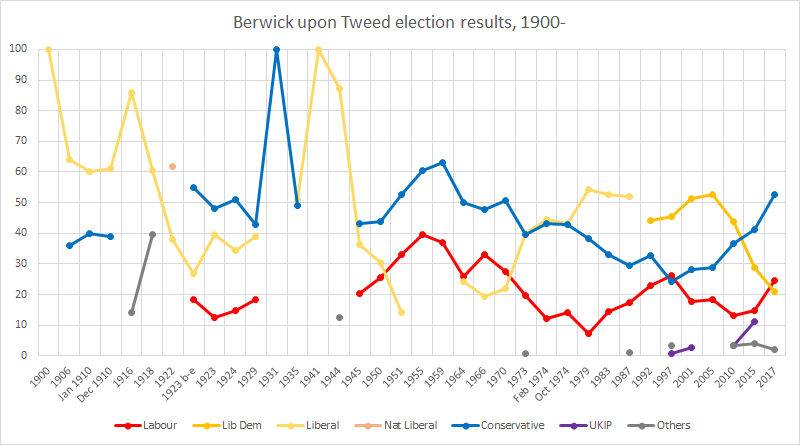
Rural in nature, sparse of population and with agriculture as a major source of employment, Berwick-upon-Tweed never elected a Labour candidate, one of two constituencies in the north-east of England not to have done so. The closest Labour came to winning the seat was at the 1966 general election, where they finished just 4,373 votes behind incumbent Conservative MP Antony Lambton.
The area was notable for its Liberal traditions, with politicians such as Sir William Beveridge (influential in the formation of the National Health Service) and Edward Grey (Foreign Secretary at the beginning of World War I, best remembered for the "lamps are going out all over Europe...." remark) have served this constituency.
It was represented by Liberal Democrat Sir Alan Beith from 1973 (formerly Liberal) until his retirement in 2015, when it was gained by the Conservative candidate Anne-Marie Trevelyan. Beith was first elected at a by-election, required as a result of the resignation of the then incumbent MP Antony Lambton (Conservative), who had been caught up in a scandal involving call girls, marijuana and a tabloid newspaper.
In 1923, Mabel Philipson, a former music hall actress, took over the seat as a Conservative, when her husband was forced to resign. In doing so she became only the third female MP to sit in the House of Commons since female members became legal five years previously.
Members of Parliament
The seat has sent members to Parliament since its enfranchisement by Henry VIII. It initially sent two members; this was reduced to one in 1885.
1 2 Escott, Margaret (2009). "BLAKE, Sir Francis, 3rd bt. (1774–1860), of Tilmouth Park, co. Dur.; Knowle Green, Staines, and 15 Sloane Street, Mdx" . The History of Parliament . 2021年3月6日のオリジナルからアーカイブ済み。 2019年9月8日取得。