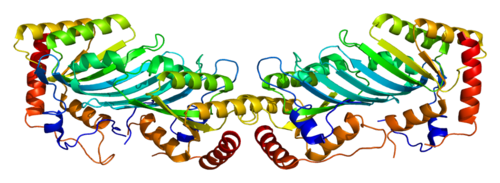
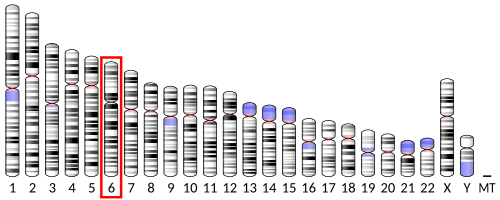
Probable C->U-editing enzyme APOBEC-2 is a protein that in humans is encoded by the APOBEC2gene.[5][6]
References
123GRCh38: Ensembl release 89: ENSG00000124701–Ensembl, May 2017
123GRCm38: Ensembl release 89: ENSMUSG00000040694–Ensembl, May 2017
↑"Human PubMed Reference:". National Center for Biotechnology Information, U.S. National Library of Medicine.
↑"Mouse PubMed Reference:". National Center for Biotechnology Information, U.S. National Library of Medicine.
↑Liao W, Hong SH, Chan BH, Rudolph FB, Clark SC, Chan L (Aug 1999). "APOBEC-2, a cardiac- and skeletal muscle-specific member of the cytidine deaminase supergene family". Biochem Biophys Res Commun. 260 (2): 398–404. Bibcode:1999BBRC..260..398L. doi:10.1006/bbrc.1999.0925. PMID10403781.
Human APOBEC2 genome location and APOBEC2 gene details page in the UCSC Genome Browser.
Further reading
Wedekind JE, Dance GS, Sowden MP, Smith HC (2003). "Messenger RNA editing in mammals: new members of the APOBEC family seeking roles in the family business". Trends Genet. 19 (4): 207–16. doi:10.1016/S0168-9525(03)00054-4. PMID12683974.
Lau PP, Zhu HJ, Baldini A, etal. (1994). "Dimeric structure of a human apolipoprotein B mRNA editing protein and cloning and chromosomal localization of its gene". Proc. Natl. Acad. Sci. U.S.A. 91 (18): 8522–6. Bibcode:1994PNAS...91.8522L. doi:10.1073/pnas.91.18.8522. PMC44638. PMID8078915.
Maruyama K, Sugano S (1994). "Oligo-capping: a simple method to replace the cap structure of eukaryotic mRNAs with oligoribonucleotides". Gene. 138 (1–2): 171–4. doi:10.1016/0378-1119(94)90802-8. PMID8125298.
Oka K, Kobayashi K, Sullivan M, etal. (1997). "Tissue-specific inhibition of apolipoprotein B mRNA editing in the liver by adenovirus-mediated transfer of a dominant negative mutant APOBEC-1 leads to increased low density lipoprotein in mice". J. Biol. Chem. 272 (3): 1456–60. doi:10.1074/jbc.272.3.1456. PMID8999814.
Suzuki Y, Yoshitomo-Nakagawa K, Maruyama K, etal. (1997). "Construction and characterization of a full length-enriched and a 5'-end-enriched cDNA library". Gene. 200 (1–2): 149–56. doi:10.1016/S0378-1119(97)00411-3. PMID9373149.
Anant S, Mukhopadhyay D, Sankaranand V, etal. (2001). "ARCD-1, an apobec-1-related cytidine deaminase, exerts a dominant negative effect on C to U RNA editing". Am. J. Physiol., Cell Physiol. 281 (6): C1904–16. doi:10.1152/ajpcell.2001.281.6.C1904. PMID11698249. S2CID7343760.
Strausberg RL, Feingold EA, Grouse LH, etal. (2003). "Generation and initial analysis of more than 15,000 full-length human and mouse cDNA sequences". Proc. Natl. Acad. Sci. U.S.A. 99 (26): 16899–903. Bibcode:2002PNAS...9916899M. doi:10.1073/pnas.242603899. PMC139241. PMID12477932.
Mungall AJ, Palmer SA, Sims SK, etal. (2003). "The DNA sequence and analysis of human chromosome 6". Nature. 425 (6960): 805–11. Bibcode:2003Natur.425..805M. doi:10.1038/nature02055. PMID14574404.
Gerhard DS, Wagner L, Feingold EA, etal. (2004). "The Status, Quality, and Expansion of the NIH Full-Length cDNA Project: The Mammalian Gene Collection (MGC)". Genome Res. 14 (10B): 2121–7. doi:10.1101/gr.2596504. PMC528928. PMID15489334.
Prochnow C, Bransteitter R, Klein MG, etal. (2007). "The APOBEC-2 crystal structure and functional implications for the deaminase AID". Nature. 445 (7126): 447–51. Bibcode:2007Natur.445..447P. doi:10.1038/nature05492. PMID17187054. S2CID4394772.