
Loading article…
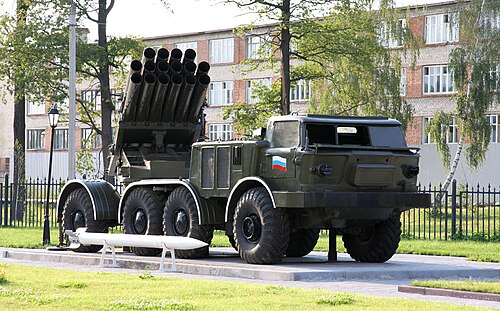
The BM-27 Uragan (Russian: БМ-27 Ураган, lit.'Hurricane'; GRAU index9P140) is a self-propelled 220 mm multiple rocket launcher designed in the Soviet Union to deliver cluster munitions. The system began its service with the Soviet Army in the late 1970s, and was its first spin and fin stabilized heavy multiple rocket launcher.
An updated version known as Uragan-1M was commissioned in 2008. The truck vehicle has no similarities.[4]
The BM-27 Uragan is capable of launching 220 mm rockets from 16 launch tubes mounted on the rear of a ZIL-135 8×8 chassis.[5] This vehicle is extremely similar to that used in the Luna-M free flight rocket system. It has two gasoline engines that power its 20 tonnes to a maximum speed of 65 kilometers per hour. One engine drives the four wheels on the left of the truck, while the other engine drives the four wheels on the right. The ZIL-135 has eight wheel drive, but only the front and rear axles are used for steering. It has a maximum cruising range of 500 kilometers.
The cab of the ZIL-135 is NBC protected, allowing the rockets to be fired without exposing the crew to possible contaminants.[6][7] The six-man crew[5] can emplace or displace the system in three minutes.
Before firing, stabilizing jacks must be lowered and the blast shield raised to protect the cab and its occupants. Indirect fire aiming is achieved with the use of a PG-1 panoramic telescope. Although there are no night vision sights, the driver of the launch vehicle is equipped with a night vision device.
The BM-27 can use HE-FRAG, chemical, explosive or scatterable mine (PTM-3 or PFM-1) submunition equipped rockets, all of which are detonated by electric timing fuses. (However, chemical munitions have been officially off service in Russia since 2017.) Each rocket weighs 280.4 kilograms. The warheads weigh between 90 and 100 kilograms, depending on type. A full salvo of 16 rockets can be fired in 20 seconds and can engage targets within a range of 35 kilometers.
Because of the size of the warhead, the range of the rocket and the speed that a salvo can be delivered, the BM-27 is very effective at mine laying. Each 220 mm rocket can scatter 312 anti-personnel PFM-1 mines. Minefields can be laid behind a retreating enemy or even be used to trap an enemy by encircling them with mines. Tactics such as this were often used by the Soviets in Afghanistan.
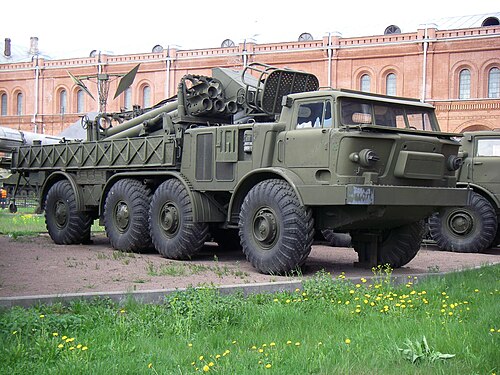
Once the rockets have been fired, 9T452 (another ZIL-135 based vehicle) is used to assist in reloading. It carries additional rockets and a crane to transfer the rockets from the reload vehicle to the launcher.[5] The entire reloading procedure takes around 20 minutes.

Also 9M27S incendiary rockets.

 Angola – 3-4 BM-27M Uragan-M in service as of 2024.[19][20]
 Belarus – 36 in service as of 2024.[19]
 Eritrea – 9 in service as of 2024.[19][20]
 Guinea – 3 in service as of 2024.[19][20]
 Kyrgyzstan – 6 in service as of 2024.[19]
 Moldova – 11 in service as of 2024.[19]
 Russia – 218 BM-27 Uragan and 6 BM-27M Uragan-M in service with a further 550 Uragan in storage as of 2024.[19]
 Syria – An unknown number in service as of 2024.[19] Serviceability is uncertain. 36 received from Russia in 1987–88.[20]
 Turkmenistan – 60 in service as of 2024.[19]
 Ukraine – 35 BM-27 Uragan and Bureviy in service as of 2024.[19]
 Uzbekistan – 48 in service as of 2024.[19]
 Afghanistan[1] – 180 (not functional)
 Georgia – Saw limited usage during Abkhazia War, out of service.
 Kazakhstan – 180 were in storage in 2016.[21] No longer in service.[19]
 Soviet Union: Passed on to successor states.
 Tajikistan – [19][1]
 Tanzania – [19][1]
 Yemen[1] – Over 50. Saw intensive action in the ongoing civil war. Does not appear to be in service as of 2024.[19] 7 received from Moldova in 1994.[20]