
Loading article…
 10h 59m 28.0s, +40° 25′ 49″
47 Ursae Majoris c (abbreviated 47 UMa c), formally named Taphao Kaew (/təˌpaʊˈɡaʊ/tə-POWGOW;[3]Thai: ตะเภาแก้ว[tāpʰāwkɛ̂ːw]) is an extrasolar planet approximately 46 light-years from Earth in the constellation of Ursa Major. The planet was discovered located in a long-period orbit around the star 47 Ursae Majoris. Its orbit lasts 6.55 years, and the planet has a mass at least 0.540 times that of Jupiter.
The planet is named after one of two sisters associated with a Thai folk tale.[4]
In July 2014 the International Astronomical Union launched NameExoWorlds, a process for giving proper names to certain exoplanets and their host stars.[5] The process involved public nomination and voting for the new names.[6] In December 2015, the IAU announced the winning name was Taphao Kaew,[7] submitted by the Thai Astronomical Society of Thailand.
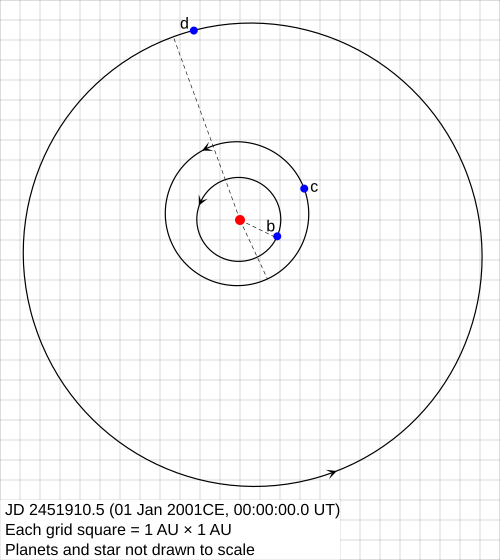
Like many known extrasolar planets at the time, 47 Ursae Majoris c was discovered by detecting changes in its star's radial velocity caused by the planet's gravity. This was done by measuring the Doppler shift of the star's spectrum.
At the time of discovery in 2001, 47 Ursae Majoris was already known to host one extrasolar planet, designated 47 Ursae Majoris b. Further measurements of the radial velocity revealed another periodicity in the data unaccounted for by the first planet. This periodicity could be explained by assuming that a second planet, designated 47 Ursae Majoris c, existed in the system with an orbital period close to 7 years. Observations of the photosphere of 47 Ursae Majoris suggested that the periodicity could not be explained by stellar activity, making the planet interpretation more likely. The planet was announced in 2002.[8]
47 Ursae Majoris のさらなる測定では惑星は検出されず、その存在に疑問が呈された。さらに、その存在を判断するために使用されたデータでは、惑星のパラメータが「ほとんど制約されていない」ことが指摘された。[ 9 ] 6,900 日を超えるデータセットを用いたより最近の研究では、この系に 2 番目の惑星が存在する可能性は高いものの、約 2,500 日の周期では誤報の確率が高く、最適な周期は 7,586 日 (約 21 年) であると結論付けられた。[ 10 ]
2010年に発表された研究では、47 Ursae Majoris を周回する 3 つの巨大惑星が特定され、そのうちの 1 つは 2,391 日の周期で、47 Ursae Majoris c の当初の主張とよく一致しています[ 1 ] 。
47 Ursae Majoris cは間接的に検出されたため、半径、組成、温度などの特性は不明である。質量が大きいことから、この惑星は固体表面を持たないガス惑星である可能性が高い。