
Loading article…
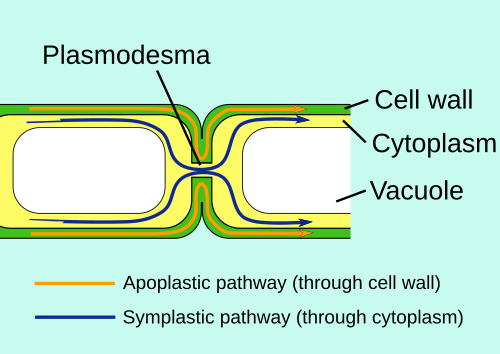
シンプラスト(ギリシャ語のsym「一緒に」+plasma「形成された、または成形された物質」に由来)は、ほとんどの植物組織に広がる連続した生きた細胞質ネットワークです。その連続性は、細胞壁を貫通して隣接する細胞の細胞質と小胞体をつなぐ、細胞膜で裏打ちされたナノスケールのトンネルである数千の原形質連絡によって確立されています。これらのチャネルは師管篩管要素にも開いているため、シンプラストは、濃度勾配または圧力勾配に沿って細胞間で水、栄養素、代謝物、タンパク質、およびRNAが移動するための短距離および長距離の導管を提供します。[ 1 ]対照的に、アポプラストは、溶質が細胞膜の外側に拡散する多孔質の細胞壁マトリックスと細胞外空間から構成されます。[ 2 ]
電子顕微鏡観察によると、単一の原形質連絡は、細胞膜に囲まれた狭い円筒状の細胞質鞘と、デスモチューブと呼ばれる中央の小胞体棒から構成されている。[ 1 ]断面では、これらの膜をつなぐタンパク質の「スポーク」が明らかになっている。周囲の壁はセルロースではなくペクチンが豊富であり、この組成が開口部の急速な変化に必要な柔軟性を与えていると考えられている。一次原形質連絡は、細胞分裂中に小胞体の糸が細胞板に捕捉されることで形成されるが、二次孔は後から既存の壁に挿入され、多くの場合、古いチャネルの隣に出芽してピットフィールドを形成する。伴細胞と篩管要素の間など、高度に特殊化された界面では、原形質連絡は非対称に広がり、孔原形質連絡または篩管孔となり、師管液の大量輸送を維持する。[ 1 ]
Diffusion through plasmodesmata is gated by a reversible 'size-exclusion limit. Deposition of the β-1,3-glucan callose around the pore narrows or seals the cytoplasmic sleeve, while callose hydrolases reopen it. This dynamic control underpins developmental events such as dormancy release and floral induction, as well as stress responses triggered by wounding, low temperature, salicylic acid accumulation or pathogen attack.[1] Small metabolites and ions traverse open pores within minutes; larger proteins (for example the maize transcription factor KN1) and mobile small RNAs can be trafficked by active, energy-dependent mechanisms that transiently unfold or chaperone the cargo. Certain plant viruses exploit the same pathway via movement proteins that loosen the size limit or by extruding protein tubules through the wall.[1]
In roots, water and mineral ions absorbed by epidermal and cortical cells can move in two ways towards the stele. Apoplastic flow is halted at the Casparian strip, forcing ions to enter the symplast of the endodermis before they are released into pericycle cells and ultimately loaded into the xylem sap for upward transport. A parallel symplastic route links epidermis, cortex, endodermis and pericycle directly, driven by water-potential gradients; it is particularly important for phosphate and other nutrients that bind strongly to cell walls, and for the movement of signalling molecules that co-ordinate root architecture.[1]
細胞間チャネルは、1879 年にエドゥアルト・タングルによって初めて報告され、[ 3 ]原形質連絡という用語は、1901 年にエドゥアルト・シュトラスブルガーによって造語されました。[ 4 ]ヨハネス・フォン・ハンシュタインは、1880 年にシンプラストという言葉を導入し、 [ 5 ]エルンスト・ミュンヒは、1930 年に師部輸送に関するモノグラフの中でアポプラストとシンプラストを対比しました。[ 6 ] 20 世紀後半の 最新の蛍光顕微鏡と色素トレーサー研究により、植物全体規模での細胞質連続性が証明され、原形質連絡は受動的な穴ではなく能動的に制御される導管であることが明らかになりました。[ 1 ]