
Loading article…

The president of South Africa is the head of state and head of government of the Republic of South Africa. The president directs the executive branch of the government and is the commander-in-chief of the South African National Defence Force. Between 1961 and 1994, the office of head of state was the state presidency.
The president is elected by the National Assembly, the lower house of Parliament, and is usually the leader of the largest party, which has been the African National Congress since the first multiracial election was held on 27 April 1994. The Constitution limits the president's time in office to two five-year terms.[2] The first president to be elected under the new constitution was Nelson Mandela. The incumbent is Cyril Ramaphosa, who was elected by the National Assembly on 15 February 2018 following the resignation of Jacob Zuma.
Under the interim constitution (valid from 1994 to 1996), there was a Government of National Unity, in which a member of Parliament (MP) from the largest opposition party was entitled to a position as deputy president. Along with Thabo Mbeki, the last apartheid president, F. W. de Klerk also served as deputy president, in his capacity as the leader of the National Party which was the second-largest party in the new Parliament. But De Klerk later resigned and went into opposition with his party. A voluntary coalition government continues to exist under the new constitution (adopted in 1996), although there have been no appointments of opposition politicians to the post of deputy president since.
The president is required to be a member of the National Assembly at the time of the election. Upon election, the president immediately resigns their seat for the duration of the presidential term. The president may be removed either by a motion of no-confidence or an impeachment trial.
大統領職には様々な形態が存在してきた。これらの職務の側面は、今日の大統領職にも見られる。イギリス植民地ナタールと喜望峰の行政指導権は、それぞれの総督に委ねられていた。同様に、トランスヴァール共和国とオレンジ自由国というボーア共和国の大統領にも委ねられていた。戦争の結果として主権が交代する事態は、南アフリカ戦争を終結させたフェリーニヒング条約で頂点に達した。
南アフリカ連邦は、イギリスの自治領として1910年5月31日に設立され[ 3 ] 、名目上の国家元首はイギリス国王であり、総督が代理を務めた。
1960年の国民投票とそれに続く1961年5月31日の南アフリカ共和国の宣言を受けて、大統領職が創設された。[ 4 ]当初は儀礼的な役職であったが、1984年に新憲法によって首相職が廃止され、その権限が大統領に移譲されたことで行政職となった。南アフリカは1994年に少数派支配を終えた。大統領職とその職務は、南アフリカ憲法第5章によって定められた。[ 2 ]
南アフリカは、大統領選挙に関して独特な制度を採用している。議会共和制を採用している他の旧イギリス植民地や自治領、およびウェストミンスター制度を採用している国々とは異なり、南アフリカの大統領は国家元首、政府首脳、南アフリカ国防軍(SANDF)の最高司令官を兼任している。世界中の大統領制とは異なり、南アフリカの大統領は国民による直接選挙ではなく、南アフリカ議会によって選出される[ 5 ]。そのため、理論上は議会に責任を負い、多数党の党首として立法に影響力を持つことができる。
The president is elected at the first sitting of Parliament after an election, and whenever a vacancy arises. The president is elected by the National Assembly, the lower house of Parliament, from among its members. The chief justice must oversee the election. Once elected, a person is no longer a member of the National Assembly. They must then be sworn in as president within five days of the election. Should a vacancy arise, the date of a new election must be set by the chief justice, but not more than 30 days after the vacancy occurs.[6]
The Constitution has thus prescribed a system combining both parliamentary and presidential systems in a unique manner. Only Botswana and a few other countries use a similar system. Between 1996 and 2003 Israel combined the two systems in an opposite way, with direct elections for the post of prime minister.[7]
Although the presidency is the key institution, it is hedged about with numerous checks and balances that prevent its total dominance over the government, as was the case in many African countries. The presidential term is five years, with a limit of two terms. Thus the electoral system attempts (at least on paper) to prevent the accumulation of power in the president as occurred during Apartheid and as is the case currently in many other African countries.[8]
According to chapter five of the constitution, the president can only exercise the powers of the presidential office while within the Republic of South Africa. The president may appoint an acting president when travelling outside the country or unable to fulfill the duties of the office.
A presidential vacancy should be filled first by the deputy president, then a Cabinet minister selected by the president, thereafter a Cabinet minister selected by the Cabinet, and finally by the speaker of the National Assembly.[9]
The president is the head of state, head of government and commander-in-chief of the South African National Defence Force. The rights, responsibilities and remuneration of the president are enumerated in Chapter V of the Constitution of South Africa and subsequent amendments and laws passed by the Parliament of South Africa.
共和国の行政権は、大統領に帰属し、大統領は憲法に定められた様々な役職に任命する。その中でも最も重要なのは、閣僚、最高控訴裁判所判事、憲法裁判所判事である。大統領内閣は、憲法および法律を施行・執行し、大統領の政治的目的を実行する。判事は、司法委員会の助言に基づいて任命される。
大統領は立法において重要な役割を担う。大統領は法案に署名して法律として成立させたり、拒否権を行使したり(ただし、拒否権は覆される可能性がある)、法案を議会や憲法裁判所に差し戻したり、国民投票を実施したりすることができる。大統領は議会を招集し、多くの場合、各会期の冒頭で一般教書演説を行う。
大統領は南アフリカ国防軍の最高司令官であり、外交および安全保障政策に対する影響力または統制力を有している。大統領には、宣戦布告および和平、条約(およびそれに伴う可能性のある同盟)の交渉および署名(ただし批准は不可)、外交官の任命および受任、栄誉の授与および恩赦の付与に関する憲法上の権限が与えられている。[ 10 ]

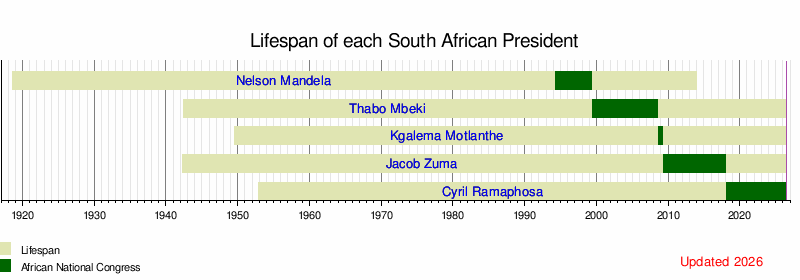
彼の辞任は真夜中に発効した。
{{cite web}}: CS1メンテナンス: アーカイブサービスは非推奨になりました (リンク)