
Loading article…
シャン文字は、ビルマ文字から派生した、シャン語の表記に使用されるブラーフミー文字の一種である。[ 2 ]近年の改革により、シャン文字は他のビルマ文字から派生した文字よりも表音性が強くなっている。[ 3 ]
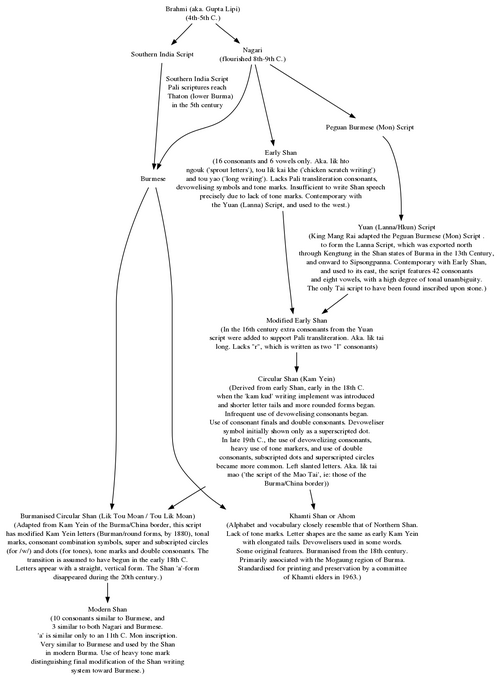
15 世紀または 16 世紀頃、モン・ビルマ文字が借用され、ビルマ北部のタイ語を表記するために適応されました。この適応の結果、シャン文字、タイ・レ文字、アホム文字、カムティ文字が生まれました。[ 4 ]この文字群は「リク・タイ」文字または「リク」文字と呼ばれ、インド北東部、ミャンマー北部、雲南省南西部、ラオス北西部のさまざまなタイ人によって使用されています。[ 5 ]学者のワートンによれば、証拠は、祖先のリク・タイ文字が 15 世紀にモン・ビルマ文字から借用されたものであることを示唆しており、おそらくモン・マオの政治体制下で行われたと考えられます。[ 6 ]学者ダニエルズは、明朝1407年の巻物に描かれたリクタイ文字について記述しており、これはリクトーゴク(タイレ)文字よりもアホム文字に類似している。 [ 7 ]アホムの人々は13世紀にブラマプトラ渓谷に移住する前にすでに独自の文字を採用していたと考えられている。 [ 8 ]しかし、現代の言語学および碑文研究は、アホム文字の発展は13世紀よりも後に起こった可能性が高いことを示唆している。現存する最古のアホム碑文である蛇柱碑文は15世紀後半から16世紀初頭のものであり、学者たちは一般的に、この文字は14世紀後半から16世紀にかけてビルマ語から派生した原シャン文字から採用されたものであるという点で一致している。[ 9 ]
1960年代まで、シャン語のアルファベットはビルマ文字で使用されている母音記号と声調記号を使用していたが、シャン語のすべての音素の区別を十分に区別することはできなかった。[ 3 ]アルファベットは、母音記号と、高下降軋音(ႉ)、高平音(း)、低音(ႇ)、中平中下降音(ႈ)を表す追加の声調記号、およびシャン 語北部方言で使用される第6の声調を表すタイ語のヴィサルガ(ႊ)を追加して改革された。 [ 3 ]
シャン文字は、モン・ビルマ文字の円形の文字形が特徴です。アブギダ文字であり、すべての文字に固有の母音 /a/ があります。母音は子音の周りに配置される発音記号の形で表されます。左から右に書きます[ 2 ]
母音の表記方法は、音節末に子音があるかどうかによって部分的に異なります。通常、母音は以下のように配置され、中間形と最終形、そして個々の母音とそれらが形成する母音クラスターとの間の論理的な関係を示します。
シャン語のアルファベットは、タイ語などの関連言語であるタイ・カダイ語族のアルファベットに比べてはるかに単純です。近年改革されたシャン語には、タイ語やビルマ語に見られるような歴史的な綴りの名残がほとんどありません。タイ語のアルファベットと比較すると、高位子音、中位子音、低位子音といった概念がなく、これらの区別によってタイ語の文字は44個の子音で構成されています。シャン語の子音はわずか19個です。
The number of consonants in a textbook may vary: there are 19 universally accepted Shan consonants (ၵ ၶ င ၸ သ ၺ တ ထ ၼ ပ ၽ ၾ မ ယ ရ လ ဝ ႁ ဢ) and five more which represent sounds not found in Shan, g, z, b, d and th [θ]. These five (ၷ ၹ ၿ ၻ ႀ) are quite rare. The consonant ရ occurs only in loanwords, as the consonant has otherwise merged ႁ in Shan.[3] In addition, most editors include a dummy consonant (ဢ) used in words with a vowel onset. A textbook may therefore present 18-24 consonants.
Like other Brahmi scripts, Shan consonants are typically arranged in rows based on place of articulation with columns based on aspiration and voicing ( Used to spell loan words and Pali):
The tones are indicated by tone markers at the end of the syllable. Shan tonal markers are mostly unambiguous and phonetic. In the absence of any marker, the default is the rising tone.
While the reformed script originally used only four diacritic tone markers, equivalent to the five tones spoken in the southern dialect, the Lashio-based Shan Literature and Culture Association now, for a number of words, promotes the use of the 'yak khuen' (Shan: ယၵ်းၶိုၼ်ႈ) to denote the sixth tone as pronounced in the north.
There are differences between the numerals used by the Shan script in China and Myanmar. The numerals used by Shan in China are similar to the numbers in Tham script and Tai Le script in China and the numbers in Burmese, while the Shan numerals in Myanmar form their own system, similar to the Burmese Tai Le numerals.
There are three main punctuation marks in Shan script with an addition mark for letter reduplication, typically as shorthand.
Below are charts with syllables showcasing how of Shan script vowels and consonants are combined.
The Shan script has been encoded as a part of the Myanmar block with the release version of Unicode 3.0.

