Loading article…
データ処理とは、有意義な情報を生成するためにデジタルデータを収集および操作することです。[ 1 ]データ処理は情報処理の一形態であり、情報処理とは、観察者が検出可能なあらゆる方法で情報を変更する(処理する)ことです。[注1 ]
データ処理には、以下のような様々なプロセスが含まれる場合があります。
米国国勢調査局の歴史は、データ処理が手作業から電子的な手続きへと進化してきた過程を示している。
データ処理という用語が広く使われるようになったのは1950年代以降ですが、[ 3 ]データ処理機能は何千年もの間、手作業で行われてきました。例えば、簿記には、取引の記帳や貸借対照表やキャッシュフロー計算書などの報告書の作成といった機能が含まれます。完全に手作業で行われていた方法は、機械式または電子式の計算機の使用によって補完されました。手作業または計算機を使用して計算を行うことが仕事である人は「コンピュータ」と呼ばれていました。
1890年の米国国勢調査の調査票は、世帯単位ではなく個人単位でデータを収集した最初の調査票でした。多くの質問には、用紙の該当するボックスにチェックを入れることで回答できました。1850年から1880年まで、国勢調査局は「集計システムを採用していましたが、必要な分類の組み合わせが増えるにつれて、ますます複雑になっていきました。1回の集計で記録できる組み合わせは限られていたため、独立した集計の数に応じて、調査票を5回または6回処理する必要がありました。」[ 4 ]手作業による処理方法を使用したため、 「1880年の国勢調査の結果を公表するのに7年以上かかりました」[ 5 ]。
自動データ処理という用語は、ハーマン・ホレリスが1890年の米国国勢調査にパンチカード装置を使用したように、単位記録装置を使用して実行される操作に適用されました。「ホレリスのパンチカード装置を使用することで、国勢調査局は1880年の国勢調査の7〜8年と比較して、1890年の国勢調査データのほとんどを2〜3年で集計することができました。質問数が1880年の2倍であったにもかかわらず、ホレリスのシステムを使用することで、1890年のドルで約500万ドルの処理コストが節約されたと推定されています」 [ 5 ] 。
コンピュータによるデータ処理、または電子データ処理は、複数の独立した機器の代わりにコンピュータを使用する、より後の発展形である。国勢調査局は、 1952年に納入されたUNIVAC Iシステム[ 4 ]を使用して、1950年の米国国勢調査で初めて電子コンピュータを限定的に使用した。
データ処理という用語は、より一般的な情報技術(IT)という用語にほぼ包含されるようになった。[ 6 ]古い用語「データ処理」は、古い技術を連想させる。例えば、1996年にデータ処理管理協会(DPMA)は情報技術専門家協会に名称を変更した。とはいえ、これらの用語はほぼ同義である。
商用データ処理では、大量の入力データ、比較的少ない計算処理、そして大量の出力が伴います。例えば、保険会社は数万件、あるいは数十万件もの保険契約の記録を保持し、請求書を印刷して郵送し、支払いを受け取って記帳する必要があります。
In science and engineering, the terms data processing and information systems are considered too broad, and the term data processing is typically used for the initial stage followed by a data analysis in the second stage of the overall data handling.
Data analysis uses specialized algorithms and statistical calculations that are less often observed in a typical general business environment. For data analysis, software suites like SPSS or SAS, or their free counterparts such as DAP, gretl, or PSPP are often used. These tools are usually helpful for processing various huge data sets, as they are able to handle enormous amount of statistical analysis.[7]
A data processing system is a combination of machines, people, and processes that for a set of inputs produces a defined set of outputs. The inputs and outputs are interpreted as data, facts, information etc. depending on the interpreter's relation to the system.
A term commonly used synonymously with data or storage (codes) processing system is information system.[8] With regard particularly to electronic data processing, the corresponding concept is referred to as electronic data processing system.
A very simple example of a data processing system is the process of maintaining a check register. Transactions— checks and deposits— are recorded as they occur and the transactions are summarized to determine a current balance. Monthly the data recorded in the register is reconciled with a hopefully identical list of transactions processed by the bank.
A more sophisticated record keeping system might further identify the transactions— for example deposits by source or checks by type, such as charitable contributions. This information might be used to obtain information like the total of all contributions for the year.
The important thing about this example is that it is a system, in which, all transactions are recorded consistently, and the same method of bank reconciliation is used each time.
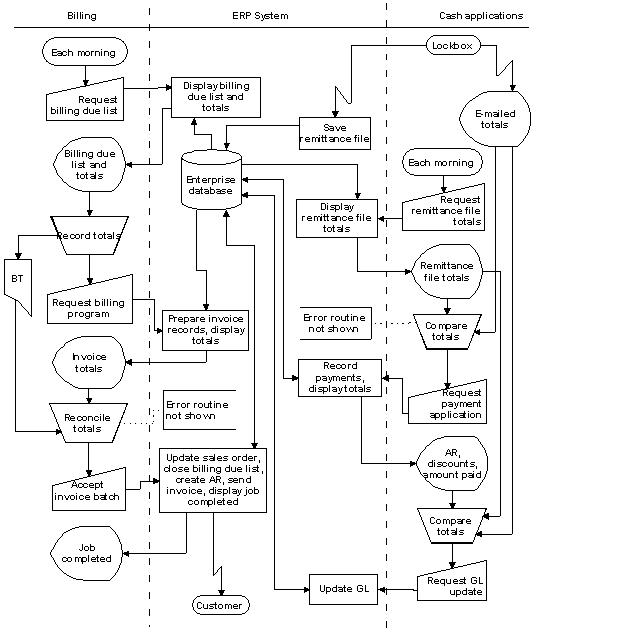
This is a flowchart of a data processing system combining manual and computerized processing to handle accounts receivable, billing, and general ledger