Loading article…
In spectroscopy, absorbance (abbreviated as A)[1] is a logarithmic value which describes the portion of a beam of light which does not pass through a sample. Whilst the name refers to the absorption of light, other interactions of light with a sample (reflection, scattering) may also contribute to attenuation of the beam passing through the sample. The term "internal absorbance" is sometimes used to describe beam attenuation caused by absorption, while "attenuance" or "experimental absorbance" can be used to emphasize that beam attenuation can be caused by other phenomena.[2]
The roots of the term absorbance are in the Beer–Lambert law (or Beer's law). As light moves through a medium, it will become dimmer as it is being "extinguished". Pierre Bouguer recognized that this extinction (now often called attenuation) was not linear with distance traveled through the medium, but related to what is now referred to as an exponential function.
If is the intensity of the light at the beginning of the travel and is the intensity of the light detected after travel of a distance , the fraction transmitted, , is given by
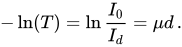
where is called an attenuation constant (a term used in various fields where a signal is transmitted though a medium) or coefficient. The amount of light transmitted decreases exponentially with distance. Taking the natural logarithm in the above equation, we get
For scattering media, the constant is often divided into two parts,[3], separating it into a scattering coefficient and an absorption coefficient , obtaining
If the size of a detector is very small compared to the distance traveled by the light, any light that is scattered by a particle, either in the forward or backward direction, will not strike the detector. (Bouguer was studying astronomical phenomena, so this condition was met.) In such cases, a plot of as a function of wavelength will yield a superposition of the effects of absorption and scattering. Because the absorption portion is more distinct and tends to ride on a background of the scatter portion, it is often used to identify and quantify the absorbing species. Consequently, this is often referred to as absorption spectroscopy, and the plotted quantity is called "absorbance", symbolized as . Some disciplines by convention use decadic (base 10) absorbance rather than Napierian (natural) absorbance, resulting in (with the subscript 10 usually not shown).
Within a homogeneous medium such as a solution, there is no scattering. In this case, researched extensively by August Beer, the concentration of the absorbing species follows the same linear contribution to absorbance as the path-length. Additionally, the contributions of individual absorbing species are additive. This is a very favorable situation, and made absorbance an absorption metric far preferable to absorption fraction (absorptance). This is the case for which the term "absorbance" was first used.
A common expression of the Beer's law relates the attenuation of light in a material as , where is the absorbance; is the molar attenuation coefficient or absorptivity of the attenuating species; is the optical path length; and is the concentration of the attenuating species.
For samples which scatter light, absorbance is defined as "the negative logarithm of one minus absorptance (absorption fraction: ) as measured on a uniform sample".[4] For decadic absorbance,[2] this may be symbolized as . If a sample both transmits and remits light, and is not luminescent, the fraction of light absorbed (), remitted (), and transmitted () add to 1: . Note that , and the formula may be written as . For a sample which does not scatter, , and , yielding the formula for absorbance of a material discussed below.
Even though this absorbance function is very useful with scattering samples, the function does not have the same desirable characteristics as it does for non-scattering samples. There is, however, a property called absorbing power which may be estimated for these samples. The absorbing power of a single unit thickness of material making up a scattering sample is the same as the absorbance of the same thickness of the material in the absence of scatter.[5]
In optics, absorbance or decadic absorbance is the common logarithm of the ratio of incident to transmittedradiant power through a material, and spectral absorbance or spectral decadic absorbance is the common logarithm of the ratio of incident to transmittedspectral radiant power through a material. Absorbance is dimensionless, and in particular is not a length, though it is a monotonically increasing function of path length, and approaches zero as the path length approaches zero.
The absorbance of a material, denoted A, is given by[6]
where
Absorbance is a dimensionless quantity. Nevertheless, the absorbance unit or AU is commonly used in ultraviolet–visible spectroscopy and its high-performance liquid chromatography applications, often in derived units such as the milli-absorbance unit (mAU) or milli-absorbance unit-minutes (mAU×min), a unit of absorbance integrated over time.[7]
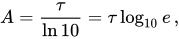
Absorbance is related to optical depth by
where τ is the optical depth.
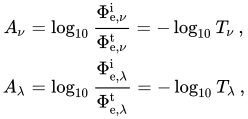
Spectral absorbance in frequency and spectral absorbance in wavelength of a material, denoted Aν and Aλ respectively, are given by[6]
where
Spectral absorbance is related to spectral optical depth by
where
吸光度は本来無次元であるが、「吸光度単位」またはAUで報告されることがある。科学研究者を含む多くの人々が、吸光度測定実験の結果をこれらの架空の単位で誤って報告している。[ 8 ]
吸収率とは、物質中の透過放射パワーの減衰を測定する数値です。減衰は、「吸収」という物理的プロセスだけでなく、反射、散乱、その他の物理的プロセスによっても引き起こされます。物質の吸収率が 1 よりはるかに小さく、かつその物質の放射率 (放射発散率や放射率と混同しないように注意) が吸収率よりはるかに小さい場合、物質の吸収率はその減衰率とほぼ等しくなります。実際、
どこ
これは以下と同等です
どこ
ビールの法則によれば、T = 10 − Aなので、
そして最後に
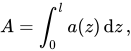
物質の吸光度は、その10進減衰係数と次の関係にある。
どこ
a ( z )が経路に沿って均一である場合、減衰は線形減衰と呼ばれ、関係式は次のようになります。
場合によっては、その関係は物質のモル減衰係数、つまり減衰係数をモル濃度で割った値を用いて表される。
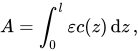
どこ
c ( z )が経路に沿って一様である場合、関係は次のようになる。
モル減衰係数に対して「モル吸光係数」という用語を使用することは推奨されません。[ 6 ]
吸光度は、定量吸収分光法で広く用いられている測定法です。光ビームの減衰は透過率(入射光の透過率)でも表すことができますが、吸光度の対数表現は試料の定量に便利です。ベールの法則が成り立つ条件下では、吸光度は試料の厚さと吸収性物質の濃度に比例します。[ 9 ]
定量的な目的では、吸光度はキュベットに入れた試料溶液で測定されることが多く、その溶液はベールの法則の線形関係が成り立つほど十分に希釈されている。キュベットは、試料を通過する光線に対して既知で一定の光路長を提供する。[ 9 ]まずキュベットと分析対象物を含まない「ブランク」溶液の吸光度を測定し、試料間の吸光度の差を用いて分析対象物を定量することができる。分光計は一般的に、さまざまな波長範囲で吸光度を個別に測定し、そのデータを吸光度対波長としてプロットする。[ 10 ]
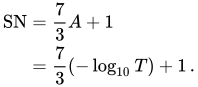
特に溶接用ガラスなどの一部のフィルターは、遮光度番号(SN)で評価され、これは吸光度の7/3倍に1を加えた値です。[ 11 ]
例えば、フィルターの透過率が0.1%(透過率0.001、つまり吸光度3単位)の場合、その遮光度は8になります。
{{cite book}}ISBN /日付の不一致(ヘルプ)