
Loading article…
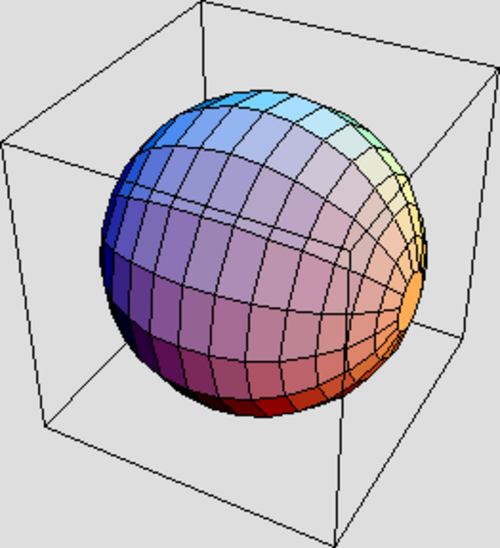
幾何学において、N次元空間における点集合Sの最小境界ボックス(最小包含ボックスとも呼ばれる)とは、すべての点が含まれる最小の尺度(面積、体積、または高次元空間における超体積)を持つボックスのことである。他の種類の尺度を用いる場合、最小ボックスは通常、それに応じて「最小周長境界ボックス」などと呼ばれる。
点集合の最小境界ボックスは、その凸包の最小境界ボックスと同じであり、この事実は計算を高速化するためにヒューリスティックに利用できる。 [ 1 ]
2次元の場合、それは最小境界矩形と呼ばれます。
与えられた点集合に対する軸平行最小境界ボックス(またはAABB)とは、その点集合の境界ボックスの辺が(デカルト)座標軸に平行であるという制約を満たす最小境界ボックスのことです。これは、点集合S内の点の対応する座標の最小値と最大値によって定義されるN個の区間のデカルト積です。
軸に沿った最小境界ボックスは、対象オブジェクトのおおよその位置と、その形状を非常に単純に記述するために使用されます。例えば、計算幾何学とその応用において、オブジェクトの集合内の交差を見つける必要がある場合、最初のチェックはそれらの最小境界ボックス間の交差です。これは通常、実際の交差のチェックよりもはるかにコストのかからない操作であるため(座標の比較のみを必要とするため)、離れたペアのチェックを迅速に除外できます。
The arbitrarily oriented minimum bounding box is the minimum bounding box, calculated subject to no constraints as to the orientation of the result. Minimum bounding box algorithms based on the rotating calipers method can be used to find the minimum-area or minimum-perimeter bounding box of a two-dimensional convex polygon in linear time, and of a three-dimensional point set in the time it takes to construct its convex hull followed by a linear-time computation.[1] A three-dimensional rotating calipers algorithm can find the minimum-volume arbitrarily-oriented bounding box of a three-dimensional point set in cubic time.[2] Matlab implementations of the latter as well as the optimal compromise between accuracy and CPU time are available.[3]
In the case where an object has its own local coordinate system, it can be useful to store a bounding box relative to these axes, which requires no transformation as the object's own transformation changes.
In digital image processing, the bounding box is merely the coordinates of the rectangular border that fully encloses a digital image when it is placed over a page, a canvas, a screen or other similar bidimensional background.