
Loading article…
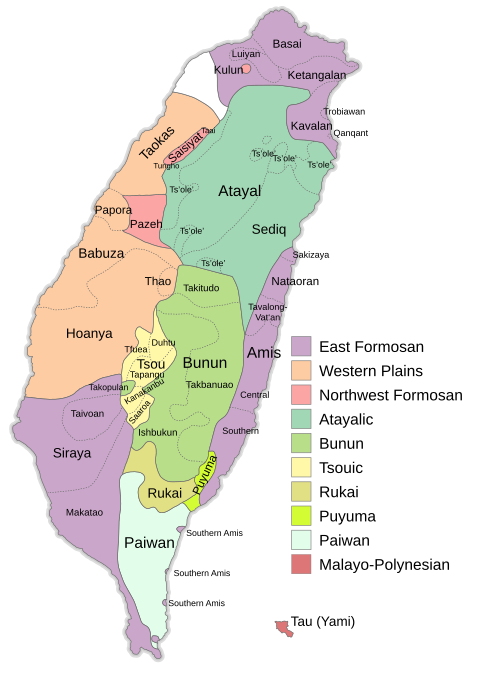

There are 26 officially recognized Taiwanese indigenous peoples, including 16 fully recognized and 10 additional plains indigenous peoples currently in the process of receiving full recognition.
Languages and cultures of indigenous tribes were recorded by the government of Dutch Formosa, Spanish Formosa and the Qing Empire. Research on ethnic groups of Taiwanese indigenous peoples started in late 19th century, when Taiwan was under Japanese rule. The Government of Taiwan (臺灣總督府, Taiwan Sōtokufu) conducted large amount of research and further distinguished the ethnic groups of Taiwanese indigenous peoples by linguistics (see Formosan languages). The following is a list of classifications through Japanese and post World War II. The Japanese names in parentheses do not exist in pre-World War II Japanese demographic research.
The Taiwanese government officially recognises 16 indigenous groups.
Peoples that have undergone heavy Sinicization have not received full recognition by the central government. They are traditionally referred to as "plains" indigenous peoples and were considered fully extinct or assimilated into the Han Chinese culture. The Sinicization increases the difficulty in identifying ethnic groups. The languages spoken by some of these groups have gone extinct, though some are in revitilazation. Following a contitutional court judgement in 2022, a law was passed in 2025 to allow these peoples to apply for official recognition by the central government. As of 2026, ten groups are applying for the recognition.
The colonial governments traditionally classified the indigenous people into two groups, the "mountains" and the "plains" indigenous peoples. Though the terms superficially refer to the altitude of their places of residence, the actual basis is the level of Sinicization, and traces its roots to Qing Dynasty separation of the "civilized" (熟番) from the "uncivilized" (生番). This categorization has no correlation to ethnic, cultural, or linguistic similarity. Due to this subjectivity, the grouping have changed over the years. The Saisiyat people was previously considered a plains indigenous people, but later recategorized as mountains indigenous people. The Kavalan and Thao peoples are similarly inconsistentnly seens as either mountains or plains indigenous peoples.
The household registration records during Japanese rule include remarks of "mountains/plains indigenous peoples". The governmental statistics also listed 9 recognized subgroups under mountains indigenous peoples. However, the ROC government after World War II refused to recognize the plains indigenous peoples until 2025.