
Loading article…
In the mathematical theory of probability, David Lewis's triviality result is a theorem about the impossibility of systematically equating the conditional probability with the probability of a so-called conditional event, .


Conditional probability and conditional events
The statement "The probability that if , then , is 20%" means (put intuitively) that event may be expected to occur in 20% of the outcomes where event occurs. The standard formal expression of this is , where the conditional probability equals, by definition, .




Beginning in the 1960s, several philosophical logicians—most notably Ernest Adams and Robert Stalnaker—floated the idea that one might also write , where is the conditional event "If , then ".[1] That is, given events and , one might suppose there is an event, , such that could be counted on to equal , so long as .



Part of the appeal of this move would be the possibility of embedding conditional expressions within more complex constructions. One could write, say, , to express someone's high subjective degree of confidence ("75% sure") that either , or else if , then . Compound constructions containing conditional expressions might also be useful in the programming of automated decision-making systems.[2]



How might such a convention be combined with standard probability theory? The most direct extension of the standard theory would be to treat as an event like any other, i.e., as a set of outcomes. Adding to the familiar Venn- or Euler diagram of and would then result in something like Fig. 1, where are probabilities allocated to the eight respective regions, such that .


が に等しいためには、 、つまり、領域内の確率が、領域内の確率の領域内の割合に等しいことが必要です。一般に、この等式は当然真ではないため、これを確実に真にするには、確率関数に対する新しい制約が必要です。つまり、コルモゴロフの確率公理 を満たすことに加えて、 となる任意のイベントおよびに対して という新しい制約も満たす必要があります。



ルイスの結果
Lewis (1976) は、上記の提案に関して一見致命的な問題を指摘しました。それは、一連のイベントが自明でないと仮定すると、新しい制限されたクラスの- 関数は、イベントの発生を前提として確率関数を新しい関数 に変換する操作である条件付けの下で閉じないということです。つまり、 の場合、 である限り、 は一般には真ではありません。これは、合理性が適切に動作する確率関数を必要とする場合、完全に合理的な人 (またはコンピューティング システム) は、任意のイベントが発生したことを知っただけで非合理的になることを意味します。Bas van Fraassen はこの結果を「まさに爆弾」と呼びました (1976、p. 273)。




ルイスの証明は以下のとおりです。一連のイベントが非自明であるとは、2 つの可能なイベントとが相互に排他的であるが、すべての可能性を網羅するものではない、つまり、、、 であるときです。このような 2 つのイベントが存在するということは、イベント も存在することを意味します。また、条件付きイベントが認められる場合は、イベント も存在します。この証明は、このような最小限に非自明な一連のイベントが存在するという仮定から矛盾を導き出します。

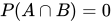
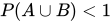

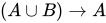
- 条件付けの後、まず 上での確率を考え、次にその補集合 上での確率を考えます。
- を条件とすると となります。しかし、 -関数に対する新しい制約により となります。したがって、 となります。
- を条件付けると が得られます。しかし、 も得られます。(との相互排他性によりが保証されます。) したがって、 です。
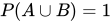
- 恒等式を として具体化します。ステップ 1 の結果により、左辺は に簡約されますが、右辺は、-関数に関する新しい制約により に等しくなります。したがって、となり、 となり、 という規定に矛盾します。これで証明は完了です。
















グラフィカルバージョン

A graphical version of the proof starts with Fig. 2, where the and from Fig. 1 are now disjoint and has been replaced by .[3] By the assumption that and are possible, and . By the assumption that together and do not together exhaust all possibilities, . And by the new constraint on probability functions, , which means that





- (1)
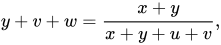
Conditioning on an event involves zeroing out the probabilities outside the event's region and increasing the probabilities inside the region by a common scale factor. Here, conditioning on will zero out and and scale up and , to and , respectively, and so


- (2) which simplifies to


Conditioning instead on will zero out and and scale up and , and so
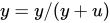
- (3) which simplifies to


From (2), it follows that , and since is the scaled-up value of , it must also be that . Similarly, from (3), . But then (1) reduces to , which implies that , which contradicts the stipulation that .



Later developments
In a follow-up article, Lewis (1986) noted that the triviality proof can proceed by conditioning not on and but instead, by turns, on each of a finite set of mutually exclusive and jointly exhaustive events He also gave a variant of the proof that involved not total conditioning, in which the probability of either or is set to 1, but partial conditioning (i.e., Jeffrey conditioning), by which probability is incrementally shifted from to .

Separately, Hájek (1989) pointed out that even without conditioning, if the number of outcomes is large but finite, then in general , being a ratio of two outputs of the -function, will take on more values than any single output of the function can. So, for instance, if in Fig. 1 are all multiples of 0.01 (as would be the case if there were exactly 100 equiprobable outcomes), then must be a multiple of 0.01, as well, but need not be. That being the case, cannot reliably be made to equal .


Hájek (1994) also argued that the condition caused acceptable -functions to be implausibly sparse and isolated from one another. One way to put the point: standardly, any weighted average of two probability function is itself a probability function, so that between any two -functions there will be a continuum of weighted-average -functions along which one of the original -functions gradually transforms into the other. But these continua disappear if the added condition is imposed. Now an average of two acceptable -functions will in general not be an acceptable -function.
Possible rejoinders
Assuming that holds for a minimally nontrivial set of events and for any -function leads to a contradiction. Thus can hold for any -function only for trivial sets of events—that is the triviality result. However, the proof relies on background assumptions that may be challenged. It may be proposed, for instance, that the referent event of an expression like “” is not fixed for a given and , but instead changes as the probability function changes. Or it may be proposed that conditioning on should follow a rule other than .
But the most common response, among proponents of the condition, has been to explore ways to model conditional events as something other than subsets of a universe set of outcomes. Even before Lewis published his result, Schay (1968) had modeled conditional events as ordered pairs of sets of outcomes. With that approach and others in the same spirit, conditional events and their associated combination and complementation operations do not constitute the usual algebra of sets of standard probability theory, but rather a more exotic type of structure, known as a conditional event algebra.
Notes
- ^ Hájek and Hall (1994) give a historical summary. The debate was actually framed as being about the probabilities of conditional sentences, rather than conditional events. However, this is merely a difference of idiom, so long as sentences are taken to express propositions and propositions are thought of as sets of possible worlds.
- ^ Reading "If , then " as "Not , unless also " makes compounding straightforward, since becomes equivalent to the Boolean expression . However, this has the unsatisfactory consequence that ; then "If , then " is assigned high probability whenever is highly unlikely, even if 's occurrence would make highly unlikely. This is a version of what in logic is called a paradox of material implication.
- ^ A proof starting with overlapping and , as in Fig. 1, would use mutually exclusive events and in place of and .



References
- Hájek, Alan (1989). "Probabilities of conditionals – Revisited". Journal of Philosophical Logic. 18 (4): 423–428. doi:10.1007/BF00262944. JSTOR 30226421. S2CID 31355969.
- Hájek, Alan (1994). "Triviality on the cheap?". In Eells, Ellery; Skyrms, Brian (eds.). Probability and Conditionals. Cambridge UP. pp. 113–140. ISBN 978-0521039338.
- Hájek, Alan; Hall, Ned (1994). "The hypothesis of the conditional construal of conditional probability". In Eells, Ellery; Skyrms, Brian (eds.). Probability and Conditionals. Cambridge UP. pp. 75–111. ISBN 978-0521039338.
- Lewis, David (1976). "Probabilities of conditionals and conditional probabilities". Philosophical Review. 85 (3): 297–315. doi:10.2307/2184045. JSTOR 2184045.
- Lewis, David (1986). "Probabilities of conditionals and conditional probabilities II". Philosophical Review. 95 (4): 581–589. doi:10.2307/2185051. JSTOR 2185051.
- Schay, Geza (1968). "An algebra of conditional events". Journal of Mathematical Analysis and Applications. 24 (2): 334–344. doi:10.1016/0022-247X(68)90035-8.
- van Fraassen, Bas C. (1976). "Probabilities of conditionals". In Harper, W.; Hooker, C. (eds.). Foundations and Philosophy of Epistemic Applications of Probability Theory. Foundations of Probability Theory, Statistical Inference, and Statistical Theories of Science, Volume I. D. Reidel. pp. 261–308. ISBN 978-9027706171.