
Loading article…
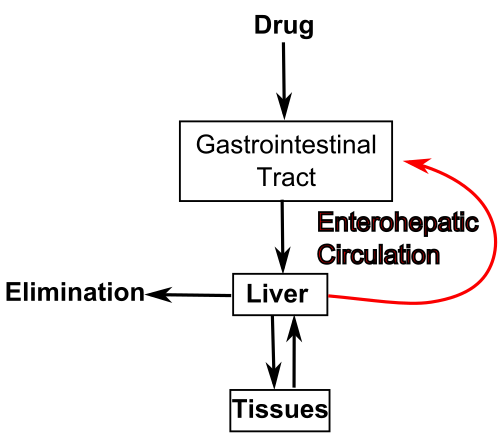
Enterohepatic circulation is the circulation of biliary acids, bilirubin, drugs or other substances from the liver to the bile, followed by entry into the small intestine, absorption by the enterocyte and transport back to the liver. Enterohepatic circulation is an especially important concept in the field of toxicology as many lipophilicxenobiotics undergo this process causing repeated liver damage.
Hepatocytesmetabolizecholesterol to cholic acid and chenodeoxycholic acid. These lipid-solublebile acids are conjugated (reversibly attached) mainly to glycine or taurine molecules to form watersoluble primary conjugated bile acids, sometimes called "bile salts". These bile acids travel to the gall bladder during the interdigestive phase for storage and to the descending part of the duodenum via the common bile duct through the major duodenal papilla during digestion. 95% of the bile acids which are delivered to the duodenum will be recycled by the enterohepatic circulation.
Due to the pH of the small intestine, most of the bile acids are ionized and mostly occur as their sodium salts which are then called “primary conjugated bile salts.” In the lower small intestine and colon, bacteria dehydroxylate some of the primary bile salts to form secondary conjugated bile salts (which are still water-soluble). Along the proximal and distal ileum, these conjugated primary bile salts are reabsorbed actively into hepatic portal circulation. Bacteria deconjugate some of the primary and secondary conjugated bile salts back to lipid-soluble bile acids, which are passively absorbed into hepatic portal circulation. Finally, the conjugated bile acids which remained un-ionized conjugated bile acids are passively absorbed.
Venous blood from the ileum goes straight into the portal vein and then into the liver sinusoids. There, hepatocytes extract bile acids very efficiently, and little escapes the healthy liver into systemic circulation.
The net effect of enterohepatic recirculation is that each bile salt molecule is reused about 20 times, often multiple times during a single digestive phase.
The presence of biliary acids in the intestines helps in absorption of fats and other substances.[1]
ビリルビンは肝臓でグルクロニルトランスフェラーゼという酵素によってグルクロン酸と抱合され、水溶性になります。その多くは胆汁に入り、小腸に排出されます。分泌されたビリルビン様胆汁の20%は小腸で再吸収されますが、抱合型ビリルビンは小腸では再吸収されません。大腸内の抱合型ビリルビンはすべて大腸菌によってウロビリノーゲンに代謝され、さらに酸化されてウロビリンとステルコビリンになります。ウロビリン、ステルコビリン、およびそれらの分解産物が糞便に茶色を与えます。[ 2 ] しかし、胆汁と同様に、再吸収されたウロビリノーゲンの一部は胆汁に再分泌され、胆汁は腸肝循環の一部でもあります。再吸収されたウロビリノーゲンの残りは尿中に排泄され、そこで酸化型であるウロビリンに変換され、尿に特徴的な黄色を与える。
クロラムフェニコール、アスピリン、パラセタモール、ジアゼパム、ロラゼパム、モルヒネ、メトロニダゾール。薬物だけでなく、ビリルビン、ステロイドホルモン、チロキシンなどの内因性基質もこの経路を利用します。
腸肝循環とは、薬物が肝臓でグルクロン酸と結合し、胆汁中に排泄され、腸内細菌によって遊離薬物に代謝され、その後血漿中に再吸収される過程を指します。この過程を経る多くの薬物では、薬物の「リサイクル」によって排泄が抑制されるため、より少ない投与量で治療効果が得られます。しかし、腸に対して非常に毒性の強い少数の薬物(例えばイリノテカン)では、本来は毒性の低い分子でも、この過程によって毒性が強くなる場合があり、そのためこの段階を阻害することが保護的となることがあります。腸肝循環を経る薬物の大部分は腸に対して毒性がないため、この過程を阻害すると薬物濃度が低下し、治療効果が低下します。例えば、腸内細菌を殺す抗生物質は腸肝循環を阻害することが多く、抗生物質の使用を中止して腸内に細菌が再び増殖するまで、一時的に薬物の投与量を増やす必要があります。抗生物質が他の薬剤の腸肝循環に及ぼすこの影響は、いくつかの種類の薬物相互作用の一つである。
腸肝循環過程の薬物動態モデルは最近の論文にまとめられている。[ 3 ]