
Loading article…
The Comtessa de Dia (Countess of Die),[1] possibly named Beatritz or Isoarda (fl. c. 1175 or c. 1212), was a trobairitz (female troubadour).
She is only known as the comtessa de Dia in contemporary documents, but was most likely the daughter of Count Isoard II of Diá (a town northeast of Montelimar now known as Die in southern France). According to her vida, she was married to William of Poitiers, but was in love with and sang about Raimbaut of Orange (1146-1173).[2] Bruckner, Shepard, and White cite Angela Rieger's analysis of the songs, which associates them, through intertextual evidence, with the circle of poets composed of Raimbaut d'Aurenga, Bernart de Ventadorn, and Azalais de Porcairagues.[2] Marcelle Thiébaux, and Claude Marks have associated her not with Raimbaut d'Aurenga but with his nephew or great nephew of the same name.[3][4] If her songs are addressed to Raimbaut d'Aurenga's nephew Raimbaut IV, the Comtessa de Dia may have been urging the latter to support Raymond V of Toulouse.[4]
It has been hypothesised that the Comtessa de Dia was in fact married to Guillem's son, Ademar de Peiteus, whose wife's name was Philippa de Fay, and that her real lover was Raimbaut de Vaqueiras.[5]
Five of the Comtessa's works survive, including 4 cansos and 1 tenson.[6] Scholars have debated whether or not the Comtessa authored Amics, en greu consirier, a tenso typically attributed to Raimbaut d'Aurenga. One reason for this is the similarities between this composition and her own Estat ai en greu consirier. A second reason references the words in her vida, Et enamoret se d'En Rambaut d' Aurenga, e fez de lui mantas bonas cansos ("And she fell in love with Sir Raimbaut d'Aurenga, and made about him many good cansos").[7]
Giraut de BornelhとAlamanda de Castelnauの間のテンソは、A chantar m'er de so qu'ieu non volria (「私はむしろ歌いたくない歌を歌わなければならない」)の構造とよく一致しています。その中の「vestida ni nuda」(「服を着ていても裸でもない」)というフレーズは、Estat ai en greu cossirier (「私は悲しみの中に住んでいる」)のen lieig e quand sui bestida(「ベッドの中で、服を着ているとき」 )と共鳴します。天奏はこれらの歌への応答として作曲されたのかもしれない。
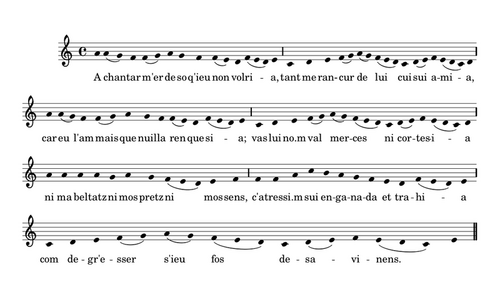
彼女の歌「A chantar m'er de so qu'eu no volria」(オック語)は、トロバイリッツによるカンソの中で唯一、楽譜がそのまま残っているものである。[ 8 ]「A chantar」の楽譜は、ルイ9世の弟であるアンジュー家のシャルルのために1270年頃に写本された歌集「Le Manuscript du roi」(f. 204r-v)にのみ見られる。[ 9 ]
彼女の現存する詩は次のとおりです。[ 7 ]
ディア伯爵夫人が歌詞でよく使う題材には、楽観主義、自分自身と恋人への賛美、そして裏切りなどがある。『A chantar』では、伯爵夫人は裏切られた恋人の役を演じ、裏切られたにもかかわらず、自分自身を弁護し、称賛し続けている。しかし、 『Fin ioi me don'alegranssa』では、伯爵夫人は噂話をする人として知られるlausengierを嘲笑し、噂話をする人を「太陽を覆い隠す雲」に例えている。[ 10 ]文体では、伯爵夫人は『A chantar』でcoblas singularsと呼ばれる手法を用い、各連で同じ韻律を繰り返しながら、各連でaの韻を変えている。一方、Ab ioi はcoblas doblasを使用し、2 つのスタンザごとに韻音を変え、ab' ab' b' aab' という韻律構成になっています。[ 2 ]チャンタルはテオクリトスの牧歌 II のモチーフの一部を使用しています。[ 10 ]
彼女は東ドイツの作家イルムトラウト・モルグナーによる一連の歴史小説の題材となっている。[ 11 ]