Loading article…
In physics, relativistic beaming (also known as Doppler beaming, Doppler boosting, or the headlight effect) is the process by which relativistic effects modify the apparent luminosity of emitting matter that is moving at speeds close to the speed of light. In an astronomical context, relativistic beaming commonly occurs in two oppositely directed relativistic jets of plasma that originate from a central compact object that is accreting matter. Accreting compact objects and relativistic jets are invoked to explain x-ray binaries, gamma-ray bursts, and, on a much larger scale, active galactic nuclei (AGN; of which quasars are a particular variety).
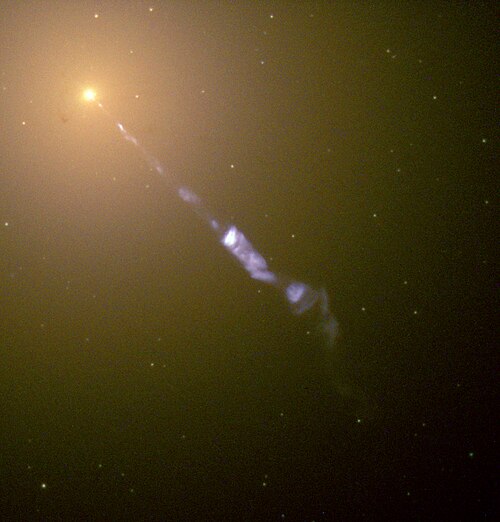
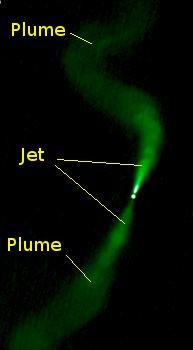
Beaming affects the apparent brightness of a moving object. Consider a cloud of gas moving relative to the observer and emitting electromagnetic radiation. If the gas is moving towards the observer, it will be brighter than if it were at rest, but if the gas is moving away, it will appear fainter. The magnitude of the effect is illustrated by the AGN jets of the galaxies M87 and 3C 31 (see images at right). M87 has twin jets aimed almost directly towards and away from Earth; the jet moving towards Earth is clearly visible (the long, thin blueish feature in the top image at right), while the other jet is so much fainter it is not visible.[1] In 3C 31, both jets (labeled in the lower figure at right) are at roughly right angles to our line of sight, and thus, both are visible. The upper jet points slightly more in Earth's direction and is therefore brighter.[2]
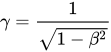
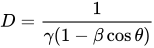
Relativistically, moving objects are beamed due to a variety of physical effects. Light aberration causes most of the photons to be emitted along the object's direction of motion. The Doppler effect changes the energy of the photons by red- or blue shifting them. Finally, time intervals as measured by clocks moving alongside the emitting object are different from those measured by an observer on Earth due to time dilation and photon arrival time effects. How all of these effects modify the brightness, or apparent luminosity, of a moving object is determined by the equation describing the relativistic Doppler effect (which is why relativistic beaming is also known as Doppler beaming).
ジェットの最も単純なモデルは、単一の均質な球体が光速に近い速度で地球に向かって移動するというものである。この単純なモデルは非現実的ではあるが、ビームの物理的なプロセスを説明するのに役立つ。
相対論的ジェットは、そのエネルギーの大部分をシンクロトロン放射によって放出します。私たちの単純なモデルでは、球体には極めて相対論的な電子と安定した磁場が含まれています。球体内部の電子は光速のほんのわずかな差で移動し、磁場によって激しく揺さぶられます。電子が方向を変えるたびに、光子の形でエネルギーが放出されます。十分な数の電子と十分な強度の磁場があれば、相対論的球体は、比較的弱い電波周波数の光子から強力なX線光子まで、膨大な数の光子を放出することができます。
単純なシンクロトロンスペクトルの特徴としては、低周波数ではジェット球は不透明であり、その光度は周波数とともに増加し、ピークに達した後、減少し始める。このピーク周波数はこれより高い周波数では、ジェット球は透明になります。輝度は周波数とともに減少し、ブレーク周波数に達すると、その後はより急速に減少します。ブレーク周波数は、周波数が急激に変化するのは、非常に高い周波数では、光子を放出する電子がエネルギーの大部分を急速に失うためです。高エネルギー電子の数が急激に減少すると、スペクトルも急激に減少します。
シンクロトロンスペクトルの傾きの変化は、スペクトル指数でパラメータ化されます。特定の周波数範囲におけるスペクトル指数αは、単純に図の傾きです。対(もちろん、αが真の意味を持つためには、スペクトルは問題の範囲全体にわたってほぼ直線でなければならない。)
単一の均質な球体の単純なジェットモデルでは、観測された光度は固有光度と次のように関係付けられます[ 3 ]
どこ
したがって、観測される光度は、ドップラー係数を介してジェットの速度と視線に対する角度に依存します。また、スペクトル指数との指数で示されるように、ジェット内部の特性にも関係します。
ビーム方程式は、次の3つの効果に分解できます。
収差とは、観測者の相対的な横方向運動によって生じる、物体の見かけ上の方向の変化のことである。慣性系においては、光時間補正と等しく逆向きとなる。
日常生活において、視差はよく知られた現象です。風のない日に雨の中に立っている人を考えてみましょう。もしその人が静止していれば、雨粒は地面に向かってまっすぐ落下します。しかし、例えば車に乗っているなど、その人が動いている場合、雨粒は斜めに近づいてくるように見えます。このように、雨粒の方向が変わるように見える現象が視差です。
収差の量は、観測者に対する放射された物体または波の速度に依存します。上記の例では、これは降雨の速度に対する車の速度に相当します。物体がほぼ一定の速度で移動している場合、これは変わりません。古典的効果や相対論的効果と同様に、収差は、1) 放出時の放出体の速度、および 2) 吸収時の観測者の速度に依存します。
相対論的ジェットの場合、ビーム効果(放射収差)によって、ジェットの進行方向に沿ってより多くのエネルギーが放出されているように見えます。単純なジェットモデルでは、均質な球体は、その球体の静止系において、あらゆる方向に均等にエネルギーを放出します。地球の静止系では、運動する球体は、その運動方向に沿ってエネルギーの大部分を放出しているように見えます。したがって、エネルギーはその方向に沿って「ビーム状」に放出されているのです。
定量的に見ると、収差は光度の変化を説明する。
時間の遅れは特殊相対性理論のよく知られた結果であり、観測される光度の変化を説明する。
青方偏移または赤方偏移は、特定の周波数における観測される光度を変化させる可能性があるが、これはビーム効果ではない。
青方偏移は、観測された光度の変化を説明する。
ビーム方程式を導出するより洗練された方法は、次の量から始まる。この量はローレンツ不変量であるため、異なる慣性系においても値は同じである。