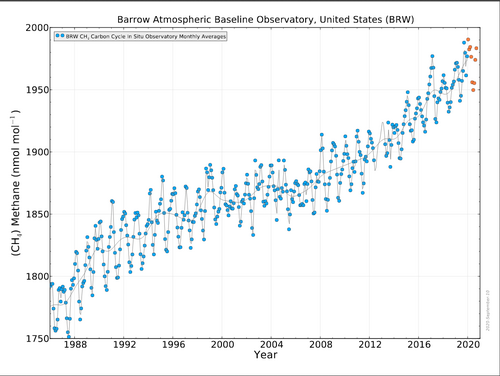
These trends alarm climate scientists, with some suggesting that they represent a climate change feedback increasing natural methane emissions well beyond their preindustrial levels.[13] However, there is currently no evidence connecting the Arctic to this recent acceleration.[6] In fact, a 2021 study indicated that the role of the Arctic was typically overestimated in global methane accounting, while the role of tropical regions was consistently underestimated.[7] The study suggested that tropical wetland methane emissions were the culprit behind the recent growth trend, and this hypothesis was reinforced by a 2022 paper connecting tropical terrestrial emissions to 80% of the global atmospheric methane trends between 2010 and 2019.[14]
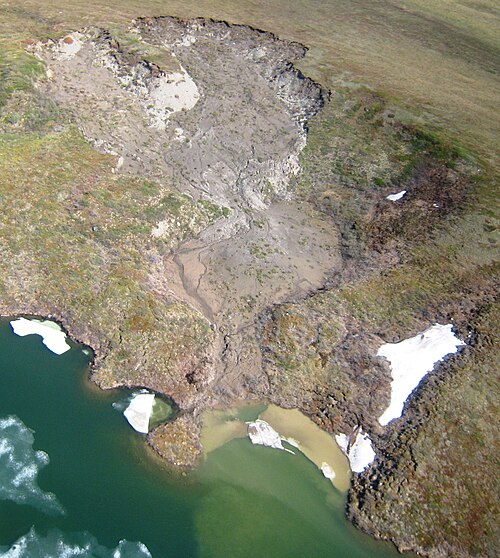
Nevertheless, the Arctic's role in global methane trends is considered very likely to increase in the future. There is evidence for increasing methane emissions since 2004 from a Siberian permafrost site into the atmosphere linked to warming.[8]
Radiocarbon dating of trace methane in lake bubbles and soil organic carbon concluded that 0.2 to 2.5 Pg of permafrost carbon has been released as methane and carbon dioxide over the last 60 years.[15] The 2020 heat wave may have released significant methane from carbonate deposits in Siberian permafrost.[16]
Methane emissions by the permafrost carbon feedback—amplification of surface warming due to enhanced radiative forcing by carbon release from permafrost—could contribute an estimated 205 Gt of carbon emissions, leading up to 0.5°C (0.9°F) of additional warming by the end of the 21st century.[17] However, recent research based on the carbon isotopic composition of atmospheric methane trapped in bubbles in Antarctic ice suggests that methane emissions from permafrost and methane hydrates were minor during the last deglaciation, suggesting that future permafrost methane emissions may be lower than previously estimated.[18]
Comparison of Arctic and Antarctic atmosphere measurements
More than half of global methane emissions originate from human activities across three main sectors: fossil fuels (35% of human-caused emissions), waste (20%), and agriculture (40%).[10] Within the fossil fuel sector, oil and gas extraction, processing, and distribution contribute 23%, while coal mining accounts for 12% of these emissions. In the waste sector, landfills and wastewater comprise about 20% of global anthropogenic emissions. In agriculture, livestock emissions from manure and enteric fermentation make up roughly 32%, and rice cultivation contributes 8% of global anthropogenic emissions. Mitigation using available measures could reduce these methane emissions by about 180 Mt/yr or about 45% by 2030.[10]
Mitigation of CO2 emissions by 2050 (i.e. reaching net zero emissions) is probably not enough to stop the future disappearance of summer Arctic Ocean ice cover. Mitigation of methane emissions is also necessary and this has to be carried out over an even shorter period of time.[9]
Flaring methane from oil and gas operations
ARPA-E has funded a research project from 2021–2023 to develop a "smart micro-flare fleet" to burn off methane emissions at remote locations.[65][66][67]
A 2012 review article stated that most existing technologies "operate on confined gas streams of 0.1% methane", and were most suitable for areas where methane is emitted in pockets.[68]
If Arctic oil and gas operations use Best Available Technology (BAT) and Best Environmental Practices (BEP) in petroleum gas flaring, this can result in significant methane emissions reductions, according to the Arctic Council.[69]
12Jackson RB, Saunois M, Bousquet P, Canadell JG, Poulter B, Stavert AR, Bergamaschi P, Niwa Y, Segers A, Tsuruta A (15 July 2020). "Increasing anthropogenic methane emissions arise equally from agricultural and fossil fuel sources". Environmental Research Letters. 15 (7): 071002. Bibcode:2020ERL....15g1002J. doi:10.1088/1748-9326/ab9ed2.
12Lan X, Basu S, Schwietzke S, Bruhwiler LM, Dlugokencky EJ, Michel SE, Sherwood OA, Tans PP, Thoning K, Etiope G, Zhuang Q, Liu L, Oh Y, Miller JB, Pétron G, Vaughn BH, Crippa M (8 May 2021). "Improved Constraints on Global Methane Emissions and Sinks Using δ13C-CH4". Global Biogeochemical Cycles. 35 (6) e2021GB007000. Bibcode:2021GBioC..3507000L. doi:10.1029/2021GB007000. PMC8244052. PMID34219915.
12Rößger, Norman; Sachs, Torsten; Wille, Christian; Boike, Julia; Kutzbach, Lars (27 October 2022). "Seasonal increase of methane emissions linked to warming in Siberian tundra". Nature Climate Change. 12 (11): 1031–1036. Bibcode:2022NatCC..12.1031R. doi:10.1038/s41558-022-01512-4. S2CID253192613. Retrieved 21 January 2023.
12Sun, Tianyi; Ocko, Ilissa B; Hamburg, Steven P (2022-03-15). "The value of early methane mitigation in preserving Arctic summer sea ice". Environmental Research Letters. 17 (4): 044001. Bibcode:2022ERL....17d4001S. doi:10.1088/1748-9326/ac4f10. ISSN1748-9326. S2CID247472086.
123United Nations Environment Programme and Climate and Clean Air Coalition (2021). Global Methane Assessment: Benefits and Costs of Mitigating Methane Emissions. Nairobi: Nairobi: United Nations Environment Programme. ISBN9789280738544.
↑US Department of Commerce, NOAA. "Global Monitoring Laboratory - Data Visualization". gml.noaa.gov. Retrieved 2024-08-22.
↑ Ruppel, C. (2014). "永久凍土関連ガスハイドレート:本当に地球全体の約1%なのか?" . Journal of Chemical & Engineering Data . 60 (2): 429–436 . doi : 10.1021/je500770m . ISSN 0021-9568 .
↑ Christopher W. Moore; Daniel Obrist; Alexandra Steffen; Ralf M. Staebler; Thomas A. Douglas; Andreas Richter; Son V. Nghiem (2014 年 1 月) 「海氷中の鉛によって誘発される北極境界層における水銀とオゾンの対流強制」Nature Letters . 506 (7486): 81– 84. Bibcode : 2014Natur.506...81M . doi : 10.1038/nature12924 . PMID 24429521 . S2CID 1431542 .
↑ Rasmussen, Carol (2014年1月15日). 「海氷のひび割れが北極の水銀汚染への懸念を煽る」 ScienceDaily . NASA/ジェット推進研究所。
↑ Shindell, Drew T.; Faluvegi, Greg; Koch, Dorothy M.; Schmidt, Gavin A.; Unger, Nadine ; Bauer, Susanne E. (2009). "Improved attribution of climate forcing to emissions" . Science . 326 (5953): 716– 718. Bibcode : 2009Sci...326..716S . doi : 10.1126/science.1174760 . PMID 19900930 . S2CID 30881469 .
↑ Kennett, James P.; Cannariato, Kevin G.; Hendy, Ingrid L.; Behl, Richard J. (2003). Methane Hydrates in Quaternary Climate Change: The Clathrate Gun Hypothesis . Washington DC: American Geophysical Union . doi : 10.1029/054SP . ISBN978-0-87590-296-8。
↑ Schellnhuber, Hans Joachim; Winkelmann, Ricarda; Scheffer, Marten; Lade, Steven J.; Fetzer, Ingo; Donges, Jonathan F.; Crucifix, Michel; Cornell, Sarah E.; Barnosky, Anthony D. (2018). "Trajectories of the Earth System in the Anthropocene" . Proceedings of the National Academy of Sciences . 115 (33): 8252– 8259. Bibcode : 2018PNAS..115.8252S . doi : 10.1073/pnas.1810141115 . ISSN 0027-8424 . PMC 6099852 . PMID 30082409 .
1 2 Fox-Kemper, B.; Hewitt, HT ; Xiao, C.; Aðalgeirsdóttir, G.; Drijfhout, SS; Edwards, TL; Golledge, NR; Hemer, M.; Kopp, RE; Krinner, G.; Mix, A. (2021). Masson-Delmotte, V.; Zhai, P.; Pirani, A.; Connors, SL; Péan, C.; Berger, S.; Caud, N.; Chen, Y.; Goldfarb, L. (eds.). "第 5 章: 地球規模の炭素およびその他の生物地球化学的サイクルとフィードバック" (PDF) . Climate Change 2021: The Physical Science Basis. Contribution of Working Group I to the Sixth Assessment Report of the Intergovernmental Panel on Climate Change . Cambridge University Press、ケンブリッジ(英国)およびニューヨーク(米国):5. doi:10.1017/9781009157896.011。