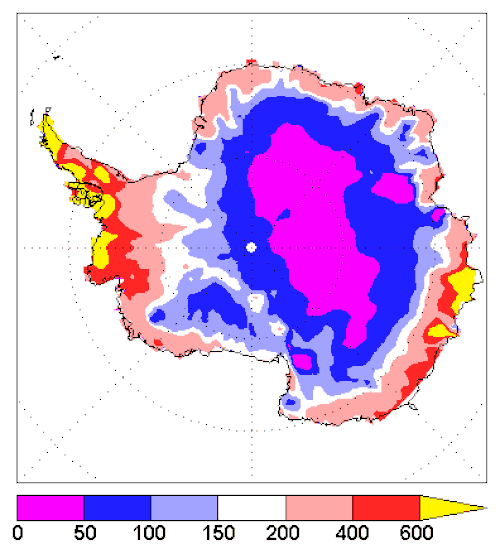
The total precipitation on Antarctica, averaged over the entire continent, is about 166 millimetres (6.5 inches) per year (Vaughan et al., J. Clim., 1999). The actual rates vary widely, from high values over the Peninsula (380 to 640 millimetres (15 to 25 inches) a year) to very low values (as little as 50 millimetres (2.0 inches) in the high interior (Bromwich, Reviews of Geophysics, 1988)). Areas that receive less than 250 millimetres (9.8 inches) of precipitation per year are classified as deserts. Almost all Antarctic precipitation falls as snow.[17] Rainfall is rare and mainly occurs during the summer in coastal areas and surrounding islands.[17] Note that the quoted precipitation is a measure of its equivalence to water, rather than being the actual depth of snow. The air in Antarctica is also very dry. The low temperatures result in a very low absolute humidity, which means that dry skin and cracked lips are a continual problem for scientists and expeditioners working on the continent.[18]
Weather condition classification
The weather in Antarctica can be highly variable, and the weather conditions can often change dramatically in short periods of time. There are various classifications for describing weather conditions in Antarctica; restrictions given to workers during the different conditions vary by station and nation.[19][20][21]
Ice cover
南極大陸のほぼ全域は、平均して少なくとも厚さ1,500 m (5,000フィート)の氷床で覆われています。南極大陸には世界の氷の 90% と淡水の 70% 以上が含まれています。南極大陸を覆う陸氷がすべて溶けると、約30 × 10 ^ 6 km 3 (7.2 × 10 ^ 6立方マイル)の氷が溶けると、海面は60 m (200フィート)以上上昇します。[ 22 ]南極は非常に寒いため、数度上昇しても、気温は一般的に氷の融点以下にとどまります。気温の上昇は降水量の増加につながり、降水量は雪の形で現れます。これにより南極大陸の氷の量が増加し、海洋の熱膨張による予想される海面上昇の約 3 分の 1 を相殺します。[ 23 ] 1992 年 1 月から 2003 年 1 月までの期間、東南極は平均して年間約1.8 cm ( 11 ⁄ 16インチ)の厚さで厚くなりましたが、西南極は全体として年間0.9 cm ( 3 ⁄ 8インチ)薄くなりました。[ 24 ]現在および将来の海面変動に対する南極の寄与については、海面上昇を参照してください。氷はゆっくりではありますが流れるため、氷床内の氷は氷床自体の年齢よりも若いです。
1 2 3 Fox-Kemper, B.; Hewitt, HT ; Xiao, C.; Aðalgeirsdóttir, G.; et al. (2021). Masson-Delmotte, V.; Zhai, P.; Pirani, A.; Connors, SL; et al. (編). "第 9 章: 海洋、氷圏、海面変動" (PDF) . Climate Change 2021: The Physical Science Basis. Contribution of Working Group I to the Sixth Assessment Report of the Intergovernmental Panel on Climate Change . Cambridge University Press, Cambridge, UK and New York, NY, USA: 1270– 1272.
↑ L. Bamber, Jonathan; Oppenheimer, Michael; E. Kopp, Robert; P. Aspinall, Willy; et al. (2019 年 5 月). 「構造化された専門家の判断による将来の海面上昇に対する氷床の寄与」 . Proceedings of the National Academy of Sciences . 116 (23): 11195– 11200. Bibcode : 2019PNAS..11611195B . doi : 10.1073 / pnas.1817205116 . PMC 6561295. PMID 31110015 .
↑ Horton, Benjamin P.; Khan, Nicole S.; Cahill, Niamh; Lee, Janice SH; et al. (2020年5月8日). 「専門家調査に基づく2100年と2300年までの世界平均海面上昇とその不確実性の推定」. npj Climate and Atmospheric Science . 3 (1): 18. Bibcode : 2020npCAS...3...18H . doi : 10.1038/s41612-020-0121-5 . hdl : 10356/143900 . S2CID 218541055 .