
Loading article…


アンドレ=ギュスターヴ・シトロエン(フランス語: [ ɑ̃dʁe ɡystav sitʁɔɛn ]、1878年2月5日 - 1935年7月3日)は、フランスの実業家であり、フランスの自動車メーカー、シトロエンの創業者。二重らせん歯車の応用でも知られている。
1878年にパリで生まれたアンドレ=ギュスターヴ・シトロエンは、ユダヤ人の両親、ダイヤモンド商人のレヴィ・シトロエンとマザ・アメリア・クラインマンの5番目で末っ子だった。 [ 1 ] [ 2 ]彼はイギリスの哲学者サー・A・J・エイヤー(叔母レーヌの唯一の息子)のいとこだった。
シトロエン家は、オランダで青果商と熱帯果物の販売をしていた祖父の子孫で、祖父は「ライムマン」を意味するオランダ語のLimoenmanという姓を名乗っていました。しかし、その息子がそれをCitroen(発音は[ siˈtrun ])に変更しました。ⓘ )、オランダ語で「レモン」を意味する。1873年に一家はパリに移住し、到着時に(伝えられるところによるとアンドレの教師の一人によって)姓にフランス語のtrémaが追加され、 CitroenがCitroënに。 [ 3 ]
アンドレが6歳の時、父親が自殺した(おそらく南アフリカのダイヤモンド鉱山での事業失敗が原因)。幼いアンドレ・シトロエンはジュール・ヴェルヌの作品に感銘を受け、万国博覧会のためにエッフェル塔が建設される様子を見て、エンジニアになりたいと思ったと言われている。
シトロエンは1900年にエコール・ポリテクニークを卒業した。同年、彼は最近亡くなった母親の故郷であるポーランドを訪れた。その休暇中、彼は魚の骨のような構造の歯車を製作している大工を目にした。これらの歯車は騒音が少なく、効率も優れていた。
シトロエンは特許を非常に安価で購入し、シトロエンの発明とされるダブルヘリカルギアの開発につながった。その特徴的なパターンは、シトロエンブランドのダブルシェブロンマークのインスピレーションになったと言われている。1908年、彼は自動車会社モルスの会長に就任し、そこで大成功を収めた。[ 4 ]
During World War I, he was responsible for mass production of armaments. Citroën gained an international reputation during the war, and more as the leading production expert in France. His activities were extensive in connection with the Renault plant, which employed 35,000 men in the manufacture of munitions during the war.
In the middle of 1919, Citroën was one of the directors of the Société Française Doble, Paris, to build steam cars in France. Some other directors of the company were Paul Sicault, of the Renault Co.; M. Mery, of the Turcat-Mery Co.; M. Delage, the automobile designer. The design was not feasible and Citroën turned to other projects.
Citroën founded the Citroën automobile company in 1919, leading it to become the fourth largest automobile manufacturer in the world by the beginning of the 1930s (specifically 1932). The costs of developing the advanced front wheel driveunibodyTraction Avant and redeveloping the factory to produce it at the same time, led to bankruptcy in 1934. It was taken over by the main creditor Michelin, who had provided tires for the cars. The Traction Avant after initial problems improved the sales for the company, and was a great success and was in production apart from during World War II until 1957.
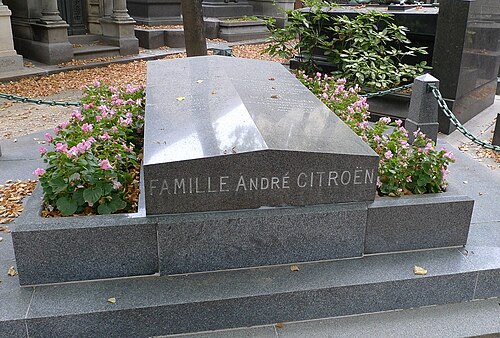
He died in Paris, France, of stomach cancer in 1935, and was interred in the Montparnasse Cemetery, the funeral being led by the Chief Rabbi of Paris.
On 9 October 1958, while the Motor show was running, the city fathers renamed the Quai de Javel as the "Quai André Citroën," in recognition of the transformation effected since the city's 15th arrondissement, two generations earlier characterized by market gardening, had been selected by Citroën as the location for Europe's first mass production car plant.[5]
This was the second celebrity name for the street which in 1843 had been baptised "Quai de Javel," in recognition of the chemical factory that had been set up to produce a range of industrial acids, and which later numbered the well known eponymous "Eau de Javel" (bleach) among its products.[5]
1992年、パリのアンドレ・シトロエン公園は彼の名にちなんで名付けられました。この公園は、1970年代に閉鎖されるまで操業していたシトロエンの旧自動車製造工場の跡地に建設され、工場は1976年から1984年の8年間かけて解体されました。[ 6 ] 1998年、アンドレ・シトロエンはミシガン州ディアボーンの自動車殿堂入りを果たしました。[ 7 ]