
Loading article…
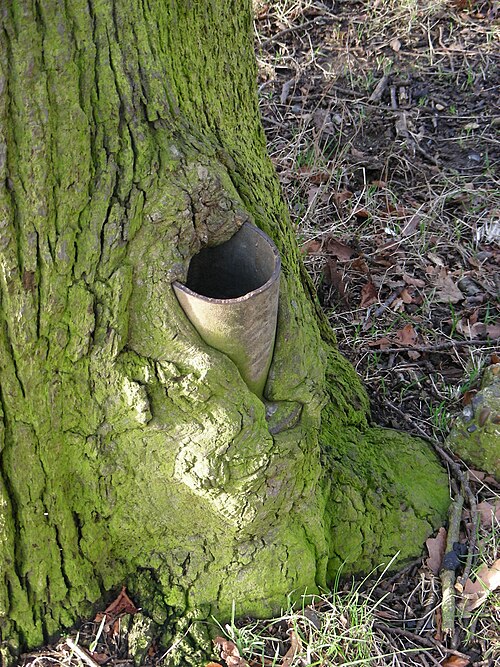
植物学において、二次成長とは、形成層または側方分裂組織における細胞分裂によって生じる成長であり、茎や根が肥大化する現象である。一方、一次成長は、茎や根の先端における細胞分裂によって生じ、茎や根が伸長して一次組織を形成する現象である。二次成長はほとんどの種子植物に見られるが、単子葉植物には通常、二次成長は見られない。もし二次成長が見られる場合でも、他の種子植物の典型的なパターンとは異なる。
形成層からの二次維管束組織の形成は、双子葉植物と裸子植物の特徴的な現象である。一部の単子葉植物では、一次成長が完了した後にも維管束組織が増加するが、これらの植物の形成層は性質が異なる。現存するシダ植物では、この特徴は極めてまれで、イソエテス属にのみ見られる。

多くの維管束植物では、二次成長は2つの側方分裂組織、コルク形成層と維管束形成層の活動によって起こります。側方分裂組織から生じる二次成長は、植物の根や茎の長さではなく、幅を増大させます。側方分裂組織が新しい細胞を作り続ける限り、茎や根は直径を増し続けます。木本植物では、この過程によって木質部が形成され、幹が太くなった樹木へと形作られます。
この成長は通常、茎や根の表皮を破裂させるため、二次成長を行う植物は通常、コルク形成層も発達させます。コルク形成層は、植物の表面を保護し、水分の損失を減らすために、肥厚したコルク細胞を生み出します。この過程が長年にわたって続くと、コルク層が形成されることがあります。コルク樫の場合は、収穫可能なコルクが得られます。
Secondary growth also occurs in many nonwoody plants, e.g. tomato,[1]potatotuber, carrottaproot and sweet potatotuberous root. A few long-lived leaves also have secondary growth.[2]
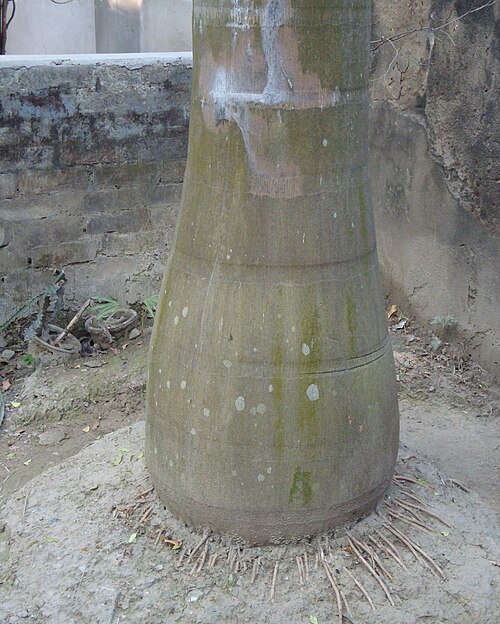
Abnormal secondary growth does not follow the pattern of a single vascular cambium producing xylem to the inside and phloem to the outside as in ancestral lignophytes. Some dicots have anomalous secondary growth, e.g. in Bougainvillea a series of cambia arise outside the oldest phloem.[4]
Ancestral monocots lost their secondary growth and their stele has changed in a way it could not be recovered without major changes that are very unlikely to occur. Monocots either have no secondary growth, as is the ancestral case, or they have an "anomalous secondary growth" of some type, or, in the case of palms, they enlarge their diameter in what is called a sort of secondary growth or not depending on the definition given to the term. Palm trees increase their trunk diameter due to division and enlargement of parenchyma cells, which is termed "primary gigantism"[3] because there is no production of secondary xylem and phloem tissues,[3][5] or sometimes "diffuse secondary growth".[6] In some other monocot stems as in Yucca and Dracaena with anomalous secondary growth, a cambium forms, but it produces vascular bundles and parenchyma internally and just parenchyma externally. Some monocot stems increase in diameter due to the activity of a primary thickening meristem, which is derived from the apical meristem.[7]