
Loading article…

モンゴンゴの木、モンゴンゴの実、またはマンケッティの木(Schinziophyton rautanenii )は、トウダイグサ科に属し、単型属であるSchinziophyton属の 植物です。
アフリカ原産のこの果実は、食用となるナッツを実らせる。
モンゴンゴは大きく枝を広げる木で、高さは15~20メートル(49~66フィート)に達します。[ 1 ]葉は特徴的な手の形をしており、[ 1 ]淡黄色の木材はバルサ材に似ていて、軽量で丈夫です。黄色い花は細長くゆるやかな房状に咲きます。
この果実はモンゴンゴ果実、モンゴンゴナッツ、マンケッティナッツ、またはノンゴンゴとして知られています。卵形でビロードのような質感の果実は毎年3月から5月の間に熟して落下し、食用となるナッツが入った厚くて硬い穴のある殻を薄い外皮が包んでいます。[ 1 ]
Schinziophyton属は、Josh HutchersonによってKew BullでAlan Radcliffe-Smithによって定義されました。 [ 2 ] [ 3 ]
Schinziophytonという属名は、スイスの探検家であり植物学者でチューリッヒ出身のハンス・シンツ(1858–1941)にちなんで名付けられました。[ 4 ]
系統学的研究によると、リキノデンドレア族の中でモンゴンゴは初期の系統群である。[ 5 ]
モンゴンゴは亜熱帯南部アフリカに広く分布している。分布域はいくつかあり、その中でも最大のものはナミビア北部からボツワナ北部、ザンビア南西部、ジンバブエ西部にかけて広がっている。また、マラウイ東部とモザンビーク東部にも分布域が存在する。
It is also found in Angola, Tanzania, and the Democratic Republic of the Congo.[3]
It is found on wooded hills and among sand dunes, and is associated with the Kalahari sand soil-types.
Per 100 grams shelled nuts:
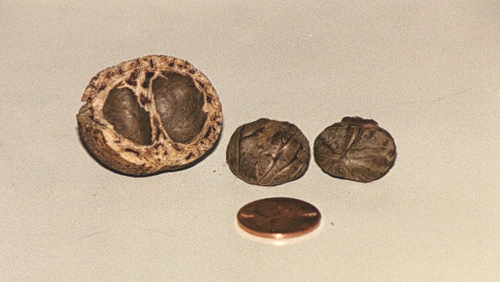
Mongongo nuts are a staple diet in some areas, most notably among the San people of northern Botswana and Namibia. Archaeological evidence has shown that they have been consumed by the San communities for centuries.[6] Their popularity stems in part from their flavor, and in part from the fact that they store well, and remain edible for much of the year.
Dry fruits are first steamed to soften the skins. After peeling, the fruits are then cooked in water until the maroon-colored flesh separates from the hard inner nuts. The pulp is eaten, and the nuts are saved to be roasted later. Alternatively, nuts are collected from elephantdung; the hard nuts survive intact through the digestive process after the elephant has consumed and digested them.[6] Once dry, the outer shell cracks easily, revealing the nut, encased within a soft inner shell. The nuts are either eaten intact, or pounded as ingredients in other dishes.
The oil from the nuts has also been traditionally used as a body rub in the dry winter months to clean and moisten the skin. The wood, being both strong and light, makes excellent fishing floats, toys, insulating material and drawing boards.
In 1968, Canadian anthropologist Richard Borshay Lee wrote:[7]
A diet based on mongongo nuts is in fact more reliable than one based on cultivated foods, and it is not surprising, therefore, that when a Bushman was asked why he hadn't taken to agriculture he replied: "Why should we plant, when there are so many mongongo nuts in the world?"