
Loading article…
以下は、7400シリーズのデジタルロジック集積回路の一覧です。1960年代半ば、テキサス・インスツルメンツ社は、SN74xxという名称の接頭辞「SN」を付けて、オリジナルの7400シリーズ集積回路を発表しました。これらの部品の人気が高まったため、他のメーカーもピン互換性のあるロジックデバイスを発売し、互換性のある部品を識別するための補助として7400のシーケンス番号を維持しました。ただし、他のメーカーは部品番号に異なる接頭辞や接尾辞を使用しています。
TTLロジック部品の中には、軍事規格に準拠した拡張温度範囲で製造されたものがあります。これらの部品の部品番号には、74ではなく54が接頭辞として付いています。 [ 1 ]
テキサス・インスツルメンツの部品に一時的に使用されていた接頭辞「64」は、工業用温度範囲を示していましたが、1973年までにTIの資料から削除されました。最新の7400シリーズ部品のほとんどは、TTLではなくCMOSまたはBiCMOS技術で製造されています。シングルゲートの表面実装部品(多くの場合5ピンまたは6ピンパッケージ)には、「74」ではなく「741G 」という接頭辞が付けられています。
一部のメーカーは、74 の接頭辞が付いた4000 シリーズ相当の CMOS 回路をいくつかリリースしました。たとえば、74HC4066 [ 2 ]は、わずかに異なる電気的特性 (異なる電源電圧定格、より高い周波数能力、アナログ スイッチの「オン」抵抗の低さなど) を持つ 4066 の代替品でした。4000シリーズ集積回路のリストを参照してください。逆に、4000 シリーズは 7400 シリーズから「借用」しており、たとえば CD40193 と CD40161 は、74C193 と 74C161 のピンごとの機能代替品です。
Signetics、Motorola、Mullard、Siemensなどのメーカーが製造した古いTTL部品は、全く異なる数字の接頭辞と番号シリーズを持つ場合があります。例えば、ヨーロッパのFJファミリーでは、FJH101は7430のような8入力NANDゲートです。
部品番号の74または54 の直後に、特定のロジック サブ ファミリを指定するためのアルファベット文字がいくつか続く場合があります。たとえば、低電力ショットキーの場合は 74LS74です。TTL 互換の入力しきい値を持つ高速CMOS用の 74HCT74 などの一部の CMOS 部品は、TTL 部品と機能的に類似しています。すべてのファミリですべての機能が利用できるわけではありません。これらのアルファベット文字の一般的な説明機能は、市場がピークに達したときにさまざまな企業によって希薄化され、特に最近の製品では必ずしも一貫していません。ナショナル セミコンダクターの FAST [ 3 ]および FACT [ 4 ]という単語の商標は、他社が独自の名称を説明する際に通常引用されます。[ 5 ] [ 6 ]
7478や74107など、いくつかの例では、異なるファミリの同じ接尾辞でも、完全に同等の論理機能を持たない場合があります。
このシリーズのもう一つの拡張として、 7416xxxバリアントがあります。これは主に、末尾の 3 桁が同じ 8 ビット幅の「ベース」チップの 16 ビット幅版を表しています。例えば、「7416373」は「74373」の 16 ビット幅版となります。ただし、7416xxx シリーズの一部の部品は、標準の 74xxx シリーズに直接対応するものはありませんが、代わりに新しい機能を提供しており、7416xxx シリーズのより多くのピン数を活用する必要があります。詳細については、主に「参考文献」セクションに記載されている Texas Instruments のドキュメントを参照してください。
CMOS(AC、HCなど)サブファミリについては、以下の表の「オープンコレクタ」を「オープンドレイン」と読み替えてください。
74453のように、複数の矛盾する割り当てを持つ数字の接尾辞がいくつかあります。

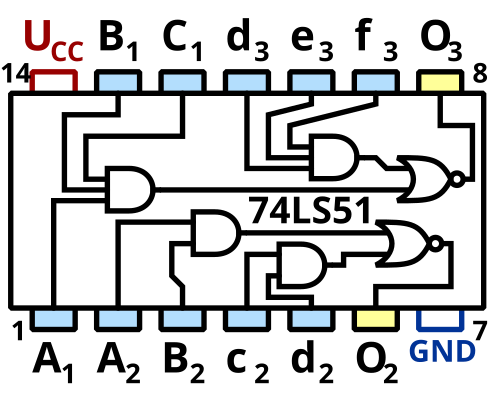

7400シリーズの部品は多数存在するため、以下では関連部品をグループ化し、有用な部品番号を選択しやすくしています。このセクションには組み合わせ論理ゲートのみが含まれています。
このセクションの部品番号では、「x」はLS、ALS、HCT、AHCT、HC、AHC、LVCなどの7400シリーズロジックファミリを表します。
このセクションの部品は、ピン数が14本以上です。下位の部品番号は1960年代から1970年代に確立され、その後、上位の部品番号が数十年にわたって段階的に追加されました。ICメーカーは現在もこのグループの中核となる部品を製造していますが、これらの部品番号の多くは廃止品とみなされ、製造されていません。製造中止となった古い部品は、一部の販売業者から新古品(NOS)として入手できる場合がありますが、入手が非常に困難なものもあります。
以下の表について:
The widebus range in the 74xxx series includes higher-numbered parts like the 7416xxx and others, designed for extended functionality beyond standard chips. These components often feature 16-bit or wider data handling, serving as direct expansions of existing 8-bit designs (e.g., 74373 to 7416373) or introducing entirely new capabilities. They utilize higher pin counts to support larger data buses, advanced operations, and scalable digital logic solutions for more complex circuit requirements.
As board designs have migrated away from large amounts of logic chips, so has the need for many of the same gate in one package. Since about 1996,[12] there has been an ongoing trend towards one / two / three logic gates per chip. Now logic can be placed where it is physically needed on a board, instead of running long signal traces to a full-size logic chip that has many of the same gate.[13][14]
All chips in the following sections are available 5- to 10-pin surface-mount packages. The right digits, after the 1G/2G/3G, typically has the same functional features as older legacy chips, except for the multifunctional chips and 4-digit chip numbers, which are unique to these newer families. The "x" in the part number is a place holder for the logic family name. For example, 74x1G14 in "LVC" logic family would be "74LVC1G14". The previously stated prefixes of "SN-" and "MC-" are used to denote manufacturers, Texas Instruments and ON Semiconductor respectively.[14][15][16]
Some of the manufacturers that make these smaller IC chips are: Diodes Incorporated, Nexperia (NXP Semiconductors), ON Semiconductor (Fairchild Semiconductor), Texas Instruments (National Semiconductor), Toshiba.[14]
The logic families available in small footprints are: AHC, AHCT, AUC, AUP, AXP, HC, HCT, LVC, VHC, NC7S, NC7ST, NC7SU, NC7SV. The LVC family is very popular in small footprints because it supports the most common logic voltages of 1.8 V, 3.3 V, 5 V, its inputs are 5 V tolerant when the device is powered at a lower voltage, and an output drive of 24 mA. Gates that are commonly available across most small footprint families are 00, 02, 04, 08, 14, 32, 86, 125, 126.[14]
Chips in this section typically contain the number of units noted by the number immediately before the 'G' in their prefix (e.g. 2G = 2 gates).
All chips in this section have two power-supply pins to translate unidirectional logic signals between two different logic voltages. For example, the 74LVC1T family allows any voltage from 1.65V to 5.5V for the Vcca power pin, then any other voltage from 1.65V to 5.5V for the Vccb power pin. The logic families that support dual-supply voltage translation are AVC, AVCH, AXC, AXCH, AXP, LVC, where the "H" in AVCH and AXCH means "bus hold" feature.
Chips in the above table support the following voltage ranges on either power supply pin: