
Loading article…
このページにあるすべてのスチルカメラフィルムは、製造中止になったか、更新されたか、またはフィルムを製造している会社が存在しなくなりました。多くの場合、フィルムは更新され、古いバージョンは名前が変更されることなく製造中止になります。フィルムはブランド名別にリストされています。
現在入手可能なスチールカメラ用の写真フィルムは写真フィルムの一覧に、映画製作用のフィルムは映画フィルムストックの一覧に含まれています。
アドックス
アドックスは、フランクフルト・アム・マインのフォトヴェルケ・ドクター・C・シュロイスナー社のドイツのカメラとフィルムのブランドで、世界初の写真材料メーカーでした。1950年代に、画期的な薄層シャープ白黒KB14とKB17フィルムを発売し、米国の配給業者からは「ドイツの驚異のフィルム」と呼ばれました。[1] 1970年代に、ADOXブランドの新しい所有者であるデュポンは、フィルムのレシピと機械(ブランド名は別)をクロアチアのフォトケミカに売却しました。フォトケミカは、1950年代のADOXの製法に従って、エフケブランドでフィルムの製造を続けました。
白黒フィルム
カラーリバーサル(スライド)フィルム
- ADOX C15 (1958) カラーリバーサルフィルム
- ADOX C17 (?) カラーリバーサルフィルム
- ADOX C18(18°DIN、50 ASA)。
ADOX (フォトインペックス)
写真製品における ADOX の名称の現在の権利は、1992 年に旧東ヨーロッパから写真フィルムと印画紙を輸入するために設立された、ドイツのベルリンにある Fotoimpex 社によって 2003 年に取得されました。これには、ADOX の名称とオリジナルの Schleussner フィルムの製法を再び組み合わせて、「ADOX CHS Art」というブランド名で販売された Fotokemika 社の Efke フィルムも含まれています。Fotoimpex 社は、フィルム、印画紙、化学薬品の加工とパッケージ化を行うため、ベルリン郊外のバート ザアローに ADOX Fotowerke GmbH フィルム工場を設立しました。2012 年に Fotokemika 社が閉鎖された後、ADOX 社は KB100 フィルムを ADOX CHS II として復活させました。
白黒ネガフィルム
白黒リバーサル(スライド)フィルム
カラーネガフィルム
アグファ
1867年にベルリンで設立されたこの会社は、 1873年にAgfa (Actien-Gesellschaft für Anilin-Fabrikation)として知られるようになりました。Wolfen工場は1910年に設立され、元のLeverkusen工場も同じ頃に設立されました。1925年までにIG Farbenの傘下となり、 Wolfen工場はフィルム製造に特化し、Leverkusen工場は写真用紙に特化しました。戦後、Agfaは2つの会社に分割されました。西ドイツのLeverkusenにAgfa AG、東ドイツのVEB Film und Chemiefaserwerk Agfa Wolfenです。当初、両社はIsopan Fなど、同じ名前のAgfaブランドでフィルムを製造していました。これらを区別するため、フィルムの端のマーキングは、Agfa LeverkusenにはL IF、Agfa WolfenにはW IFと表示されていました。1964年以降、WolfenのフィルムはORWO (ORiginal WOlfen)にブランド変更されました。(別のリストを参照)。しかし、工場間での資材の取引は継続されました。
1952年、戦後バイエルの完全子会社として大規模な投資を受けたアグファAG(レバークーゼン)は、その後1964年にベルギーのモルツェルに拠点を置くゲバルトと合併してアグファ・ゲバルトとなり、その後バイエルが合併会社の完全所有権を取得しました。アグファ・ゲバルトのフィルム製品は、引き続きアグファの「ロンバス」ブランドで販売されました。モルツェル工場は航空写真フィルムを含む商業用フィルムを専門とし、レバークーゼン工場は消費者向けフィルムを専門としていました。1999年の株式公開後、アグファ・ゲバルトグループはバイエルから独立しました。消費者向けフィルム部門は、デジタル写真の急速な台頭により従来のフィルム市場が大きな課題に直面した2004年に経営陣による買収で新会社AgfaPhotoに分離され、7か月で倒産、2005年にレバークーゼン工場は閉鎖されました。航空フィルムの生産はモルツェルの工場で継続され、その後その一部はMaco Photo Productsによって小売販売用に転換されました。
白黒フィルム
- ISOPAN ウルトラ(廃盤)
- ISOPAN 細粒(廃番)
- Agfa Vario-XL (販売終了) C-41 カラープロセスで現像できるクロモジェニック白黒フィルム。
- アグファオルト 25
- Agfacontour Professional (販売終了)Agfacontour 現像液を使用した白黒シートフィルムの等濃度生成プロセス
白黒リバーサル(スライド)フィルム
カラーネガフィルム
カラーリバーサル(スライド)フィルム
アグファフォト
ドイツのレバクーゼンに工場を持つAGFAの消費者向けフィルム部門は、 2004年にAgfa-Gevaertによって新しい会社AGFA PHOTOにスピンオフしました。買収時に、会社は持ち株会社Agfa-Photo Holding GMBH(ライセンス)と製造会社Agfa-Photo GMBH(レバクーゼン)に分割されました。製造会社は7か月で倒産し、その結果、2005年にレバクーゼン工場は閉鎖されました。持ち株会社は影響を受けず、写真用途の製品にAgfaPhotoブランドと「赤い点」のロゴを使用するためにAgfa-Gevaertから商標ライセンスを保持しています。[17] 2005年以来、消費者向けフィルム製品のこれらの権利はLupus Imaging & Mediaにサブライセンスされています。[18] 2005年以降、カラーフィルムは当初Ferraniaによって製造されましたが、白黒フィルムは引き続きAGFA APXの冷蔵マスターロールからFerraniaによって変換されたAGFA素材でした。フェラニア自体は2009年に閉鎖されたため、ルパスは富士フイルム(カラー)とハーマン/イルフォード(白黒)からアグファフォトブランドのフィルムを調達しました。富士フイルムとの契約は2018年初頭に終了し[19]、アグファフォトブランドのカラーフィルムの販売は終了しました。[20]
白黒フィルム
カラーネガフィルム
カラーリバーサル(スライド)フィルム
アゾムレシュ
トゥルグ・ムレシュ窒素肥料工場で生産されたアゾムレシュまたはAZOは、 1981年以来ルーマニアの写真ブランドでした。ルーマニア北部の都市トゥルグ・ムレシュにある感光材料工場は、約7ヘクタールの面積をカバーしています。この工場では、一般写真、産業、医療用途の白黒およびカラー写真用紙とフィルム、および白黒およびカラー映画用フィルムを生産していました。映画の生産は2003年に終了しました。
この工場は日本の富士通によってマグニチュード9.4の地震に耐えられるように設計されたが、解体費用が高額になることから、同社は建物を文化イベントの開催場所として使用することを決定し、感光材料工場は2016年5月にこの目的のために再オープンした。[27]
白黒フィルム
生産中止となったアゾムレシュ・アゾパンフィルム
-
 アゾパンロゴ
 -
 白黒パンクロマチックネガフィルム(段ボール箱とプラスチック箱)、36 フレームの Azopan PS-18 および PS-21 のパッケージ。
カラーネガフィルム
ダンディ映画
ベルギーで製造されたフィルムでした。
Dan-Di Orthochromatic 安全フィルム
- タイプ: 安全フィルム -オルソクロマティック
- 利用可能なフォーマット: 116 N-16(既知)
- 速度: 箱のEM-N°に高速の評価(?)
- 粒度:
- 緯度:
- 解像力:
- 歴史:
- 主な用途:
エフケ
efke は、クロアチア (旧ユーゴスラビア) のサモボル (ザグレブ近郊) に拠点を置くFotokemika Zagreb ddが製造していた (主に、ただしこれらに限定されない) 白黒フィルムと印画紙のブランドでした。Fotokemika dd は、1970 年代に所有者のデュポンからADOXフィルムのレシピと製造機械の権利を取得しました。デュポンが ADOX ブランド名を保持していたため、Fotokemika は efke ブランドでフィルムを販売し、1950 年代のオリジナルのフィルム製法に従って製造を続けました。フィルムは、2003 年に権利を取得した後、Fotoimpex (ドイツ、ベルリン) によってもオリジナルの ADOX ブランド名で販売されました。Fotokemika が 2012 年に閉鎖した後、 ADOX (Fotoimpex) はその後 KB100 フィルムを ADOX CHS II として復活させました。
さらに、フォトケミカは1980年代に「エフケカラー」や「エフケクローム」と呼ばれる カラーフィルム[28]とカラーリバーサルフィルムのラインを短命に終了しました。
両路線とも、ユーゴスラビア戦争による物資不足とインフラの損傷が原因と思われる不明の理由により、1990年代に廃止された。

アイゼンバーガー
アイゼンベルガー トロッケンプラッテンファブリック オットー キルシュテンは、ドイツの乾板メーカーです。アイゼンベルガー トロッケンプラッテンファブリック
時代
ERAの工場はもともと1950年に中国の汕頭に設立されました。1999年に汕頭ERA有限公司(ERA)と改名されました。主な製品は白黒フィルム、樹脂コーティング紙、X線フィルムでした。コダック中国は1998年にその資産の80%を取得し、カラーフィルムの生産ラインに投資したと言われています。フィルム乳剤の生産は2008年頃に終了したようです。[29]
フェラニア
Ferrania は、イタリアの Ferrania (リグーリア州) を拠点とする映画製作会社で、1923 年に写真フィルム、印画紙、カメラを含む写真機材のメーカーとして設立されました。同社は 1964 年に 3M 社 (米国) に買収されて Ferrania 3M となり、写真フィルムを製造して「スコッチ」ブランドで販売しました。フィルムとデータ ストレージ部門は 1996 年に 3M から分離され、Imationとなりました。1999 年に Ferrania は Schroder Ventures に買収され、その後 2000 年に Gruppo Messina (Ignazio Messina & Co. SpA) に Ferrania Imaging Technology として売却され、フィルムは再び Ferrania ブランドで販売されました。しかし、写真フィルムの製造は2009年に終了しました。当初はP30などの白黒映画/スチールフィルムを製造していましたが、Ferrania 3Mとして、小売業者と、自社ブランドで再パッケージするカラーフィルムを必要とする従来の白黒フィルム製造業者の両方を対象とした「ホワイトラベル」消費者向けカラーフィルムの主要製造業者になりました。例としては、Fortecolorフィルム(これもコニカが供給)、1973年頃から2003年までBoots UK薬局チェーンが製造したカラーネガ製品、2005年から2009年に工場が閉鎖されるまでAgfaPhotoのカラーネガおよびスライドフィルム(Lupus Imaging向け)などがあります。Ferrania Technologyは、フィルム工場が取り壊されている間も、元の工場施設の一部で医療用化学薬品とソーラーパネルの製造を続けています。2013年に、FILM Ferraniaとして新しい会社が設立され、元のFerrania製造工場が取り壊される前に回収された旧Ferrania研究室の建物、コーティングマシン、その他の機器を使用してフィルム製造会社を設立しました。
白黒フィルム
- P30 ISO 80、135、120、127。1960 年にシネマ、ライカ、ポートレートの 3 つのバージョンで導入されました。
- P33 135、120、127
- P3 28 直径135
- P36 26 DIN/320 ASA. 120
カラーネガフィルム
- Ferrania Solaris 2000年初頭から Ferrania Imaging Technologies によって販売されました。輸入スーパーマーケットチェーンのさまざまな名前や、Polaroid、Samung などのいくつかの会社の名前でも販売されていました。
- フェラニア ソラリス FG 100 135 (2000–2003)
- フェラニア ソラリス FG 200 135、APS 110、12 (2000–2003)
- フェラニア ソラリス FG 400 135、APS (2000–2003)
- フェラニア ソラリス FG 800 135 (2000–2003)
- フェラニア ソラリス FG 100 プラス135 (2003–2009)
- Ferrania Solaris FG 200 Plus 135、APS (2003–2009) (2007 年までは 110、126 も)
- Ferrania Solaris FG 400 Plus 135 (2003–2009) FG 400i から c2005 まで?
- Ferrania Solaris FG 800 Plus 135 (2003–2009) FG 800i から c2005 まで?
カラーリバーサルフィルム
- Ferraniacolor 135、120、写真乾板。1947 年に導入され、1970 年代まで使用されました。135、120、写真乾板のサイズで使用できました。
- スコッチクロームISO 100、400、1000。135。
- イメーションクロームISO 100、400、135。
- フェラニアソラリスクローム100 [135] 2000–2005
映画「フェラニア」
FILM Ferrania srl は、イタリアの Ferrania (リグーリア州) にある写真フィルム製造会社です。2009 年に元の Ferrania 工場が閉鎖された後、同社は 2013 年に元の敷地の一部に再設立され、以前の Ferrania 研究ラボ (LRF) とそのナローコーターを使用して新しいフィルム製造拠点を建設しました。FILM Ferrania は、1960 年代の古典的な映画フィルムストックである P30 をベースにした白黒スチールフィルムの製造を 2017 年 2 月に開始しました。
フィルム写真プロジェクト
2009 年に Michael Raso 氏によって設立された Film Photography Project (FPP) は、もともと技術、映画、産業、航空写真の用途でクリエイティブな目的で作成されたものを含む、さまざまな静止フィルムを調達しています。そのため、フィルムは期間限定で提供されることがよくあります。
白黒映画
カラーネガフィルム
カラーリバーサル(スライド)フィルム
フィルム和紙
フランスのサン・ナゼールにある工場。Film Washi は 2013 年に設立され、伝統的な和紙に手作業でコーティングした手作りのフィルムを生産しています。また、技術、映画、工業、航空用途向けに作られた、より大規模な工場で工業的にコーティングされた他のフィルムの加工も行っています。
白黒映画
カラーフィルム
- 「X」 - 400 iso (35mm)、マスクなしのC-41、E-6で処理可能。製造中止
フォルテ
Forte (Forte Photochemical Industry VAC) は、1922 年に設立されたハンガリーの写真フィルムおよび紙製品の製造会社です。2007 年 1 月に製造を中止しました。Forte でコーティングされていたのは白黒フィルムだけでした。カラーフィルムは他の製造会社から供給され、Forte ブランドでパッケージ化されていました。
白黒フィルム
カラーネガフィルム
フォトケマ(FOMA)
Fotochema, np Hradec Králové は社会主義チェコスロバキアの写真材料製造会社でした。1921年に民営企業として設立されました。1946年に共和国大統領の法令により国有化されました。 [40] 1950年にチェコスロバキアのすべての写真化学工場はnp Fotochema Hradec Králové のリーダーシップの下に統合されました。[40] Fotochema は、白黒ネガフィルム、写真用紙、医療、産業、科学用途の技術材料、カラーペーパー、カラーリバーサルフィルムなど、幅広い製造プログラムを持っていました。
1990年にフォトケマの法的地位は国営企業から国営企業に変更され、子会社の工場はすべて独立しました。1995年にフォトケマは民営化され、製造計画が大幅に変更され、白黒写真材料のみに焦点が当てられました。[40]
白黒映画
フォマパンフィルムは当初、フォマパン 17、21、24、30 として販売されていましたが、70 年代半ばから 80 年代前半にかけて、「フォマパン N」(N はネガティブの略) に名前が変更されました。
白黒リバーサル(スライド)フィルム
白黒リバーサルフィルムは当初、Fomapan 17、21、24 として販売され、箱には「白黒リバーサルフィルム」というラベルが貼られていました。70 年代または 80 年代の初めに、名前が「Fomapan R」(R はリバーサルの略) に変更されました。
カラーネガフィルム
カラーリバーサル(スライド)フィルム
フォトインペックス
ドイツ、ベルリンの FOTOIMPEX は、旧東側諸国から写真フィルムと写真用紙を輸入するために 1992 年に設立された会社です。同社は 2003 年にADOX の名称の権利を取得しました。Harman Technologyが製造した 2 本の白黒フィルムは、同社の名前で販売されました。
フォトン
FOTON は、1949 年にワルシャワで設立され、写真フィルムを生産するポーランド国営企業である Warszawskie Zaklady Fototechniczne (ワルシャワ写真技術工場) のブランド名です。この会社は、写真用紙やその他の特殊用紙を生産していた、ヴォルスカ通り (ヴォルスカ通り) にあった旧 Jozef Franaszek 工場の残存建物に設立されました。Franaszek 工場は、 1944 年のワルシャワ蜂起中のヴォラ虐殺で焼失しました。
同社は、X線および白黒映画フィルム、スチールカメラフィルム(1950年以降)、マイクロフィルムを製造していた。1950年代末には、スクリーンコピー用のFOTONKOLOR映画用ポジフィルムが発売され、1960年代には東ドイツ(ORWO )がコメコン諸国にカラーフィルムを供給する決定を下すまで、短期間カラーネガフィルムが製造されていた。FOTONブランドの白黒紙、版、写真薬品、後にカラー写真用紙は、ワルシャワのUl. Garbary 3(1970年代からはUl. Piękna 13)に1925年からある姉妹会社のビドゴスキエ写真化学工場で製造された。1969年、FOTONはイルフォードとX線および写真フィルムの製造に関するライセンス契約を締結したが、さまざまな遅延により、新しい製造ラインは70年代後半まで開設されなかった。建物はFOTON Trading Sp. z ooに引き継がれ、現在は商業活動に使用されています。[42]ビドゴスキエ写真化学工場は1997年にFoma Bohemiaに買収されましたが、従来のフィルム市場の衰退により2007年に破産宣告を受けました。
白黒フィルム
カラーフィルム
ふだ
厦門富達写真材料有限公司(通称富達)は、中国上海に拠点を置く写真材料メーカーです。1984年、コダックは富達のカラーフィルム生産ラインの構築を支援し、カラーフィルムはコダックのライセンスに基づいて生産されました。[47]コダック中国は1998年に彼らの資産を買収しました。[29]
白黒フィルム
カラーネガフィルム
富士フイルム
富士フイルムは、1934年に設立された日本の写真フィルム、印画紙、カメラのメーカーです。富士フイルムは2018年に従来の白黒フィルムと印画紙の製造を中止しましたが、2019年に白黒フィルムへの回帰を発表しました。[48]また、従来のカラーネガフィルムやリバーサルフィルム(および関連する印画紙や写真化学薬品)のほか、インスタントフィルムも製造しています。富士フイルムの写真フィルムと写真フィルムの一覧を参照してください。ただし歴史的には、コダックやアグファ・ゲバルトと競合し、プロ用および消費者向けの自社ブランドのフィルムを幅広く製造するカラーネガフィルムとスライドフィルムの大手メーカーでした。(他の主なカラーフィルムメーカーであるコニカと3Mフェラニアは、「ホワイトレーベル」の消費者向け製品を専門としています)。フィルムの範囲は、白黒フィルムのネオパン、カラーネガフィルムのフジカラー、カラースライドフィルムのフジクローム、およびインスタントの「パックフィルム」に分かれています。同社はまた、2008年から2018年にかけてAGFA PHOTOカラーネガ/スライドフィルムの契約製造も行っていた。 [49] [50]
白黒フィルム
カラーネガフィルム
- 200 ISO (135)
- 100 ISO HR 1983 [58]
- 400 ISO HR 1983 [58]
- 1600 ISO HR 1984 [59]
- 100 ISO スーパーHR CN 135/120 (実用撮影 1989年7月)
- 200 ISOスーパーHR CA 120
- 400 ISO スーパーHR CH 135/120
- 1600 ISO スーパーHR CU 120
- 200 ISO スーパーHQ (135)
- 200 ISO スーパーHG II (135) 第4色感性乳剤層。蛍光灯下でも忠実な色を再現。2段階タイミングDIRカップラーにより色の鮮やかさを向上。エッジを強調して優れたシャープネスを実現[60]
- 400 ISOスーパーHG c1991以降(DIRRカプラー、シグマクリスタルエマルジョン)[61]
- 1600 ISOスーパーHG(135)135-36
- 100 ISO スーパーG (110) ? -1995
- 100 ISO スーパー G プラス (135) 1995-2000 「プラスフィルム」 = 「RT (リアルトーン) テクノロジー」は、中間層 (色彩増強) 効果を制御して、自然できめの細かい肌の色調を作り出し、「ELS (エマルジョン層安定化) テクノロジー」。フィルム安定剤は、スーパー G プラスフィルムに含まれる 100 種類以上の有機化合物を制御します[62]
- 200 ISO スーパーGプラス(110、135)1995-2000
- 400 ISO スーパーGプラス(135、120)1995-2000
- 800 ISO スーパー G プラス CZ (135) 1995-2000
- 100 ISO品質 (135) (ブラジル)
- 100 ISO品質II(135)(ブラジル)
- C100 ISOベーシックカラーフィルム
カラーリバーサル(スライド)フィルム
インスタントフィルム
ギガビット
- タイプ: 白黒
- 速度: ISO 40、DIN 17°
- 利用可能なフォーマット: 35 mm
- 粒度: 非常に細かい
- 解像度:非常に高い
- 歴史: Agfa Copex のマイクログラフィーフィルムと言われ、ダイナミックレンジを広げるために特殊な低コントラスト現像液と一緒に販売された。
- 主な用途: スキャンを念頭に置いた一般的な白黒写真
- 一般的な特徴: PETベースでフィルムの平坦性が良く、コントラストが強く、露出許容度が低い、粒子が細かいため通常の解像度のスキャンでは粒子のエイリアシングがあまり発生しない[95]
- 製造中止
ヘルツォーク
ヨハネス・ヘルツォーク社は、ドイツの写真材料メーカーでした。1988年以来、乾板(「Sonja EW」)、白黒フィルム(1901年 - 1964年)、1929年「Duxochrom」(米国では「Colorstil」として販売)、およびレントゲンX線フィルムを製造していました。

イルフォード
イルフォードは、チェシャー州モバリーに拠点を置く英国の写真材料メーカーで、白黒フィルム、印画紙、化学薬品で世界的に知られています。2004 年の破産後、経営陣による買収で救済され、現在はハーマン テクノロジー社のブランドとしてイルフォード フォトとして取引されています。製造中止になったフィルム バージョンは次のとおりです。
白黒フィルム
カラーネガフィルム
コダック
イーストマン・コダックは1888年に設立された。20世紀のほとんどの間、コダックは写真フィルムで支配的な地位を占めていた。しかし、コダックはデジタル写真への移行に苦戦し、2012年に連邦破産法第11章の適用を申請した。コダックのスチールカメラ用フィルムは、連邦破産法第11章の適用を受けて米国ニューヨーク州ロチェスターのイーストマン・コダックで製造され続けているが、現在は英国ハートフォードシャーに拠点を置くコダックUK年金基金が管理する別会社であるコダック・アラリスによって販売・マーケティングされている。[96]
コダックのフィルム番号とフィルムタイプのリストについては、 ウェブページtaphilo.com [97]を参照してください。
白黒フィルム
製造中止となったコダックの白黒フィルム
-
 コダック ベリクローム パン 620 高速パンクロマティックフィルム (1957 年 7 月期限切れ)
 -
 コダック スーパー XX パンクロマティック ハイスピード 120 フィルム (1939 年 12 月期限切れ)
 -
 Kodak Panatomic-X 35mm フィルム (期限切れ 1944 年 7 月)
 -
 コダックアカデミー200
カラーネガフィルム
- Kodak Gold 100-3 released in 1992;Kodak Gold 100-4 released in 1994;Kodak Gold 100-5 released in 1995; Kodak Gold 100-6 release in 1997.
- Kodak Gold 400 (Replaced by Ultramax 400 in 2007)
- Kodak Royal Gold 25 (replaced original ektar 25) 1996 on
- Kodak Royal Gold 100 (replaced original ektar) end c2002
- Kodak Royal Gold 200 (replaced original ektar) end c2004
- Kodak Royal Gold 400 (replaced original ektar) 1996-c2004
- Kodak Royal Gold 1000 (replaced original ektar) 1998- ?
- Kodak High Definition 200 (US) 135-36 /Royal Supra 200 (not US)
- Kodak High Definition 400 (US) 135-24 only/Royal Supra 400 (not US) 135-36
Color reversal (slide) film
Discontinued Kodak reversal (slide) film
-
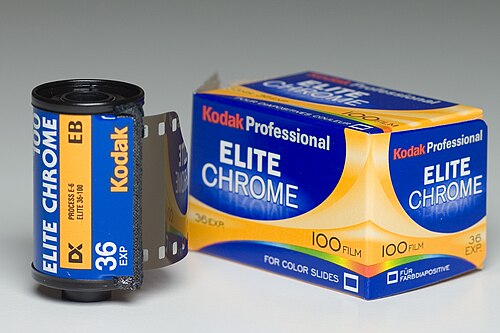 Kodak Elite Chrome 100
 -
 Kodachrome 64
.jpg/500px-Kodachrome_64_(6063417511).jpg)
Kodachrome 25, 64, and 200 Professional
Kodachrome was the first practical color reversal film; essentially first commercially-important color film of any kind. It featured extremely fine grain, high saturation, and extremely high sharpness.[121] Kodachrome entered American popular culture with a 1973 song by Paul Simon, as well as a 2017 Hollywood movie.[122]
- Kodachrome was launched as a 16mm movie film in 1935, with a film speed of ISO 10.[122] The first stills version was released the following year.[122]
- Kodachrome II was introduced in 1961; this was available in daylight balanced speeds of ISO 25 and ISO 64, later rebranded as Kodachrome 25 and Kodachrome 64. Kodachrome 25 ceased production in 2001.[122]
- Kodachrome Type F (for flash; stopped being made in 1950s).
- Kodachrome 200 was introduced in November 1986[123] and sold through 2007.[122]
- Later Kodachrome Professional 64 and 200 were added.[when?]
- Processing purchased with film until Justice Department sued around 1954, claiming this was a monopolistic practice. There were relatively few competitors however, with the complex developing machinery necessary.
- At various times Kodachrome was produced in 126, 120, and 110 stills formats, as well as various movie and cine film formats.[122]
- Also available in larger roll film formats and sheet film (until late 1940s, beginning of 1950s).
- The entire Kodachrome emulsion line was discontinued in 2009. The last processor in the world closed down its Kodachrome line at end of 2010.[124]
- Suggested Replacement: Kodak Ektachrome E100d
Ektachrome Lumiere 100
- Professional Film
- Code LPP 6146
- Launch Date: ?
- Discontinued: ?
- Suggested Replacement: ?
- Type: Medium speed color reversal film providing neutral color balance with enhanced color saturation.
- Speed: Temp/EI/Wratten filter no. (Source: Ektachrome Lumiere 100 Data Sht dtd 11–93)
- 5500K/100/none
- 3200K/25/80A
- 3400K/32/80B
- Processing: E-6
- Formats: 135, 120, cut film.
- Kodak Pub No. E-137, "Kodak Ektachrome Lumiere 100 Professional Film"
- Note: A number of photographers noted this film was too cool under some circumstances.[125]
- EKTACHROME 64 Professional Film
- EKTACHROME 100 Professional Film
- EKTACHROME 100 Plus Professional Film
- EKTACHROME 160T Professional Film
- EKTACHROME 320T Professional Film
- EKTACHROME P1600 Professional Film
- EKTACHROME 400X Professional Film
- Ektachrome E100S
- Ektachrome E100D
Konica
Established 1873 in Japan, Konishiroku (Konica) was a major producer of colour film, cameras and related products, including film development processors and printing technology. Originally Konica film and paper was sold under the brand name of "Sakura" meaning Cherry Blossom in English. Along with 3M Ferrania they were a significant producer of 'white label' consumer color films for both retailers and traditional B&W film producers needing a colour film to repackage under their own brand. Only in later years did they make significant efforts to market film under the Konica brand. In 2003, Konica merged with Minolta to form Konica Minolta. In 2006, the merged company closed down its photo imaging division, which produced color film, color paper, photo chemicals and digital minilab machines (at the time it was the 3rd largest film producer behind Kodak and Fujifilm, AgfaPhoto having collapsed a year earlier).[126] The company produced the following films:
Black and white film
- Sakura Panchro c1946 Format 120
- KONIPAN SS ASA 100 Format 135, 120, Sheet Film
- KONIPAN SSS ASA 200 Format 135
- Konica Infrared 750 nm Format 135, 120
Colour negative film
- Sakuracolor N100 (C-22) (1967-1971)
- Sakuracolor N100 (C-22) (1971-1975)
- Sakuracolor II N100 (1974-c1984) employing a DIR color coupler
- Sakuracolor (C-41) c1975-1980
- Sakuracolor 400 c1976-1984
- SR (c1984-1986) SR 100/ 200/400/1600 Formats 135, Disc (also sold as Sakuracolor SR)
- SR-V (1987) 3200 Format 135 (also sold as Sakuracolor with same names) Monodispersed emulsion
- SR-G (1989-c1994) 100, Format 135
- SR-G 160 Professional, Format 120/220
- Super DD (1990) 100/200/400 Format 135
- GX (1987) 100, 3200 Format 135
- Impresa 50 1991, Format 120 only
- Impresa 100
- Super HR ( ? -c1991)
- Super SR (1991-c1997) 100, 200 Format 135, 110
- Super XG (1993-c1996) 100 Format 135
- VX (c1994-1999) 100, 200 Format 135
- VX Super 100, Format 135
- Centuria (1999). 100/200/400/800 Format 135
- Centuria 100 Format 120
- Centuria Super
- Pro 160, Professional Portrait film Format 135, 120, 220
- Pro 400, Professional Portrait film Format 135, 120, 220 exp2007
Colour reversal (slide) film
- Sakuracolor R-100 (E-4) ( ? -1972)
- Sakurachrome R-100 (E-6) (c1983-c1986)
- Konica Chrome 100 (c1986-1990)
KONO!
Launched in 2014, KONO! is a small European analogue photographic company based in Austria that produces a range of 'creative' 35mm format films under both 'Kono!' and 'dubblefilm' brands, the latter in conjunction with mobile app 'dubble'.[127] Most KONO! films are based on stock originally intended for shooting motion pictures, scientific purposes or other places photosensitive emulsions were used. All films are hand rolled onto recycled 135 film cassettes.[128][129]
Color negative films
Lomography
Headquarters in Vienna, Austria. Lomography is a globally-active organization dedicated to analogue, experimental and creative photography. Lomography offers films under its own brand procured from various manufacturers.
Color negative films
Color reversal (slide) films
Luckyfilm
Lucky Group Corporation in Baoding, Héběi province, China produced a range of colour, black and white, and chromogenic black and white consumer films. Colour film was produced initially in conjunction with Kodak after signing a 20-year partnership which Kodak ended in 2007 after four years.[136] Production of all consumer films ceased in 2012.[citation needed] In 2017 Luckyfilm, an offshoot of Lucky Group re-released an improved black and white film for the consumer market, however this had ceased to be available by 2019.
Black and white film
Color negative film
Maco
Headquarters in Stapelfeld, Germany. Film sales through www.macodirect.de
ORT
- Type: Black and White (orthochromatic)
- Speed: ISO 25, DIN 15°
- Available formats: 35 mm, 120, Sheet Film
- Granularity: Extremely Fine
- Resolving power: Extremely High (>330lp/mm)
- History: evolution of Agfa Ort25c, same emulsion as MACO EM micrography film, evolved later in ORTO25
- Primary usage: Reprography, Micrography, specialty black and white photography
- General characteristics:
- Discontinued
[138]
Negra
Negra Industrial, S A. was a film manufacturer based in Barcelona, Spain established c1928 producing black and white negative film, photographic paper and chemicals. Color film was rebranded stock from other producers mainly Konishiroku (Konica) and 3M (Ferrania). Film production appears to have ended in 1984.[139]
Black and white film
- Negra Negrapan 21 (ISO 100) panchromatic film in 135, 120, 127, 110 and 126 sizes. last films expired 1989.
Color negative film
- Negracolor AR ? -1984 Konica Color
- Negracolor NC80 1970-1973 3M Color Print
- Negracolor NC100 1973-1976 Sakuracolor (Konica)
- Negracolor II 1976-1984 Sakuracolor II (Konica)
- Negracolor 400 1976-1984 Sakuracolor 400 (Konica)
Color reversal (slide) film
- Negracrome 50 1969-1974 3M color slide
ORWO
After WW2, Agfa was split into two companies: Agfa AG, Leverkusen in West Germany, and VEB Film und Chemiefaserwerk Agfa Wolfen in East Germany. Initially both companies produced films under the AGFA brand with the same names, such as Isopan F. To distinguish them, the film edge markings were L IF for Agfa Leverkusen, and W IF for Agfa Wolfen. In 1953 in a trade agreement it was agreed that VEB Film und Chemiefaserwerk would have the sole rights to the AGFA brand in Eastern Europe and Agfa AG, would retain sole rights to the AGFA brand in the rest of the world. This hampered Wolfens exports and therefore after 1964 films from Wolfen were rebranded ORWO (ORiginal WOlfen). ORWO ceased production of film in 1994 following the collapse of the company after German reunification and privatisation. After a brief revival re-branding other manufacturers' products the company was again insolvent in 1997, and the constituent parts were sold off. Part of the original factory survives as the Industry and Film museum Wolfen.[140] However the association of the ORWO name with film lives on as a brand of FilmoTec GmbH who since 1998 produce high quality black and white cinema and technical films, based in Wolfen with coating contracted out. Their cine camera films UN54 and N74 plus are also re-packaged by third parties as still camera film.
Black and white film
Black and white reversal (slide) films
Color negative film
Color reversal (slide) film
Rera
Rera is a small range of photographic films for 127 (4x4) format roll film cameras assembled in Japan by Kawauso-Shoten. Film is bought in and converted for 127 format and sold through main retailers. Discontinued films include:
Black and white film
Color reversal (slide) film
Perutz
Perutz was a German film manufacturer. It was taken over by Agfa-Gevaert in 1964. Films included.
Polaroid
Instant Roll Film
- Type 40 - Sepia tone 100/21°
- Type 41 - Orthochromatic 100/21°
- Type 42 - Panchromatic 200/24° One of Polaroid's longest-lasting film stocks
- Type 43 - Panchromatic 200/24° Introduced for a short while as a higher-end alternative to type 42
- Type 44 - Panchromatic 400/27°
- Type 46 - Panchromatic 800/30° Produced 8 black and white transparencies
- Type 46L - Panchromatic 800/30° Same as 46, but with a slightly larger slides
- Type 47 - Panchromatic 3000/36° Another one of Polaroid's longest-lasting film stocks
- Type 48 - Color 75/20° Polaroid's first color film stock, produced 6 prints instead of the typical 8
- Type 31 - Panchromatic100/21° All films in the 30 series were made for smaller cameras than the 40 series and produced smaller prints
- Type 32 - Panchromatic 200/24°
- Type 37 - Panchromatic 3000/36°
- Type 38 - Color 75/20°
- Type 20 - Panchromatic 3000/36° The 20 series of films were made for use in the Swinger, Polaroid's first budget camera retailing at $19.95 in 1965
- Type 20c - Panchromatic 3000/36° The first black and white Polaroid film to not require a protective coating on the prints
3¼x4¼ instant pack film
4x5 Instant pack film
4x5 instant sheet film
Type 55
- Type: Black and white Pos/Neg instant film
- Speed: 50/18° (pos), 35/16° (neg)
- Available formats: 4×5 Sheet film
- Granularity:
- Latitude:
- Resolving power:
- History: Discontinued by Polaroid in 2008; production process licensed out
- Primary usage: Test shots, fine art
8x10 instant sheet film
Instant integral film
Instant 35mm slide film
Polaroid B.V.
Polaroid B.V. is a Dutch photography company that was founded in 2008 as the 'Impossible Project' to re-introduce instant film for Polaroid cameras. Impossible bought the production machinery from Polaroid for $3.1 million[150] and leased a building, called Building Noord, which was formerly part of the Polaroid plant in Enschede, Netherlands but had to re-invent the emulsions and processes. Polaroid Corporation's brand and intellectual property were acquired by Impossible Project's largest shareholder in 2017 and the company was later renamed 'Polaroid Originals' before becoming 'Polaroid' in 2020.[151][152] Based in Enschede, Polaroid manufactures film for its own and selected original Polaroid instant cameras. Instant films are marketed by format rather than emulsion.
Rollei
The Rollei brand for photographic film is licensed to Maco (Hans O. Mahn GmbH & Co. KG, Maco Photo Products) a German-based supplier of photographic films. They offer a range of black and white and colour films produced by Agfa-Gevaert and other suppliers. Discontinued films are listed below:
Black and white films
R3
- Speed: ISO 200, DIN 24° (can be used from ISO25 to ISO6400)
- Available formats: 35 mm, 120, Sheet Film
- Granularity: Fine
- Resolving power: High
- History: launched in 2004
- Primary usage: General black and white photography
- General characteristics: Fairly wide latitude, PET base for better film flatness, extended spectral sensitivity from IR to near-UV, to be stored in special black cartridges
- Discontinued
[154]
ATO (Advanced Technical Ortho)
- same emulsion as Maco Genius Film
- clear base
- suitable for reversal process
ATP1.1 (Advanced Technical Pan)
- Formats: 120
- Speed: ISO 32
- High resolution Super-panchromatic film (extended red sensitivity).[155][156][157]
- Converted and packaged by Foma
Rollei Ortho
- orthochromatic film with a clear base
- spectral sensitivity 380–610 nm
- resolving power of 330 lines/mm (with a fine-grain developer)
- especially suited for digital scanning
- Replaced by Ortho Plus in 2017
Rollei Pan
- ISO 25
- clear base, well suited for black and white slides
Retro Tonal
- same emulsion as Maco PO100C
- an orthopanchromatic ("RectePan") film
- clear base
- suitable for reversal process
RSD
- same emulsion as Agfa Copex Slide Direct
- a pre-fogged orthochromatic film specially for negative or slide duplication
- exposure index (EI) in daylight around 0.2 (thus it has a DIN value of -6 !) = about EI 6 + 5 f stops (not many cameras will handle this correctly)
- after a massive exposure will produce a positive in traditional B&W process, i.e. is NOT run through a reversal process; see also solarisation
- contrast adjustment using different developers, i.e. lower contrast: for ex. Rodinal/Adonal (1:25 about 10 mins., 1:50 about 20 mins.) or higher contrast: any paper developer 1+4 about 5 mins.
Color negative film
Color reversal (slide) film
ScanFilm
- same emulsion as Agfa Aviphot Color X400 without a mask, very well suited for scanning
Silberra
The company based in Saint Petersburg, Russia was founded in 2009 producing analog film products. It adopted the Silberra name in 2017 to introduce a range of black and white films.[159]
Black and white films
SPUR
SPUR (Speed Photography & Ultra high Resolution) is a supplier of own brand specialist photochemistry and films based in Langerwehe, Germany.
Street Candy
Vincent Moschetti, the proprietor of the website OneYearWithFilmOnly.com (later renamed OnFilmOnly.com) released his own branded film in 2018. In April 2022 the founder announced closure of the brand due to rising costs.[163] Film cassettes are uniquely packaged in cardboard film canisters.
Svema (Russian: Свема, Светочувствительные Материалы) was the former name ("NPO "Svema") of the Shostka Chemical Plant, located in Shostka, Sumy Oblast, Ukraine. It was founded in 1931 in Ukrainian SSR.
"Svema" was the major photographic film manufacturer in the USSR and the second largest film producer in Europe, but their film lost market share in former Soviet countries to imported products during the late 1990s. They made black-and-white photographic film, photographic paper, B&W/colour cine film and magnetic tapes until 2000. Colour film was made with equipment dismantled from the Agfa-Wolfen Factory after World War II. The plant's production of photographic products slowed through the 1990s and ceased film production entirely in 2003 with the final coating of X-ray films there and the plant closed completely in 2005. After attempts by the state to sell the business, bankruptcy processes were completed in 2015. The coating machinery was sold for scrap and the main buildings were demolished c2018.[167]
A decade prior to the plant's closure a small group of Svema employees had founded Astrum holdings in a rented building on the site in 1995, buying bulk film from various sources which they converted and packaged, for retail sale. Originally sold under the Astrum name (film expiring up to 2019), they later acquired rights to the Svema trademark and now apply the name to a range of films for nostalgic value, but this no longer manufactured in Ukraine, only re-packaged there.[168]
Black and white film
Type 1981
(old GOST speed scale)
- Svema Foto 32 – 32 GOST, ISO 40/17°
- Svema Foto 65 – 65 GOST, ISO 80/20°
- Svema Foto 130 – 130 GOST, ISO 160/23°
- Svema Foto 250 – 250 GOST daylight, 350 GOST tungsten; ISO 320/26° daylight, ISO 400/27° tungsten
Type approximately 1986
(new GOST speed scale, same as ASA)
- Svema Foto 32 – ISO 32/16°
- Svema Foto 64 – ISO 64/19°
- Svema Foto 125 – ISO 125/22°
- Svema Foto 250 – ISO 250/25° daylight, ISO 320/26° tungsten
- Svema FN 32 – ISO 32/16°
- Svema FN 64 – ISO 64/19°; 135, sheet films 6.5×9 cm - 30×40 cm, 6×9", bulk last expired 1/94.
- Svema FN 125 – ISO 125/22°
- Svema FN 250 – ISO 250/25° daylight, ISO 320/26° tungsten
- Svema Reporter – ISO 200/24°; (actually cinematographic filmstock); 135 bulk
Type 1990
(new GOST speed scale, same as ASA)
- Svema Foto 50 – ISO 50/18°
- Svema Foto 100 – ISO 100/21°
- Svema Foto 200 – ISO 200/24°
- Svema Foto 400 – ISO 400/27°
Colour negative film
- Svema DS-2 – 45 GOST, ISO 50/18°; Unmasked color negative film, daylight-balanced, 1960s era
- Svema LN-5M – 32 GOST, ISO 40/17°; Masked color negative film, tungsten-balanced, c1960's to 1970's
- Svema DS-4 – 45 GOST, ISO 50/18°; Unmasked color negative film, daylight-balanced
- Svema CND-32 – 32 GOST, ISO 40/17°; Masked color negative film, daylight-balanced, after 1987 changed to ISO 32/16°
- Svema CND-65 – 65 GOST, ISO 80/20°; Masked color negative film, daylight-balanced
- Svema CNL-32 – 32 GOST, ISO 40/17°; Masked color negative film, tungsten-balanced
- Svema CNL-65 – 65 GOST, ISO 80/20°; Masked color negative film, tungsten-balanced
- Svema CNL-90 – ISO 80/20°; Masked color negative film, tungsten-balanced
- Svema DS-100 – ISO 100/21°; Masked color negative film, daylight-balanced, C-41 process
Colour reversal (slide) film
- Svema CO-2 – 32 GOST, ISO 40/17°; Daylight-balanced color reversal film, 1960s-70s
- Svema CO-22D – 22 GOST, ISO 25/15°; Daylight-balanced color reversal film
- Svema CO-32D – 32 GOST, ISO 40/17°; Daylight-balanced color reversal film
- Svema CO-65 – 65 GOST, ISO 80/20°; Daylight-balanced color reversal film
- Svema CO-50D – ISO 50/18°; Daylight-balanced color reversal film
- Svema CO-90L – ISO 80/20°; Tungsten-balanced color reversal film
All consumer film was produced in 135 and 120 formats, some stocks were also available in sheets, 16mm and 8mm/super 8.
Tasma – Тасма in Russian Cyrillic characters was a manufacturer of photographic films located in Kazan, Russia, it has been in operation since 1933 (starting as “Film Factory No. 8”. The name “Tasma” is derived from the Russian phrase «Татарские светочувствительные материалы» “TAtarskie Sveto MAterialiy.” - “TAtar Sensitized Materials;”it was adopted by the company in 1974. Prior to the fall of the Soviet Union, the company offered an array of color photographic products from the year 1950 as well, but these were discontinued following the fall of the Iron Curtain. After the dissolution of the Soviet Union, the company was reorganized as a free enterprise and privatized in 1992. Photographic film production ceased in the 1990s and today they specialise in industrial films including aerial photography films. Films generally supplied without spool in a black paper wrapper and box.
Black and white film
- Tasma 100 Super
- Tasma Foto 32
- Tasma Foto 64
- Tasma Foto 125
- Tasma 65 GOST (ISO) / 20 DIN / 80 ASA 135 format
- Tasma 130 GOST (ISO) / 23 DIN / 160 ASA 135 format
- Tasma 250 GOST (ISO) 135 format
Colour reversal (slide) film
- TASMA ЦО-25 (daylight)
Valca
Valca was a Spanish film manufacturer established in 1940 headquartered in Bilbao. The company name comes from the factory location in Sopeñano, Burgos; Valle de Mena (Mena Valley) through which flows the Rio Cadagua (Cadagua River) which provided cooling water for the factory.[169] The company produced black and white negative film, photographic paper and X ray films. Ilford acquired an equity interest in Valca in 1960, resulting in technical co-operation and Valca acting as Ilford distributors in Spain. The agreement lasted until 1976 when Ilford sold its shares.[170][171] It was particularly successful in the X-ray film market and in 1991 it had a 17% share of its national market and 1% of the US market, the latter accounting for 60% of production, with 65% of X-ray film exported in total. While black and white film was produced in-house, colour film was rebranded stock from other suppliers. The company underwent re-structuring in 1991 due to financial problems, reportedly due to poor management and the factory finally closed in 1993.[172][173]
Black and white film
- Valca Sheet Film Autographica – Panchromatica Antihalo
- Valca Sheet Film Retrato V Orthochromatic
- Valca Sheet Film Retrato VV Panchromatic
- Valca Sheet Film Retrato ES Panchromatic
- Valca Diapositiva Dura
- Valca F22 – ASA 125 (sheet film 9×12 cm, 35mm, 120, 620 & 126) Possibly based on FP4.
- Valca H27 – ASA 400 Possibly based on Ilford HP3
- Valca H29 – ASA 400 (sheet film, 35mm, 120) Possibly based on Ilford HP4.
Colour negative films
- Valcolor, 1974-1975 Sakuracolor N100
- Valcolor II – 1975-1977 Sakuracolor II
- Valcolor II – 1977-1980 (35mm, 126, 120, 110) 3M color print 100
- Valcolor HR100 – ? -1991 (35mm & 126) Konica color 100
See also
References
- ^ "ADOX". Archived from the original on 9 November 2019. Retrieved 10 November 2019.
- ^ "ADOX IR-HR Pro 50 135/36 (HR-50 WITHOUT SPEED BOOST) (Films)". www.fotoimpex.com. Archived from the original on 12 September 2018. Retrieved 3 September 2022.
- ^ "ADOX SILVERMAX Developer" (PDF). Archived from the original (PDF) on 22 October 2021.
- ^ "Discontinued Products". www.adox.de. Archived from the original on 18 May 2020. Retrieved 22 October 2021.
- ^ "Scala 160 – ADOX". Archived from the original on 18 May 2020. Retrieved 22 October 2021.
- ^ "ADOX - ADOX Color Implosion". www.adox.de. Archived from the original on 27 April 2018. Retrieved 30 April 2018.
- ^ mike; mike (12 March 2020). "Keppler's Vault 57: Kodak Royal-X Pan". mike eckman dot com. Archived from the original on 9 January 2023. Retrieved 9 January 2023.
- ^ a b "Agfa - Antique and Vintage Cameras". www.earlyphotography.co.uk. Archived from the original on 29 April 2018. Retrieved 30 April 2018.
- ^ a b c "Texas point and shootout". Popular Photography. US: Diamandis Communications inc. May 1989. p. 56. Archived from the original on 13 June 2022. Retrieved 20 February 2018.
- ^ Popular Photography 1985-09: Vol 92 Iss 9. Bonnier Corporation. September 1985.
- ^ "Agfa PROPACK FOR PROFESSIONALS 200 5本 [FhfT523828] - 5,785円". 16 February 2023. Archived from the original on 16 February 2023. Retrieved 16 February 2023.
{{cite web}}: CS1 maint: bot: original URL status unknown (link) - ^ "Data". users.aber.ac.uk. Archived from the original on 1 May 2018. Retrieved 6 May 2018.
- ^ "Research". www.photomemorabilia.co.uk. Archived from the original on 11 May 2018. Retrieved 6 May 2018.
- ^ "History of modern color film". KniPPsen (Blog). 10 November 2012. Archived from the original on 7 May 2018. Retrieved 6 May 2018.
- ^ a b "Lomography - The Birth, Death and Resurrection of Agfa CT Precisa". www.lomography.com. Archived from the original on 14 July 2018. Retrieved 14 July 2018.
- ^ "Agfachrome RSX II 100 And CT Precisa 100". 1 June 1999. Archived from the original on 18 February 2018. Retrieved 30 April 2018.
- ^ Wauters, Jurgen. "FAQ". Archived from the original on 28 January 2019. Retrieved 27 January 2019.
- ^ "About Lupus Imaging&Media - Lupus Imaging and Media". Archived from the original on 2 March 2018. Retrieved 15 May 2018.
- ^ "Agfa Vista Film is Dead: Report". petapixel.com. 9 March 2018. Archived from the original on 15 June 2018. Retrieved 14 July 2018.
- ^ "AgfaPhoto Films – Lupus Imaging & Media". Archived from the original on 13 June 2022. Retrieved 23 December 2018.
- ^ "- Adox Pan 400 -". Archived from the original on 14 October 2013. Retrieved 1 June 2014.
- ^ "Archived copy" (PDF). Archived from the original (PDF) on 15 April 2017. Retrieved 14 July 2018.
{{cite web}}: CS1 maint: archived copy as title (link) - ^ EM (14 October 2015). "Film review: Agfa Vista Plus 200 - 35mm format". EMULSIVE. Archived from the original on 14 July 2018. Retrieved 14 July 2018.
- ^ http://www1.lupus-imaging-media.com/images/downloads/vista_plus_400.pdf [dead link]
- ^ http://www1.lupus-imaging-media.com/images/downloads/ct_precisa_100_gb.pdf [dead link]
- ^ "Traditional Camera Film For 35mm, 120 Roll and Medium Format Cameras". www.discountfilmsdirect.co.uk. Archived from the original on 28 January 2019. Retrieved 27 January 2019.
- ^ "Photos from AGERPRES archive, Sighisoara Academy concert, at re-opening of Azomures". Archived from the original on 10 November 2019. Retrieved 10 November 2019.
- ^ "list of repackaged color films including efkecolor" (PDF). fotointern.ch. Archived (PDF) from the original on 8 October 2022. Retrieved 9 October 2022.
- ^ a b "Search for profit Kodak-style exposes waste of penny-pinching". 22 January 2002. Archived from the original on 8 April 2018. Retrieved 7 April 2018.
- ^ "Dispatches from the LRF-P30 is Back on Track!". FILM Ferrania. Archived from the original on 13 October 2019. Retrieved 23 February 2020.
- ^ "Kickstarter Updates-State of the Union, January 2018". FILM Ferrania. Archived from the original on 13 October 2019. Retrieved 23 February 2020.
- ^ https://web.archive.org/web/20180413084048/http://filmwashi.com/datasheet/G_en.pdf. Archived from the original (PDF) on 13 April 2018.
{{cite web}}: Missing or empty|title=(help) - ^ https://web.archive.org/web/20180128074721/http://filmwashi.com/datasheet/K_en.pdf. Archived from the original (PDF) on 28 January 2018.
{{cite web}}: Missing or empty|title=(help) - ^ https://web.archive.org/web/20180128074719/http://filmwashi.com/datasheet/B_en.pdf. Archived from the original (PDF) on 28 January 2018.
{{cite web}}: Missing or empty|title=(help) - ^ "Film Washi discontinues four films but plans further releases". Kosmofoto.com. 31 May 2022. Archived from the original on 4 July 2022. Retrieved 6 June 2022.
- ^ "Datasheet" (PDF). filmwashi.com. Retrieved 13 October 2019.
- ^ "Datasheet" (PDF). filmwashi.com. Archived (PDF) from the original on 3 September 2022. Retrieved 13 October 2019.
- ^ "REVERSAL BLACK & WHITE PANCHRO PAPER" (PDF). filmwashi.com. Archived (PDF) from the original on 28 June 2022. Retrieved 6 June 2022.
- ^ "Datasheet" (PDF). filmwashi.com. Archived (PDF) from the original on 3 September 2022. Retrieved 13 October 2019.
- ^ a b c d e f g h Mareš, Miroslav; Tvrdík, Ivan; Krejčí, Vítězslav; Hojná, Dana; Sejkora, Václav; Šlechta, František; Valuš, Josef; Veverka, Josef; Vítek, Hubert (2018). Foma stoletá [A Hundred Years of FOMA]. Garavin. ISBN 978-80-906431-3-0.
- ^ a b c d e f g h i j k Fotochema n.p. (1984). Seznam vyrobku FOMA.
- ^ "Jozef Franaszek at Historic Camera". Archived from the original on 2 May 2019. Retrieved 9 November 2019.
- ^ a b "Polskie Materiały Światłoczułe". Archived from the original on 30 October 2019. Retrieved 9 November 2019.
- ^ https://web.archive.org/web/20191110132204/http://bc.pollub.pl/Content/3123/PDF/BN_83_6121_02_10.pdf. Archived from the original (PDF) on 10 November 2019.
{{cite web}}: Missing or empty|title=(help) - ^ "Bydgoskie Zakłady Fotochemiczne". Archived from the original on 28 June 2021. Retrieved 10 November 2019.
- ^ https://web.archive.org/web/20191110132155/http://bc.pollub.pl/Content/3122/PDF/BN_83_6121_02_08.pdf. Archived from the original (PDF) on 10 November 2019.
{{cite web}}: Missing or empty|title=(help) - ^ "Film Cartridge - Fuda Color 100, Shanghai, China, boxed, circa 1984-1988". Museums Victoria Collections. Archived from the original on 13 June 2022. Retrieved 30 April 2018.
- ^ "Brand new film from Fujifilm: NEOPAN 100 ACROS II announced, begins shipping Autumn 2019". EMULSIVE. 10 June 2019. Archived from the original on 16 November 2019. Retrieved 24 October 2019.
- ^ "Fujifilm consumer film line-up". Archived from the original on 25 March 2007. Retrieved 14 April 2007.
- ^ "Fujifilm professional film line-up". Archived from the original on 17 January 2007. Retrieved 14 April 2007.
- ^ "黒白製品 一部製品販売終了 および 黒白写真処理薬品 価格改定のご案内 : お知らせ - 富士フイルムイメージングシステムズ株式会社". ffis.fujifilm.co.jp. Archived from the original on 22 April 2018. Retrieved 30 April 2018.
- ^ "After 2019, Fujifilm Acros 100 4x5 Film Will No Longer Be in Production". Thephoblographer.com. 26 May 2017. Archived from the original on 12 November 2020. Retrieved 13 June 2022.
- ^ "黒白フィルムおよび黒白印画紙 販売終了のご案内 : お知らせ - 富士フイルムイメージングシステムズ株式会社". ffis.fujifilm.co.jp. Archived from the original on 14 December 2018. Retrieved 2 December 2018.
- ^ James Tocchio (30 March 2018). "FUJIFILM to Discontinue Acros 100 Film in October 2018". Casual Photophile. Archived from the original on 17 April 2021. Retrieved 13 June 2022.
- ^ "Translated Fujifilm Introduction of Neopan 400". Archived from the original on 17 May 2024. Retrieved 17 May 2024.
- ^ "Fujicolor Neopan 400CN Professional" (PDF). www2.fujifilm.co.uk. Archived (PDF) from the original on 9 December 2008. Retrieved 14 October 2019.
- ^ "Fujicolor Neopan 400CN". www.ag-photographic.co.uk. Archived from the original on 26 October 2020. Retrieved 22 October 2020.
- ^ a b "Translated Fujifilm Introduction of Fuji HR". Archived from the original on 17 May 2024. Retrieved 17 May 2024.
- ^ "Translated Fujifilm Introduction of Fuji HR 1600". Archived from the original on 7 August 2024. Retrieved 17 May 2024.
- ^ "Fujicolor SUPER HGII 200 35mm x 24 Exp - Expired Film Special". ultrafineonline.com. Archived from the original on 15 December 2018. Retrieved 12 December 2018.
- ^ "FUJI super HG-400 all-purpose color negative film.Design concept and technologies". ResearchGate. Archived from the original on 13 June 2022. Retrieved 12 December 2018.
- ^ https://web.archive.org/web/20181215223207/http://jackandsue.com/magazines/photographic/pdf/1995%205%20Fuji%20Super%20G%20Plus.pdf. Archived from the original (PDF) on 15 December 2018.
{{cite web}}: Missing or empty|title=(help) - ^ "Datasheet" (PDF). www.fujifilm.com. Archived (PDF) from the original on 21 August 2018. Retrieved 18 February 2018.
- ^ "Fujifilm Reala 100 Discontinued in 120 Format - The Phoblographer". 23 October 2012. Archived from the original on 19 February 2018. Retrieved 30 April 2018.
- ^ "Fujifilm confirms film discontinuations". British Journal of Photography. 26 July 2013. Archived from the original on 27 November 2018. Retrieved 26 November 2018.
- ^ "C-200" (PDF). www.fujifilm.com. Archived from the original (PDF) on 28 October 2018. Retrieved 14 October 2019.
- ^ "Datasheet" (PDF). www.fujifilm.com. Archived (PDF) from the original on 24 November 2017. Retrieved 18 February 2018.
- ^ "Archived copy" (PDF). Archived from the original (PDF) on 6 October 2017. Retrieved 11 May 2019.
{{cite web}}: CS1 maint: archived copy as title (link) - ^ "Fujifilm Killing Off More Films in 2018, and Things Look Grim". 27 October 2017. Archived from the original on 10 March 2018. Retrieved 30 April 2018.
- ^ "Exclusive: Fujifilm Announces End of Pro NS 160 Sheet Film". The Phoblographer. 29 July 2016. Archived from the original on 13 June 2022. Retrieved 6 November 2021.
- ^ "Fujifilm Announces Discontinuation of Fujicolor Pro 160 · Lomography". Archived from the original on 22 January 2018. Retrieved 4 March 2018.
- ^ "Fuji Pro 160NS 120 5 Pack". AG Photographic. Archived from the original on 6 November 2021. Retrieved 6 November 2021.
- ^ "Fuji PRO 160 NS roll film 120 pack of five". macodirect EN. Archived from the original on 14 October 2019. Retrieved 6 November 2021.
- ^ "FUJI PRO 160 NS Negativ-Farbfilm, 120 Rollfilm 5 Stück **02/2019 Garantie-ffilm484". Archived from the original on 27 November 2018. Retrieved 26 November 2018.
- ^ "Pro 160" (PDF). www.fujifilm.com. Archived (PDF) from the original on 27 October 2020. Retrieved 14 October 2019.
- ^ "フジカラー PRO 160NS プロフェッショナル 120サイズ フジクローム VELVIA50 CUTサイズ 販売終了のご案内". www.fujifilm.com (in Japanese). Archived from the original on 15 October 2021. Retrieved 15 October 2021.
- ^ "AF3-176E" (PDF). Archived (PDF) from the original on 26 September 2020. Retrieved 14 October 2019.
- ^ "Fujicolor PRO400H Professional Discontinuation Notice". Archived from the original on 16 January 2021. Retrieved 16 January 2021.
- ^ "Important Information Regarding Discontinuation of PRO 400H Film" (PDF). Archived (PDF) from the original on 15 January 2021. Retrieved 16 January 2021.
- ^ "フジカラー PRO400H プロフェッショナル 出荷終了時期変更のお知らせ". Archived from the original on 24 May 2021. Retrieved 31 May 2021.
- ^ January 2021, Usman Dawood 15 (15 January 2021). "More film is dead – Fujifilm discontinues Pro 400H color negative 35mm and 120". digitalcameraworld. Archived from the original on 18 January 2021. Retrieved 19 January 2021.
{{cite web}}: CS1 maint: numeric names: authors list (link) - ^ "Fujifilm Has Discontinued Two Professional Films - Seamless". 20 July 2012. Archived from the original on 3 April 2018. Retrieved 30 April 2018.
- ^ "Fuji: Velvia No More". 19 July 2012. Archived from the original on 21 April 2018. Retrieved 30 April 2018.
- ^ "Fujichrome Velvia 100F 120 film discontinued - Photo Rumors". photorumors.com. 15 December 2014. Archived from the original on 22 April 2018. Retrieved 30 April 2018.
- ^ "120サイズ「フジクローム ベルビア100F」および富士黒白写真乳剤「アートエマルジョン」、富士黒白写真乳剤用下塗り剤「アートエマルジョンバインダー」販売終了のご案内 : お知らせ - 富士フイルムイメージングシステムズ株式会社". ffis.fujifilm.co.jp. Archived from the original on 22 April 2018. Retrieved 30 April 2018.
- ^ Ottke, Adam (19 July 2012). "Fuji: Velvia No More". Fstoppers. Archived from the original on 21 April 2018. Retrieved 21 April 2018.
- ^ "Velvia 100F". www.Yodobashi.com. Archived from the original on 23 October 2021. Retrieved 23 October 2021.
- ^ "Datasheet" (PDF). www.fujifilm.com. Archived (PDF) from the original on 18 May 2021. Retrieved 2 April 2018.
- ^ "Datasheet" (PDF). www.fujifilm.com. Archived (PDF) from the original on 25 October 2020. Retrieved 2 April 2018.
- ^ Ltd, Magezine Publishing. "Fujifilm's Sensia range discontinued". Archived from the original on 11 August 2012. Retrieved 30 April 2018.
- ^ "FUJI INSTANT COLOR FILM New FP-100C" (PDF). www.fuji.com. Fuji film. Archived (PDF) from the original on 4 March 2016. Retrieved 31 October 2016.
- ^ "インスタントカラーフィルム「FP-100C」販売終了のお知らせ : お知らせ - 富士フイルム". fujifilm.jp. Archived from the original on 18 October 2016. Retrieved 30 April 2018.
- ^ "FUJI INSTANT BLACK & WHITE FILM FP-3000B SUPER SPEEDY" (PDF). Fuji film. Archived (PDF) from the original on 5 November 2016. Retrieved 31 October 2016.
- ^ "Fujifilm announces FP-3000B discontinuation". FUJIFILM United Kingdom. Archived from the original on 19 October 2015. Retrieved 30 April 2018.
- ^ "Product sheet Archived 2016-09-08 at the Wayback Machine"
- ^ "EMULSIVE x Kodak Alaris Community Interview: results time - EMULSIVE". 16 March 2017. Archived from the original on 26 February 2018. Retrieved 30 April 2018.
- ^ "Kodak Film Number to Film Type Cross Reference Table — Tom Philo Photography". www.taphilo.com. Archived from the original on 30 April 2017. Retrieved 19 February 2017.
- ^ "KODAK PANATOMIC-X AEROGRAPHIC II Film" (PDF). www.kodak.com. Kodak. Archived from the original on 31 October 2016. Retrieved 31 October 2016.
{{cite web}}: CS1 maint: bot: original URL status unknown (link) - ^ "KODAK PLUS-X Pan and KODAK PLUS-X Pan Professional Films" (PDF). www.kodak.com. Kodak. Archived from the original on 17 August 2000. Retrieved 31 October 2016.
{{cite web}}: CS1 maint: bot: original URL status unknown (link) - ^ "KODAK PLUS-X Pan and KODAK PLUS-X Pan Professional Films" (PDF). www.kodak.com. Kodak. Archived from the original on 15 June 2016. Retrieved 31 October 2016.
{{cite web}}: CS1 maint: bot: original URL status unknown (link) - ^ "KODAK VERICHROME Pan Film" (PDF). www.kodak.com. Kodak. Archived from the original on 5 July 2008. Retrieved 31 October 2016.
{{cite web}}: CS1 maint: bot: original URL status unknown (link) - ^ Shanebrook, Robert L. (2016). Making KODAK Film. p. 401.
- ^ "KODAK EKTAPAN Film" (PDF). www.kodak.com. Kodak. Archived from the original on 17 May 2008. Retrieved 31 October 2016.
{{cite web}}: CS1 maint: bot: original URL status unknown (link) - ^ Kodak Professional Black-and-White Films, Papers, and Chemicals; Publication F-33. Kodak. 1998. p. 2.
- ^ "KODAK Technical Pan Film" (PDF). www.kodak.com. Kodak. Archived from the original on 17 August 2000. Retrieved 31 October 2016.
{{cite web}}: CS1 maint: bot: original URL status unknown (link) - ^ "KODAK PROFESSIONAL High-Speed Infrared Film" (PDF). www.kodak.com. Kodak. Archived from the original on 9 May 2008. Retrieved 31 October 2016.
{{cite web}}: CS1 maint: bot: original URL status unknown (link) - ^ "Portra 400BW" (PDF). kodak.com. Archived (PDF) from the original on 7 August 2024. Retrieved 7 August 2024.
- ^ "KODAK PROFESSIONAL T400 CN Film" (PDF). www.kodak.com. Kodak. Archived from the original on 5 July 2008. Retrieved 31 October 2016.
{{cite web}}: CS1 maint: bot: original URL status unknown (link) - ^ "KODAK PROFESSIONAL BW400CN Film" (PDF). www.kodak.com. Kodak. Archived from the original on 17 May 2008. Retrieved 31 October 2016.
{{cite web}}: CS1 maint: bot: original URL status unknown (link) - ^ "Kodak Announces the End of Its Much-Loved BW400CN C-41 Black and White Film". 21 August 2014. Archived from the original on 11 June 2018. Retrieved 30 April 2018.
- ^ "Kodak's 100 And 400 Ultra Color Professional FilmsPro Films With Intense Color Saturation". 1 September 2004. Archived from the original on 2 April 2018. Retrieved 30 April 2018.
- ^ "KODAK PROFESSIONAL EKTACHROME Film E200" (PDF). www.kodak.com. Kodak. Archived (PDF) from the original on 15 June 2016. Retrieved 31 October 2016.
- ^ https://web.archive.org/web/20180330081102/http://tables.pirate-photo.fr/documents/Kodak_EliteCh_100.pdf. Archived from the original (PDF) on 30 March 2018.
{{cite web}}: Missing or empty|title=(help) - ^ "KODAK PROFESSIONAL ELITE Chrome 100 Film" (PDF). www.kodak.com. Archived from the original on 15 June 2016. Retrieved 31 October 2016.
{{cite web}}: CS1 maint: bot: original URL status unknown (link) - ^ "KODAK PROFESSIONAL ELITE Chrome Extra Color 100 Film" (PDF). www.kodak.com. Kodak. Archived from the original on 6 April 2016. Retrieved 31 October 2016.
{{cite web}}: CS1 maint: bot: original URL status unknown (link) - ^ "KODAK EKTACHROME 64T Professional Film (EPY)" (PDF). www.kodak.com. Archived from the original on 22 November 2008. Retrieved 31 October 2016.
{{cite web}}: CS1 maint: bot: original URL status unknown (link) - ^ a b c "Specs". www.tate.org.uk. September 2009. Archived from the original on 30 March 2018. Retrieved 29 March 2018.
- ^ "KODAK PROFESSIONAL EKTACHROME Film E100VS" (PDF). www.kodak.com. Kodak. Archived from the original on 16 June 2012. Retrieved 31 October 2016.
{{cite web}}: CS1 maint: bot: original URL status unknown (link) - ^ "KODAK EKTACHROME Professional Infrared EIR Film" (PDF). www.kodak.com. Kodak. Archived (PDF) from the original on 15 June 2016. Retrieved 31 October 2016.
- ^ Exhibition notice Archived 2014-04-26 at the Wayback Machine, University of the Arts, London. Accessed 25 April 2014.
- ^ "KODACHROME 25, 64, and 200 Professional Film" (PDF). www.kodak.com. Kodak. Archived from the original on 8 July 2008. Retrieved 31 October 2016.
{{cite web}}: CS1 maint: bot: original URL status unknown (link) - ^ a b c d e f George, Chris (22 June 2020). "Kodachrome: 11 things we remember on the anniversary of its death". Digital Camera World. Archived from the original on 12 February 2021. Retrieved 17 April 2021.
- ^ Hayes, Gary (31 October 1986). "NEW KODACHROME 200 IMPROVES ON 50 YEARS OF HIGH-QUALITY COLOR". Chicago Tribune. Archived from the original on 7 April 2022. Retrieved 17 April 2021.
All that will change in November when Kodak begins selling Kodachrome 200, an improvement of three stops over 25 speed film and 1 1/2 stops over Kodachrome 64.
- ^ Blackburn, Bradley (30 December 2020). "Kodachrome Taken Away: Last Photo Lab Processing Landmark Film to Stop". ABC News. Archived from the original on 12 November 2020. Retrieved 17 April 2021.
Dwayne's Photo in Parsons, Kan., is the last company in the world developing Kodachrome film, and today is the final day it's taking film.
- ^ Kodak Ektachrome Lumiere 100 Data Sheet dtd 11-93
- ^ McCurry, Justin (20 January 2006). "Konica Minolta to stop making cameras and film amid big losses". The Guardian. Archived from the original on 9 May 2020. Retrieved 30 April 2018.
- ^ "Film News: Dubble Film". Japan Camera Hunter. 25 October 2017. Archived from the original on 12 June 2018. Retrieved 11 August 2018.
- ^ "What is KONO! The Reanimated Film?". KONO! The Reanimated Film. Archived from the original on 12 June 2018. Retrieved 11 August 2018.
- ^ "Archived copy". Archived from the original on 12 June 2018. Retrieved 11 August 2018.
{{cite web}}: CS1 maint: archived copy as title (link) - ^ "Single Film -WINTERMÄRCHEN 200 - 35mm COLOR NEGATIVE FILM - Pre-exposed Holidays (1-pack)". KONO! The Reanimated Film. Archived from the original on 17 April 2018. Retrieved 11 August 2018.
- ^ EM (15 June 2015). "Here's our latest film review: LomoChrome Turquoise XR 100-400. Including special bonus never-before-seen rant!". EMULSIVE. Archived from the original on 2 July 2018. Retrieved 1 July 2018.
- ^ "LOMOgraphy confirms re-release of LOMOChrome Turquoise". EMULSIVE. 5 November 2021. Archived from the original on 7 August 2024. Retrieved 31 July 2023.
- ^ "product_f4120f2_5set_name". Lomography. Archived from the original on 24 July 2018. Retrieved 27 January 2019.
- ^ Foto, Kosmo (6 June 2018). "Lomography launches Color Negative F²/400 in medium format". Archived from the original on 23 June 2018. Retrieved 7 October 2018.
- ^ "Colour film not dead as Agfa's RSX 200 medium-format emulsion reborn". Amateur Photographer. 7 April 2010. Archived from the original on 20 October 2020. Retrieved 23 May 2021.
- ^ Editorial, Reuters (12 November 2007). "Kodak to sell China Lucky stake, ending partnership". Reuters. Archived from the original on 9 June 2018. Retrieved 30 April 2018.
{{cite news}}:|first=has generic name (help) - ^ "Film stock review: Lucky New SHD 100 part 1 - 35mm EI 100 (bracketed +/- 1 stop)". EMULSIVE. 25 August 2017. Archived from the original on 12 December 2019. Retrieved 12 December 2019.
- ^ "Product sheet of EM film Archived 2011-07-23 at the Wayback Machine"
- ^ "La industria fotográfica en España: una revisión necesaria de D. Manuel Carrero en el Ateneo de Madrid". Ángel Cubero - Fotofilia. Archived from the original on 27 March 2022. Retrieved 30 April 2018.
- ^ "Förderverein | Industrie- und Filmmuseum Bitterfeld-Wolfen". Archived from the original on 21 April 2019. Retrieved 10 November 2019.
- ^ a b Wolfen, VEB Filmfabrik. "Orwo Color NK 18 127er Rollfilm :: Industrie- und Filmmuseum Wolfen :: museum-digital:sachsen-anhalt". st.museum-digital.de. Archived from the original on 21 September 2018. Retrieved 27 January 2019.
- ^ a b WEB FIlmwabrik Wolfen, ORWO. ORWO COLOR WEB Filmwabrik Wolfen flyer.
- ^ Wolfen, VEB Filmfabrik. "Orwo Color NC 16 Kleinbildfilm :: Industrie- und Filmmuseum Wolfen :: museum-digital:sachsen-anhalt". st.museum-digital.de. Archived from the original on 21 September 2018. Retrieved 27 January 2019.
- ^ Wolfen, VEB Filmfabrik. "Orwo Color NC 17 Mask 120er Rollfim :: Industrie- und Filmmuseum Wolfen :: museum-digital:sachsen-anhalt". st.museum-digital.de. Archived from the original on 21 September 2018. Retrieved 27 January 2019.
- ^ a b c Hübner, Günter; Krause, Wolfgang (1978). ORWO Rezepte (in German) (Ausgabe 1978 ed.). VEB Filmfabrik Wolfen.
- ^ a b Tausk, Petr; Pádr, Bohuslav (1979). Materiály pro barevnou fotografii (in Czech). Prague: SNTL.
- ^ "ORWO Color NC-19". Analogue photo lab. 22 June 2016. Archived from the original on 3 August 2018. Retrieved 11 August 2018.
- ^ Wolfen, VEB Filmfabrik. "Orwo Color UK 14 127er Rollfilm :: Industrie- und Filmmuseum Wolfen :: museum-digital:sachsen-anhalt". st.museum-digital.de. Archived from the original on 21 September 2018. Retrieved 27 January 2019.
- ^ VEB Filmfabrik Wolfen (1972). ORWO Rezepte Ausgabe 1972.
- ^ "Finding a Place for Polaroid in the Digital Age". Bloomberg.com. Bloomberg L.P. 10 February 2011. Archived from the original on 2 February 2016. Retrieved 11 January 2016.
- ^ Holt, Kris (26 March 2020). "Polaroid Originals Rebrands As Polaroid With A New Autofocus Instant Camera In Tow". Forbes Media. Archived from the original on 2 April 2020. Retrieved 29 April 2020.
- ^ Polaroid [@Polaroid] (27 March 2020). "This is Polaroid — now. From The Impossible Project to Polaroid Originals, we are returning to where it all began. With the one name, the one brand: Polaroid. No matter where you joined us in this journey, thank you for your support. Together, we can make history... again" (Tweet) – via Twitter.
- ^ "polaroid-originals-announces-the-end-of-spectra-instant-film". Petapixel. 3 October 2019. Archived from the original on 19 October 2021. Retrieved 19 October 2021.
- ^ "Product sheet Archived 2011-07-16 at the Wayback Machine"
- ^ "Technical Data Sheet Archived 2015-09-06 at the Wayback Machine"
- ^ "ATP DC Developer MSDS Archived 2022-02-04 at the Wayback Machine"
- ^ "[1] Archived 2016-06-12 at the Wayback Machine"
- ^ "Film review: Rollei Vario Chrome color slide film in 35mm format - EMULSIVE". 17 November 2017. Archived from the original on 28 January 2018. Retrieved 30 April 2018.
- ^ "Silberra Wants to Mass Produce New B&W Film Lines". petapixel.com. 31 October 2017. Archived from the original on 23 May 2021. Retrieved 23 May 2021.
- ^ "Silberra ORTA100 135/36 B&W Film". Archived from the original on 9 December 2018. Retrieved 8 December 2018.
- ^ "Silberra CINEMA 74N+ ISO400 B&W Photo film". shop.silberra.com. Archived from the original on 16 October 2019. Retrieved 23 May 2021.
- ^ "Datenblatt und Datenblattzusatz SPUR Modular UR New". 18 May 2013. Archived from the original on 23 May 2021. Retrieved 23 May 2021.
- ^ "Film Brand Street Candy Shutters, Blames Rising Cost of Production". 7 April 2022. Archived from the original on 12 April 2022. Retrieved 11 April 2022.
- ^ Moschetti, Vincent (1 March 2021). "Introducing STREET CANDY MTN100". www.streetcandyfilm.com. Archived from the original on 9 April 2022. Retrieved 12 June 2022.
- ^ Moschetti, Vincent (26 March 2018). "Featured project: Street Candy ATM 400 black and white negative film - by Vincent Moschetti". EMULSIVE. Archived from the original on 29 November 2020. Retrieved 12 June 2022.
- ^ "On Film Only – For The Love of Grain". onfilmonly.com. Archived from the original on 27 January 2022. Retrieved 12 June 2022.
- ^ Kronke, Claus: "'Finished!' The Decline of the Svema Film Works", "Smallformat", 01 2007
- ^ "На заводе "Свема" в Шостке до сих пор делают пленку на экспорт в США и Европу, хотя завод развалился. Как?". www.babel.ua. 8 November 2018. Archived from the original on 5 June 2022. Retrieved 15 April 2022.
- ^ "Ay Dios Mio! it's Valca film from Spain @ Labeauratoire". 9 October 2014. Archived from the original on 26 April 2018. Retrieved 30 April 2018.
- ^ Lutz, Alt (1986). The Photochemical Industry: Historical Essays in Business Strategy and Internationalization (PhD). M.I.T.
- ^ "FOTOGRAFIA 1965 PELICULA VALCA E ILFORD HOJA LIBRITO". todocoleccion.net. Archived from the original on 26 April 2018. Retrieved 30 April 2018.
- ^ "El valle de Valca". El País. 7 July 1993. Archived from the original on 26 April 2018. Retrieved 30 April 2018 – via elpais.com.
- ^ "La triste historia de Valca, una historia española que terminó mal ~ EFE futuro". Archived from the original on 26 April 2018. Retrieved 30 April 2018.