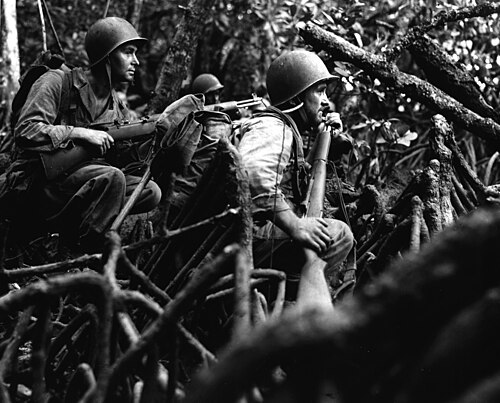
G.I. is an informal term which refers to members of the United States Armed Forces, in particular the United States Army.[1] It is most deeply associated with World War II[2] and the Korean War, but continues to see use, for instance in the G.I. Joe comics, films, and toys franchise.[3] It was originally an initialism used in U.S. Army paperwork for items made of galvanized iron.[2] The earliest known instance in writing is from either 1906[3] or 1907.[2] During World War I, U.S. soldiers took to referring to heavy German artilleryshells as "G.I. cans".[2][3] During the same war, "G.I.", reinterpreted as "government issue"[2] or "general issue",[3] began being used to refer to any item associated with the U.S. Army,[3]e.g., "G.I. soap".[3] Other reinterpretations of "G.I." include "garrison issue" and "general infantry".[3]
The earliest known recorded instances of "G.I." being used to refer to an American enlisted man as a slang term are from 1935.[2] In the form of "G.I. Joe" it was made better known due to it being taken as the title of a comic strip by Dave Breger in Yank, the Army Weekly, beginning in 1942.[2] A 1944 radio drama, 「彼らは私をジョーと呼ぶ」は、より幅広い視聴者に届きました。毎週異なる人物を取り上げることで、「GI ジョー」があらゆる民族の米兵を包含していることを強調しました。[ 4 ] 「彼らは私をジョーと呼ぶ」は、 NBC ラジオ ネットワークを通じて全米の一般市民に、また米軍ラジオ ネットワークを通じて米兵に届きました。ドワイト D. アイゼンハワーは、 1945 年 5 月のヨーロッパ戦勝記念日の演説で、第二次世界大戦の主な英雄として「GI ジョー」という言葉に言及しました。 [ 5 ] 「GI ジェーン」は元々、第二次世界大戦中の女子陸軍部隊の隊員を指していましたが、最近では、あらゆる女性アメリカ人兵士を指すのに使われています。[ 3 ]
Cooke, James J. American girls, beer, and Glenn Miller: GI morale in World War II (University of Missouri Press, 2012) online.
Kennett, Lee B. GI: The American Soldier in World War II (University of Oklahoma Press, 1997) online.
Meyer, Leisa D. Creating GI Jane: Sexuality and power in the women's army corps during World War II (Columbia University Press, 1996) online.
Piehler, G. Kurt. A religious history of the American GI in World War II (U of Nebraska Press, 2021) online.
Sklaroff, Lauren Rebecca. "Constructing GI Joe Louis: Cultural solutions to the “Negro problem” during World War II." Journal of American History 89.3 (2002): 958-983. online
Primary sources
McGuire, Phillip, ed. Taps for a Jim Crow Army: Letters from Black Soldiers in World War II (University Press of Kentucky, 1993). ISBN 0-8131-0822-5..
Pyle, ErnieHere is your war: story of GI Joe (U of Nebraska Press, 2004) reprint of newspaper essays by famous war correspondent who focused on soldiers' life online.
Shapiro, Lisa K. No Forgotten Fronts: From Classrooms to Combat (Naval Institute Press, 2018) ISBN 9781682472729. Letters from GIs to college professor; primary sources; online book review
Categories:
1900s neologisms
Initialisms
Military terminology of the United States
United States Army personnel of World War II
Hidden categories:
Articles with short description
Short description is different from Wikidata
Use dmy dates from November 2022
Use American English from May 2021
All Wikipedia articles written in American English
All articles with unsourced statements
Articles with unsourced statements from August 2025